- Table of Content
- 1.Parker Solar P...
- 2.Partial solar ...
- 3.Review of sola...
- 4.The Internatio...
- 5.PROBA2 Observa...
- 6.Review of geom...
- 7.Geomagnetic Ob...
- 8.The SIDC Space...
- 9.Review of iono...
2. Partial solar eclipse from space
3. Review of solar activity
4. The International Sunspot Number
5. PROBA2 Observations (6 Aug 2018 - 12 Aug 2018)
6. Review of geomagnetic activity
7. Geomagnetic Observations at Dourbes (6 Aug 2018 - 12 Aug 2018)
8. The SIDC Space Weather Briefing
9. Review of ionospheric activity (6 Aug 2018 - 12 Aug 2018)
Parker Solar Probe en route to the Sun
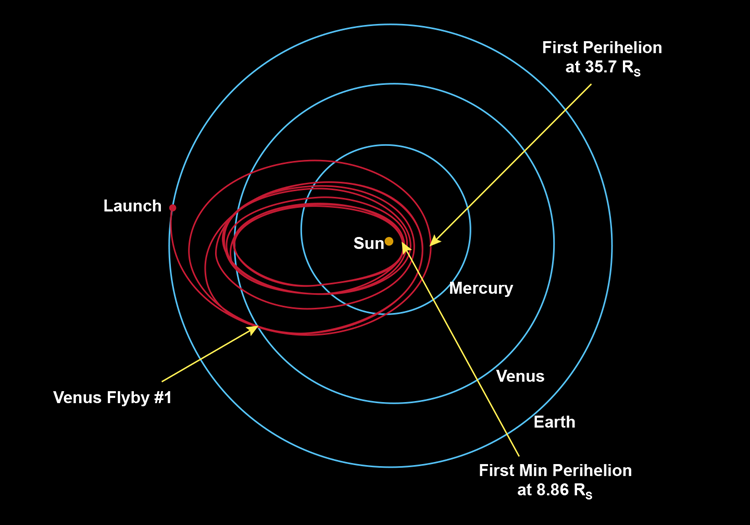
On 12 August, the Parker Solar Probe (PSP) was launched from Cape Canaveral, Florida. After a Venus gravity assist flyby early October, the probe will have its first close encounter with the Sun in November this year, at a distance of about 25 million km. Another 6 Venus flybys will gradually alter its trajectory around the Sun. Hence, in 2025, when PSP will complete the last few of its total 24 scheduled orbits, its closest distance to the solar surface will be about 6 million km. It will have a speed of about 192 km/s, the fastest man-made object ever, Helios-B currently being the record holder (70 km/s).
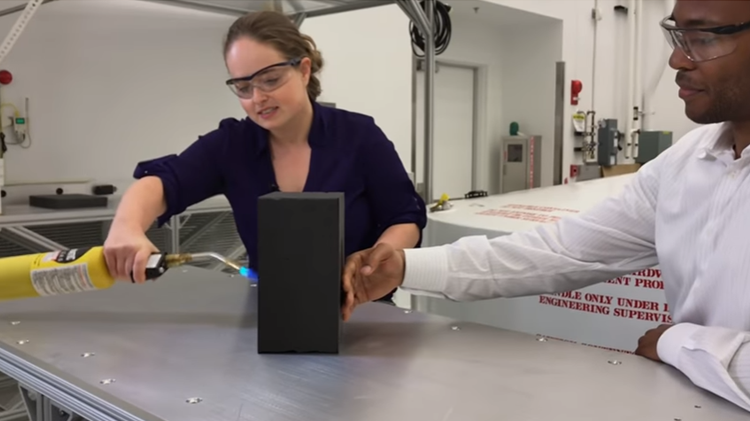
Coming so close to the Sun, the probe will have to fully endure the scorching heat from our nearest star. The solar radiation will indeed be more than 400 times as intense as is experienced by satellites orbiting the Earth. As such, the probe has been equipped with a carbon-based heat shield to keep it in the shadow, and water-cooled solar cells to drain away the heat. Outside sensors will allow to spacecraft to orient itself correctly to the Sun. It has onboard software to take autonomously the correct decisions, because when something goes wrong so close to the Sun (i.e. so far from Earth), the operators won't have enough time to properly deal with the situation. Underneath are 2 engineers from the Johns Hopkins University Applied Physics Lab (JHUAPL; Betsy Congdon and Curtis Wilkerson) demonstrating the impressive capabilities of the heat shield. On the torching side, temperatures reach several hundreds degrees, whereas at the other side it remains "nice and cool".
The primary science goals for the mission are to trace the flow of energy and understand the heating of the solar corona (the Sun's outer atmosphere) and to explore what accelerates the solar wind. Parker Solar Probe has three detailed science objectives:
- Trace the flow of energy that heats and accelerates the solar corona and solar wind.
- Determine the structure and dynamics of the plasma and magnetic fields at the sources of the solar wind.
- Explore mechanisms that accelerate and transport energetic particles.
It's no surprise that solar and space weather researchers are looking forward to the wealth of data PSP will produce. Fittingly, the probe was named in honor of Eugene Parker, who is still alive (he actually attended the launch) and is considered to be the godfather of the solar wind which he predicted 60 years ago in 1958.
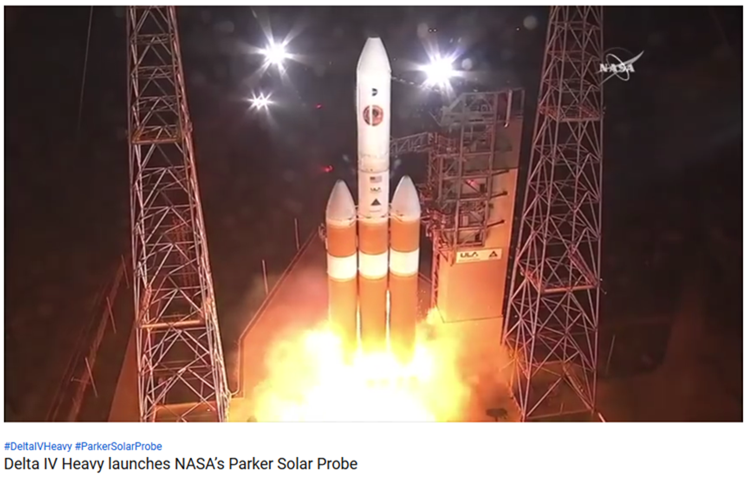
Good luck, Parker Solar Probe!
Further reading, watching and listening
- NASA website at https://www.nasa.gov/content/goddard/parker-solar-probe
- Website from the JHUAPL at http://parkersolarprobe.jhuapl.edu/index.php
- There's also a lot of information at Wikipedia https://en.wikipedia.org/wiki/Parker_Solar_Probe
- Interviews (in Dutch) with Dr David Berghmans from the Royal Observatory of Belgium: radio at http://stce.be/movies/david_parkersolarprobe.m4a (VRT) and TV at https://nieuws.vtm.be/video/volledige-afleveringen/id/vtm_20180812_VM067EF6F_vtmwatch (VTM)
- The website of the Centre Spatial de Liège (CSL), which has contributed to one of the instruments (WISPR) onboard PSP: http://www.csl.uliege.be/jcms/c_15266/en/lancement-reussi-de-la-sonde-solaire-parker (French)
- Eugene Parker's seminal 1958 paper at http://adsabs.harvard.edu/abs/1958ApJ...128..664P
Partial solar eclipse from space
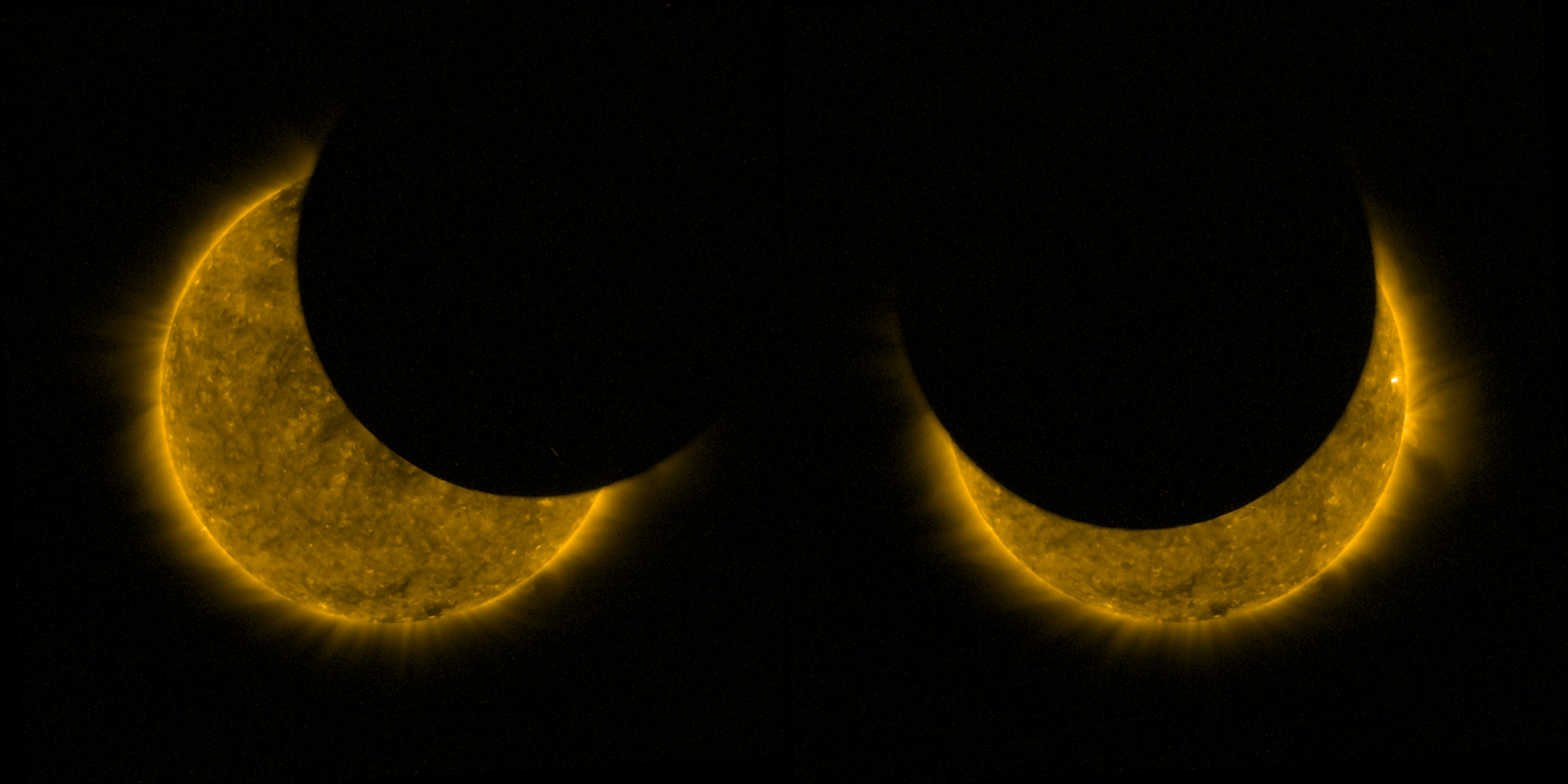
The SWAP camera onboard the PROBA2 satellite observed a partial solar eclipse on 11 August.
All details and plenty of images are at http://www.esa.int/spaceinimages/Images/2018/08/Partial_solar_eclipse_from_space
Review of solar activity
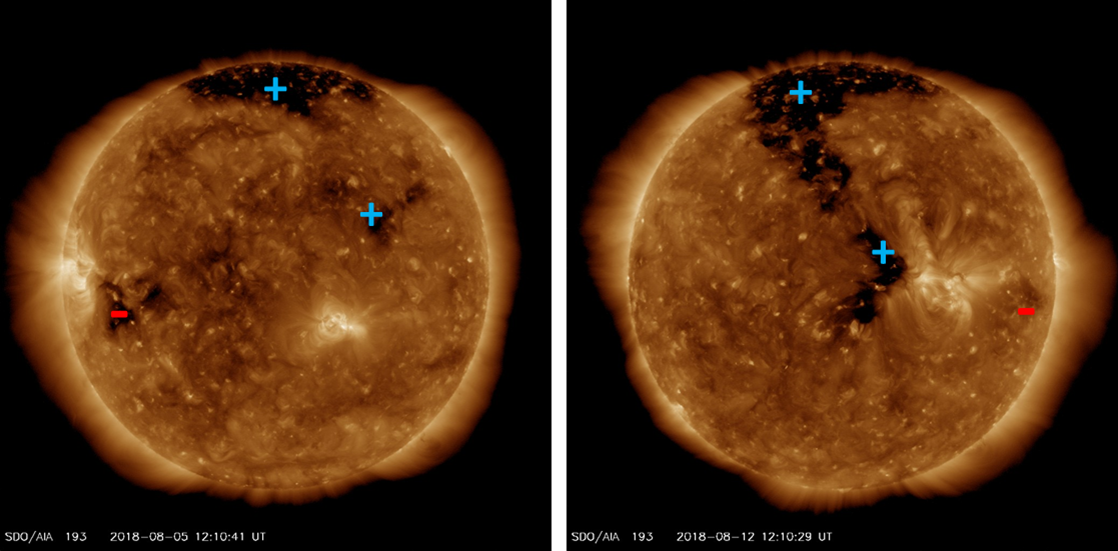
Solar activity was at very low levels all week. No active regions, no sunspots, no significant coronal mass ejections (CMEs) and no flares were observed. A small positive coronal hole was in a geoeffective position at the beginning of the week and a small negative one at the end of the week. The SDO/AIA 193 images underneath show the main coronal holes on 5 and 12 August. The "+" and "-" indicate the magnetic polarity of the coronal hole, with the open field lines resp. "coming out" (positive) and "returning to" (negative) the Sun.
The International Sunspot Number
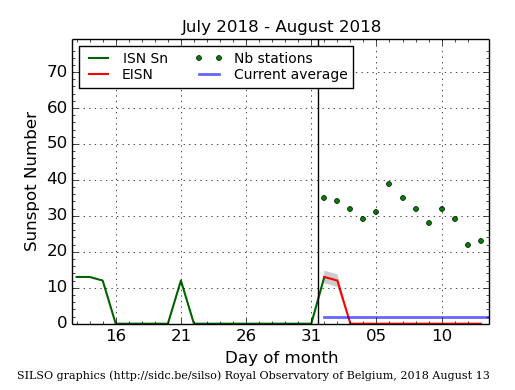
The daily Estimated International Sunspot Number (EISN, red curve with shaded error) derived by a simplified method from real-time data from the worldwide SILSO network. It extends the official Sunspot Number from the full processing of the preceding month (green line). The plot shows the last 30 days (about one solar rotation). The horizontal blue line shows the current monthly average, while the green dots give the number of stations included in the calculation of the EISN for each day.
PROBA2 Observations (6 Aug 2018 - 12 Aug 2018)
Solar Activity
Solar flare activity remained very low during the week.
In order to view the activity of this week in more detail, we suggest to go to the following website from which all the daily (normal and difference) movies can be accessed: http://proba2.oma.be/ssa
This page also lists the recorded flaring events.
A weekly overview movie can be found here (SWAP week 437): http://proba2.oma.be/swap/data/mpg/movies/weekly_movies/weekly_movie_2018_08_06.mp4
Details about some of this week's events, can be found further below.
If any of the linked movies are unavailable they can be found in the P2SC movie repository here: http://proba2.oma.be/swap/data/mpg/movies/
Saturday Aug 11
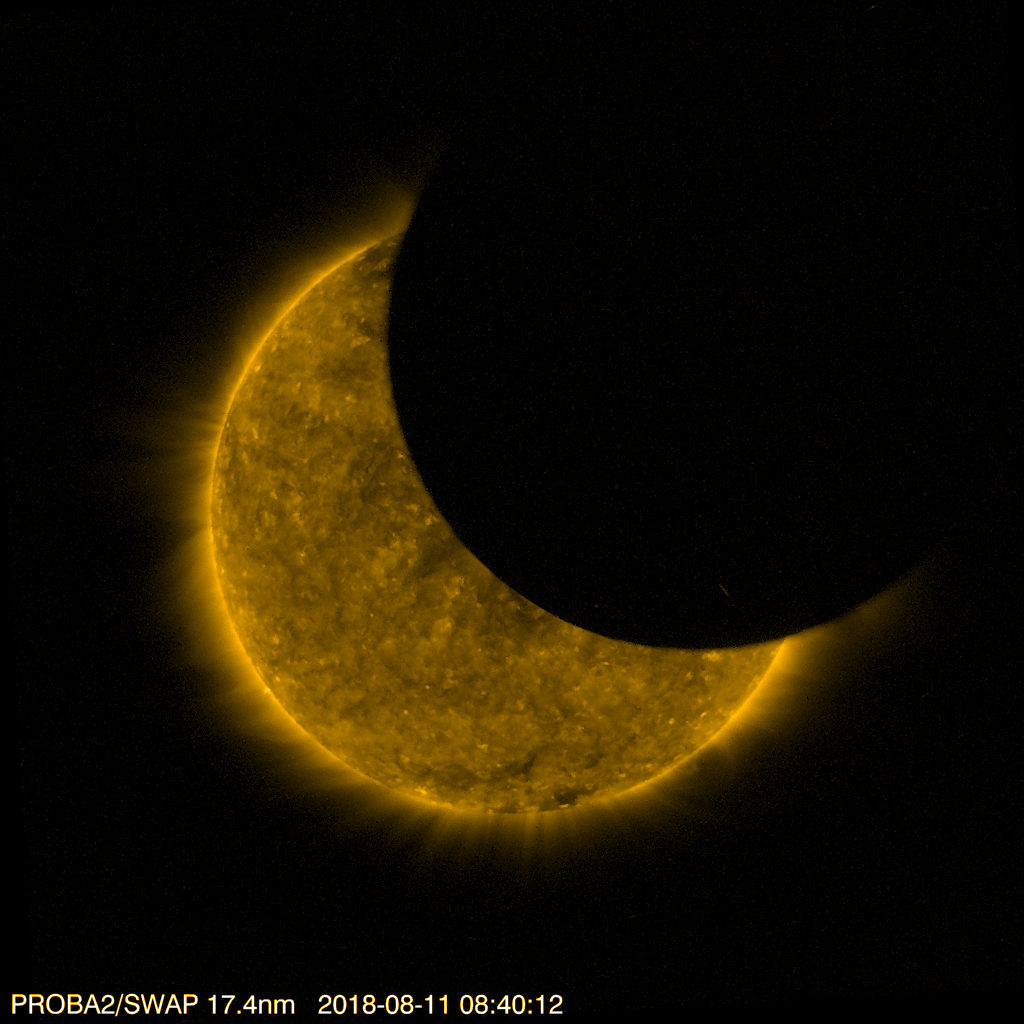
On 2018-Aug-11 two partial eclipses were observed by SWAP, between 08:29 and 08:49 UT, and between 10:21 and 10:45 UT respectively. The SWAP image above was taken during the first partial occultation. Additionally, the Moon appeared one more time into the SWAP and LYRA field of view, but without obscuring the solar disk.
Find a movie of the event here http://proba2.oma.be/Events/2018-Aug-11-SolarEclipse/movies/Eclipse1/swap_eclipse_2018_08_11_01_logos_compressed.mp4 and further images available of both eclipses here http://proba2.oma.be/Events/2018-Aug-11-SolarEclipse/movies/ .
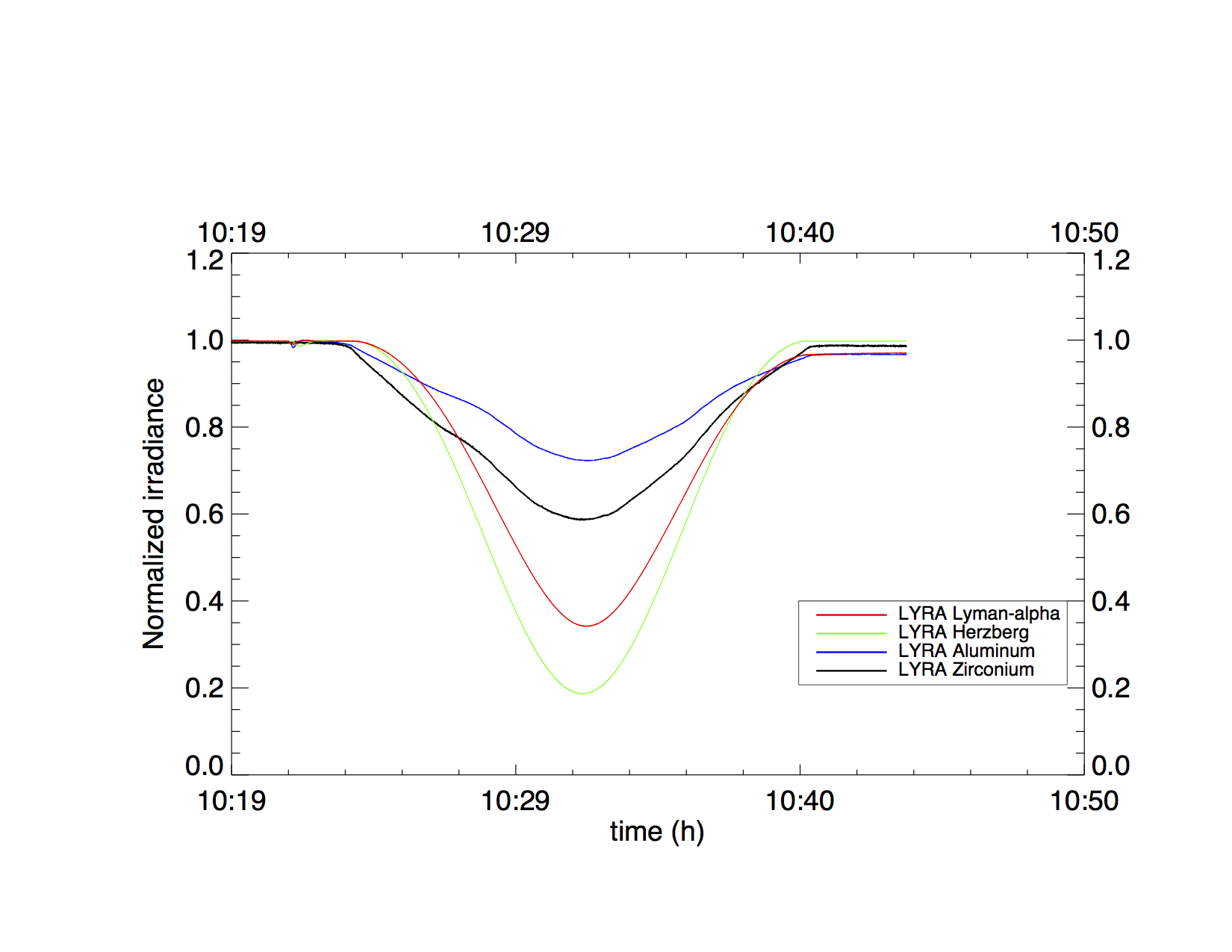
The partial eclipses on 2018-Aug-11 were also observed by LYRA which used the nominal unit (unit 2) and then the backup unit (unit 3) in parallel with the calibration unit (unit 1) for the two occultations, respectively. The above image shows the irradiance curves from LYRA throughout the second occultation event between 10:21 and 10:45 UT.
Find further LYRA files and images for this event here: http://proba2.oma.be/Events/2018-Aug-11-SolarEclipse/lyra/
Review of geomagnetic activity
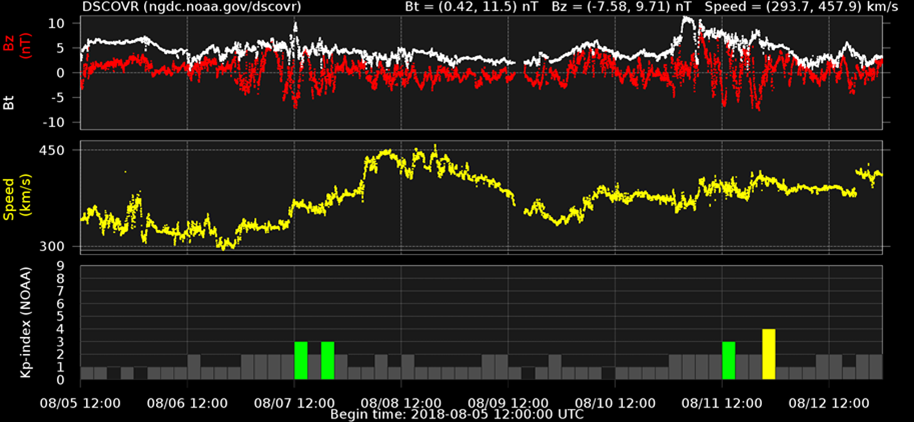
Solar wind was slow all week (below 450 km/s). A sector boundary crossing was observed on 11 August, followed by several hours of negative Bz (around -7nT) that produced active conditions around midnight from 11 to 12 August. Quiet to unsettled geomagnetic conditions were observed the rest of the week. The composition underneath shows the evolution of the solar wind magnetic field, the solar wind speed, and the Kp index for the entire week.
Geomagnetic Observations at Dourbes (6 Aug 2018 - 12 Aug 2018)

The SIDC Space Weather Briefing
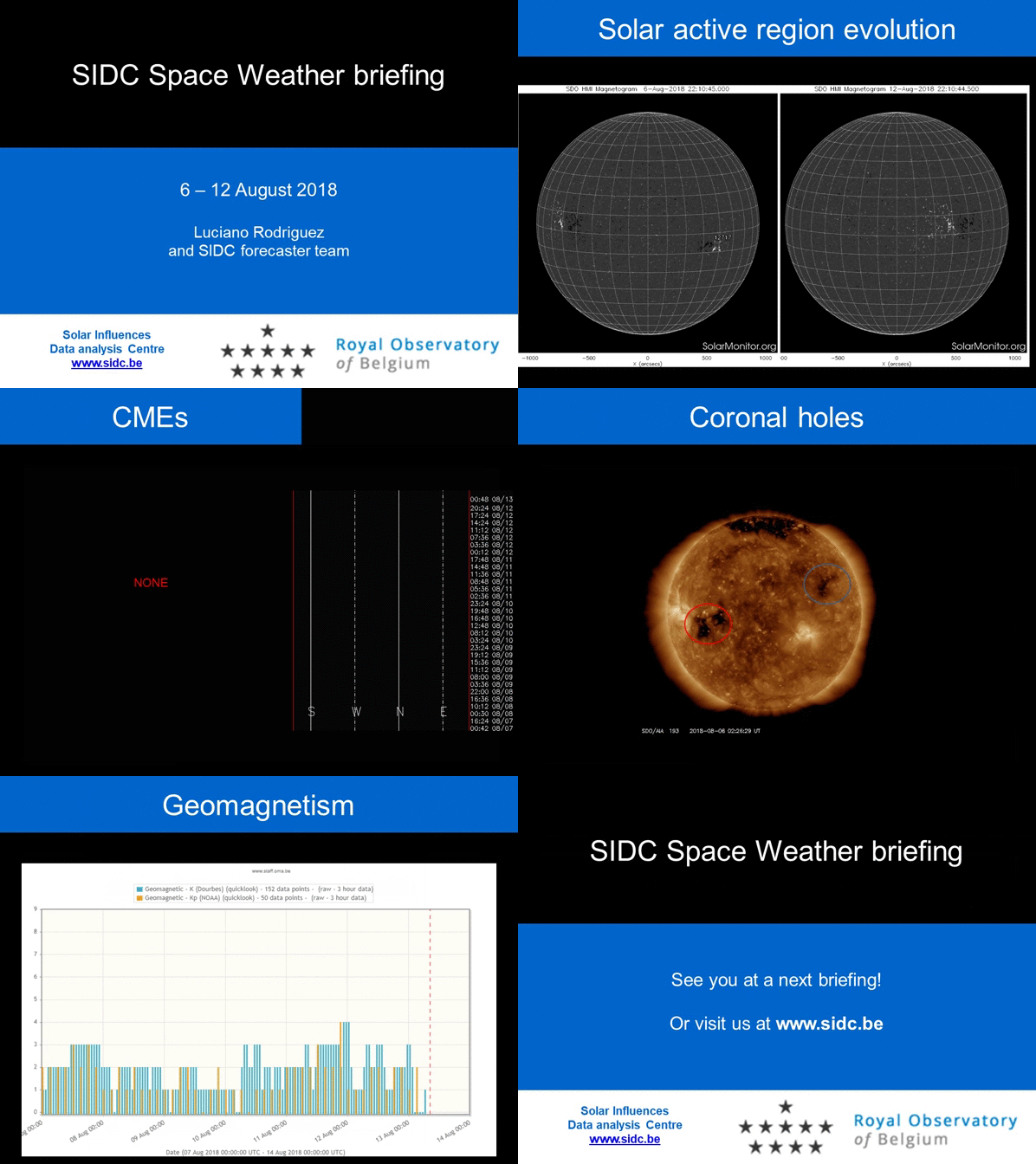
The Space Weather Briefing presented by the forecaster on duty from 6 till 12 August. It reflects in images and graphs what is written in the Solar and Geomagnetic Activity reports. A .wmv version can be found at http://stce.be/movies/SIDCbriefing_20180813_FINAL.wmv A pdf version is available at http://stce.be/movies/SIDCbriefing_20180813_FINAL.pdf
Review of ionospheric activity (6 Aug 2018 - 12 Aug 2018)

The figure shows the time evolution of the Vertical Total Electron Content (VTEC) (in red) during the last week at three locations:
a) in the northern part of Europe(N61°, 5°E)
b) above Brussels(N50.5°, 4.5°E)
c) in the southern part of Europe(N36°, 5°E)
This figure also shows (in grey) the normal ionospheric behaviour expected based on the median VTEC from the 15 previous days.
The VTEC is expressed in TECu (with TECu=10^16 electrons per square meter) and is directly related to the signal propagation delay due to the ionosphere (in figure: delay on GPS L1 frequency).
The Sun's radiation ionizes the Earth's upper atmosphere, the ionosphere, located from about 60km to 1000km above the Earth's surface.The ionization process in the ionosphere produces ions and free electrons. These electrons perturb the propagation of the GNSS (Global Navigation Satellite System) signals by inducing a so-called ionospheric delay.
See http://stce.be/newsletter/GNSS_final.pdf for some more explanations ; for detailed information, see http://gnss.be/ionosphere_tutorial.php