- Table of Content
- 1.The 2 July Sol...
- 2.ESWW2019 - NEW...
- 3.Review of sola...
- 4.The Internatio...
- 5.PROBA2 Observa...
- 6.Review of geom...
- 7.Geomagnetic Ob...
- 8.The SIDC space...
- 9.Review of iono...
2. ESWW2019 - NEWS! NEWS!
3. Review of solar activity
4. The International Sunspot Number by SILSO
5. PROBA2 Observations (24 Jun 2019 - 30 Jun 2019)
6. Review of geomagnetic activity
7. Geomagnetic Observations at Dourbes (24 Jun 2019 - 30 Jun 2019)
8. The SIDC space weather Briefing (24 Jun 2019 - 30 Jun 2019)
9. Review of ionospheric activity (24 Jun 2019 - 30 Jun 2019)
The 2 July Solar Eclipse seen from space
On July 2, 2019 the Great South American Eclipse took place. We could see it from space!
The PROBA2 team was ready to catch the solar eclipse with 2 instruments flying in space: SWAP, an EUV imager took pictures in the EUV and LYRA measured the EUV radiation during the eclipse. And PROBA2 could witness 4 times an eclipse because of its fast orbit around Earth allowing 4 passages through the shadow of the moon.
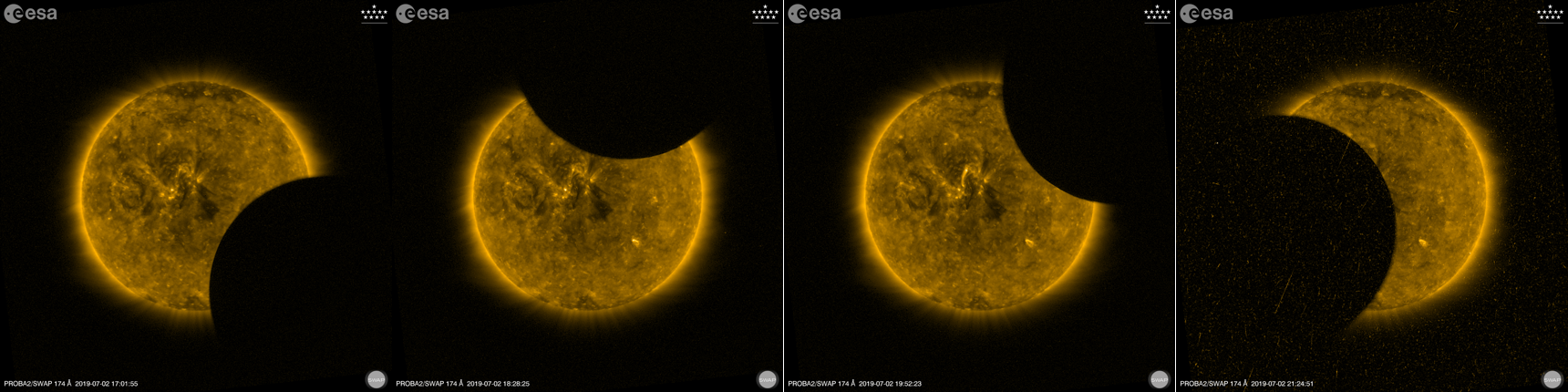
Elke tells us all about it on the PROBA2 webpage: http://proba2.oma.be/PartialEclipse2019July2
Interesting!
ESWW2019 - NEWS! NEWS!
Dear Colleagues
The last before-the-holidays-news:
* All submitters will be notified about acceptance/oral/poster on Monday July 8. Curieus?
* ESWW2019 will have a Wednesday Space Weather Fair. Participants with a full week conference ticket can ask for a free fair-booth: http://www.stce.be/esww2019/program/fair.php
* Since many of your colleagues and collaborators might be present at ESWW2019, it is also the place and the time to hold your private Business Meeting : http://www.stce.be/esww2019/program/businessmeetings.php
* A small number of grants for PhD students and early stage researchers is available: http://www.stce.be/esww2019/grant.php
* The early bird registration ends on July 31: http://www.stce.be/esww2019/registration.php
Don’t hesitate to check the website if one of these stars interests you.
Enjoy the holidays!
The LOC
P.S. From July 10 until August 1, we might be not as fast to respond to emails.
P.S. You can always try the LOC shell
Review of solar activity
Solar flaring activity was low, without C-class, or B-class flares reported. Two active regions that were observed on the visible side of the Sun, NOAA AR 2742 and NOAA AR 2743 did not cause any flare.
There were no wide CMEs reported this week and the solar protons remained at the background level during the whole week.
Two coronal holes of negative polarity were observed on the visible side of the Sun. The coronal hole that reached the central meridian in the evening of June 27, was small (between S20 and S40). The other equatorial coronal reached the central meridian in the evening of June 30.
The International Sunspot Number by SILSO
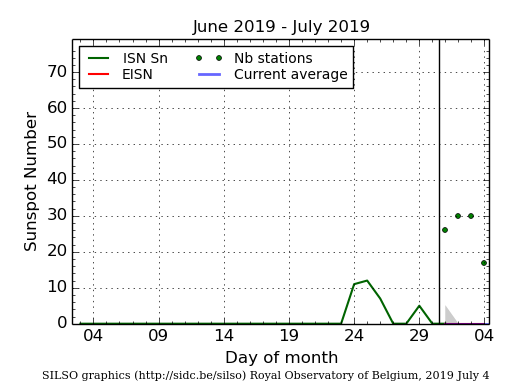
The daily Estimated International Sunspot Number (EISN, red curve with shaded error) derived by a simplified method from real-time data from the worldwide SILSO network. It extends the official Sunspot Number from the full processing of the preceding month (green line). The plot shows the last 30 days (about one solar rotation). The horizontal blue line shows the current monthly average, while the green dots give the number of stations included in the calculation of the EISN for each day.
PROBA2 Observations (24 Jun 2019 - 30 Jun 2019)
Solar Activity
Solar flare activity remained very low during the week.
In order to view the activity of this week in more detail, we suggest to go to the following website from which all the daily (normal and difference) movies can be accessed: http://proba2.oma.be/ssa
This page also lists the recorded flaring events.
A weekly overview movie can be found here (SWAP week 483): http://proba2.oma.be/swap/data/mpg/movies/weekly_movies/weekly_movie_2019_06_24.mp4
Details about some of this week's events, can be found further below.
If any of the linked movies are unavailable they can be found in the P2SC movie repository here: http://proba2.oma.be/swap/data/mpg/movies/
Friday June 28
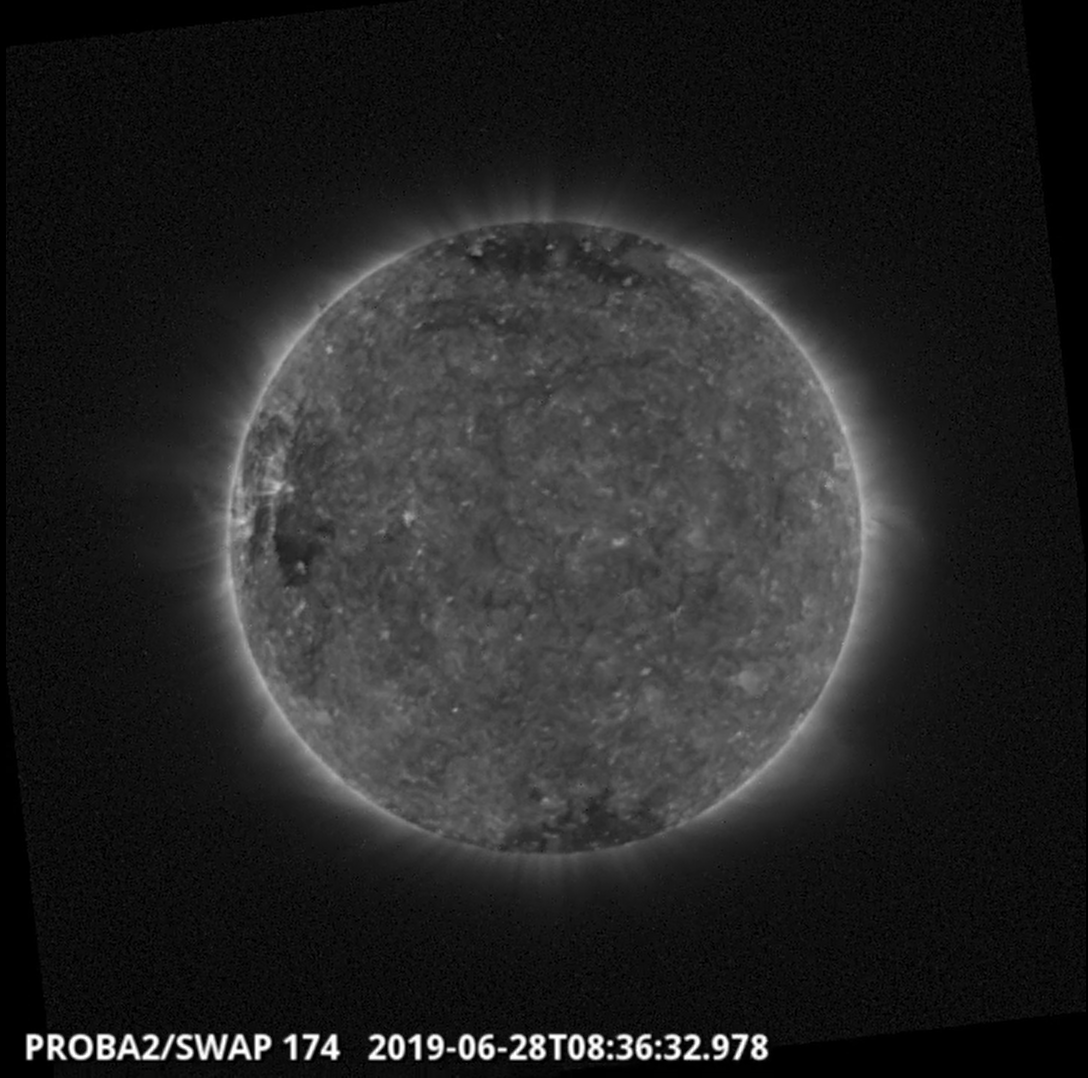
A faint rising rising loop system and subsequent eruption was observed by SWAP on 2019-Jun-28 and is visible on the eastern limb of the Sun in the SWAP image above taken at 08:36 UT.
Find a movie of the event here (SWAP movie): http://proba2.oma.be/swap/data/mpg/movies/20190628_swap_movie.mp4
Review of geomagnetic activity
Earth was inside a slow solar wind with its speed between 320 and 420 km/s. The interplanetary magnetic field magnitude ranged between 3 to 5 nT.
Accordingly, the geomagnetic conditions were quiet (i.e. Local K at Dourbes and NOAA Kp 0,1 or 2) with only a few isolated intervals of unsettled conditions (i.e. K and Kp=3).
Geomagnetic Observations at Dourbes (24 Jun 2019 - 30 Jun 2019)

The SIDC space weather Briefing (24 Jun 2019 - 30 Jun 2019)
The Space Weather Briefing presented by the forecaster on duty from Jun 24 to 30. It reflects in images and graphs what is written in the Solar and Geomagnetic Activity report.
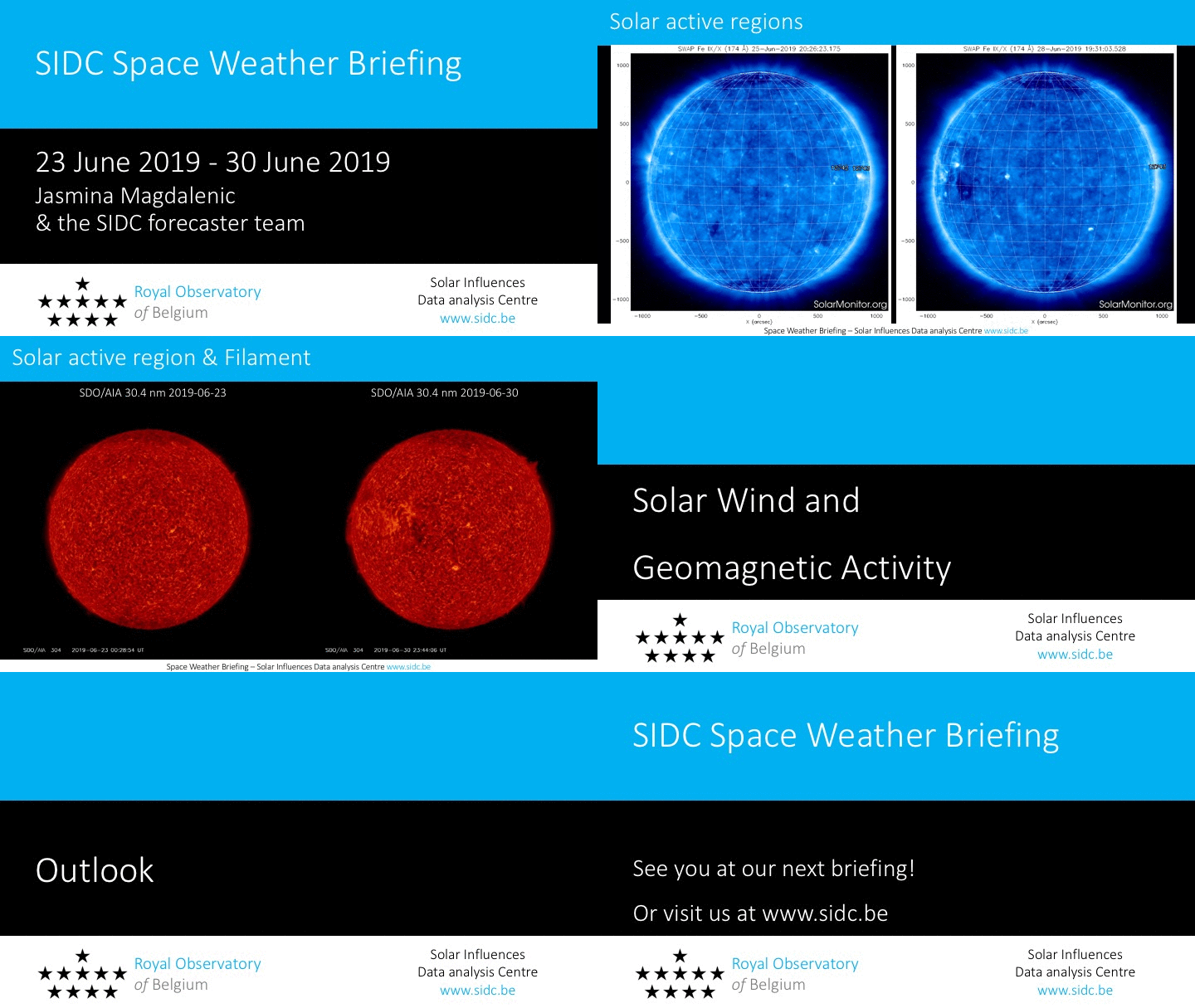
The pdf-version: http://www.stce.be/briefings/20190701_SWbriefing.pdf
The automatically running presentation: http://www.stce.be/briefings/20190701_SWbriefing.ppsm
Review of ionospheric activity (24 Jun 2019 - 30 Jun 2019)

The figure shows the time evolution of the Vertical Total Electron Content (VTEC) (in red) during the last week at three locations:
a) in the northern part of Europe(N61°, 5°E)
b) above Brussels(N50.5°, 4.5°E)
c) in the southern part of Europe(N36°, 5°E)
This figure also shows (in grey) the normal ionospheric behaviour expected based on the median VTEC from the 15 previous days.
The VTEC is expressed in TECu (with TECu=10^16 electrons per square meter) and is directly related to the signal propagation delay due to the ionosphere (in figure: delay on GPS L1 frequency).
The Sun's radiation ionizes the Earth's upper atmosphere, the ionosphere, located from about 60km to 1000km above the Earth's surface.The ionization process in the ionosphere produces ions and free electrons. These electrons perturb the propagation of the GNSS (Global Navigation Satellite System) signals by inducing a so-called ionospheric delay.
See http://stce.be/newsletter/GNSS_final.pdf for some more explanations ; for detailed information, see http://gnss.be/ionosphere_tutorial.php