- Table of Content
- 1.Double X-class...
- 2.E-SWAN School ...
- 3.Review of Sola...
- 4.International ...
- 5.PROBA2 Observa...
- 6.Noticeable Sol...
- 7.Geomagnetic Ob...
- 8.The SIDC Space...
- 9.Upcoming Activ...
2. E-SWAN School series prior to ESWW2026
3. Review of Solar and Geomagnetic Activity
4. International Sunspot Number by SILSO
5. PROBA2 Observations
6. Noticeable Solar Events
7. Geomagnetic Observations in Belgium
8. The SIDC Space Weather Briefing (20 Apr 2026 - 26 Apr 2026)
9. Upcoming Activities
Double X-class flare
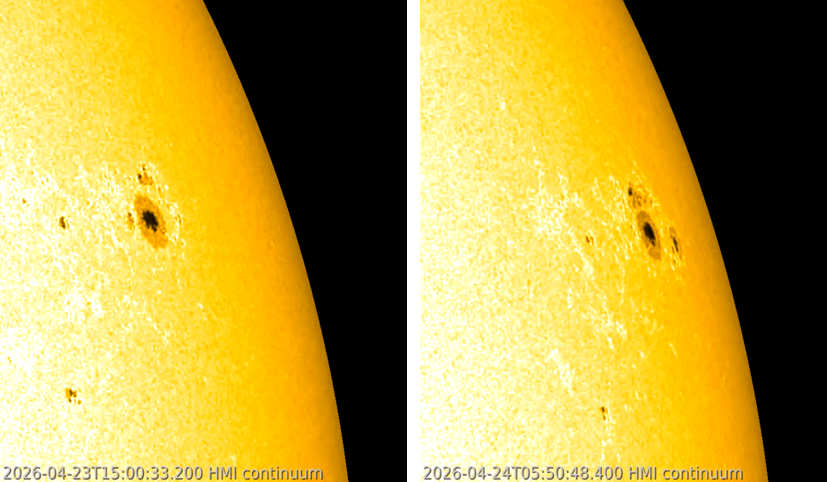
SIDC Sunspot Group 825 (NOAA Active Region 4419) was all in all relatively quiet until 23 April, when it started to add sunspots to its north and west. In hardly 15 hours, there's an obvious emergence of magnetic flux (sunspots) in these locations. This can be seen in the SDO/HMI white light imagery underneath (huge zoom). Clips are available in the newsflash on this topic at https://www.stce.be/news/815/welcome.html
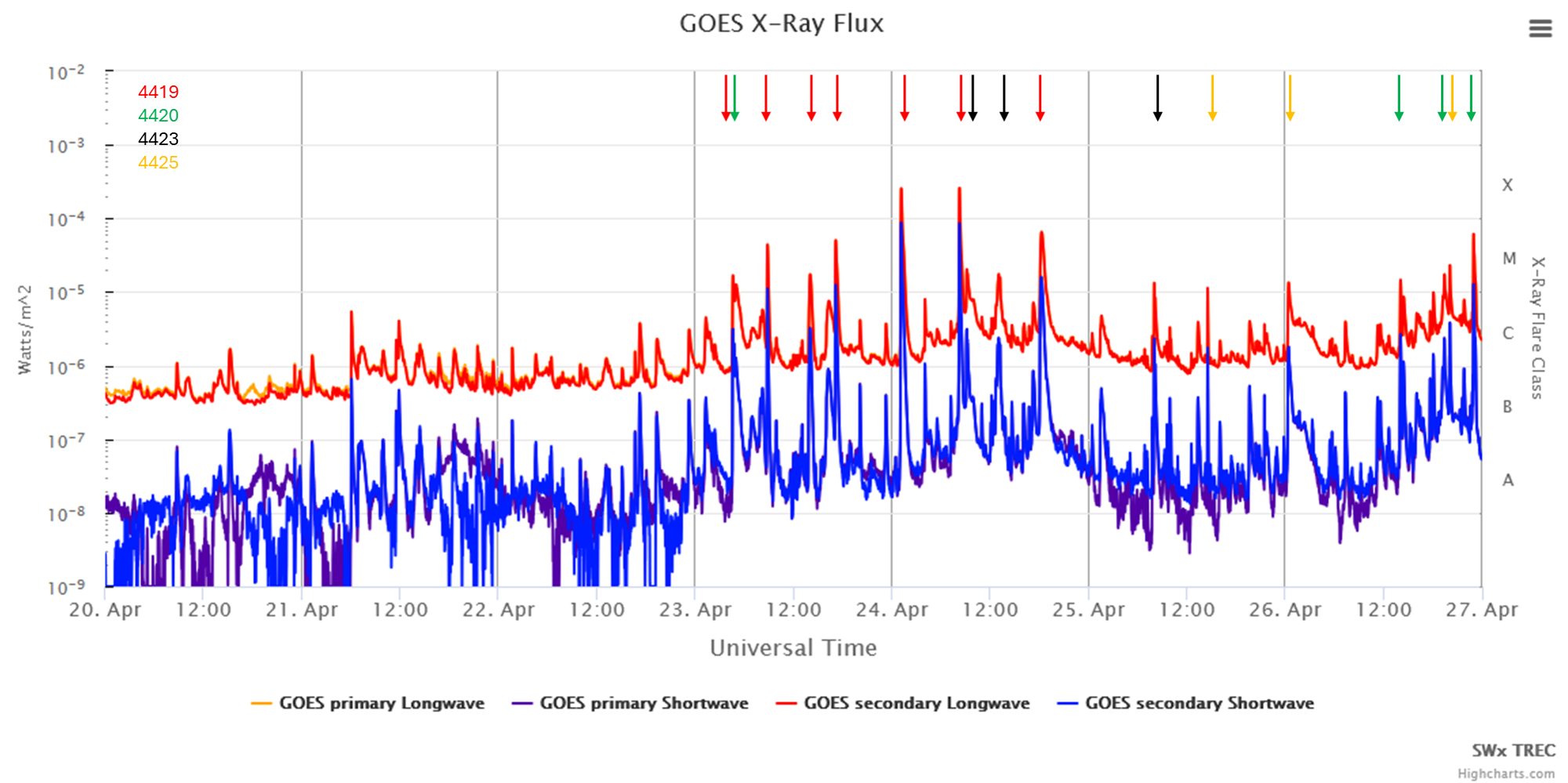
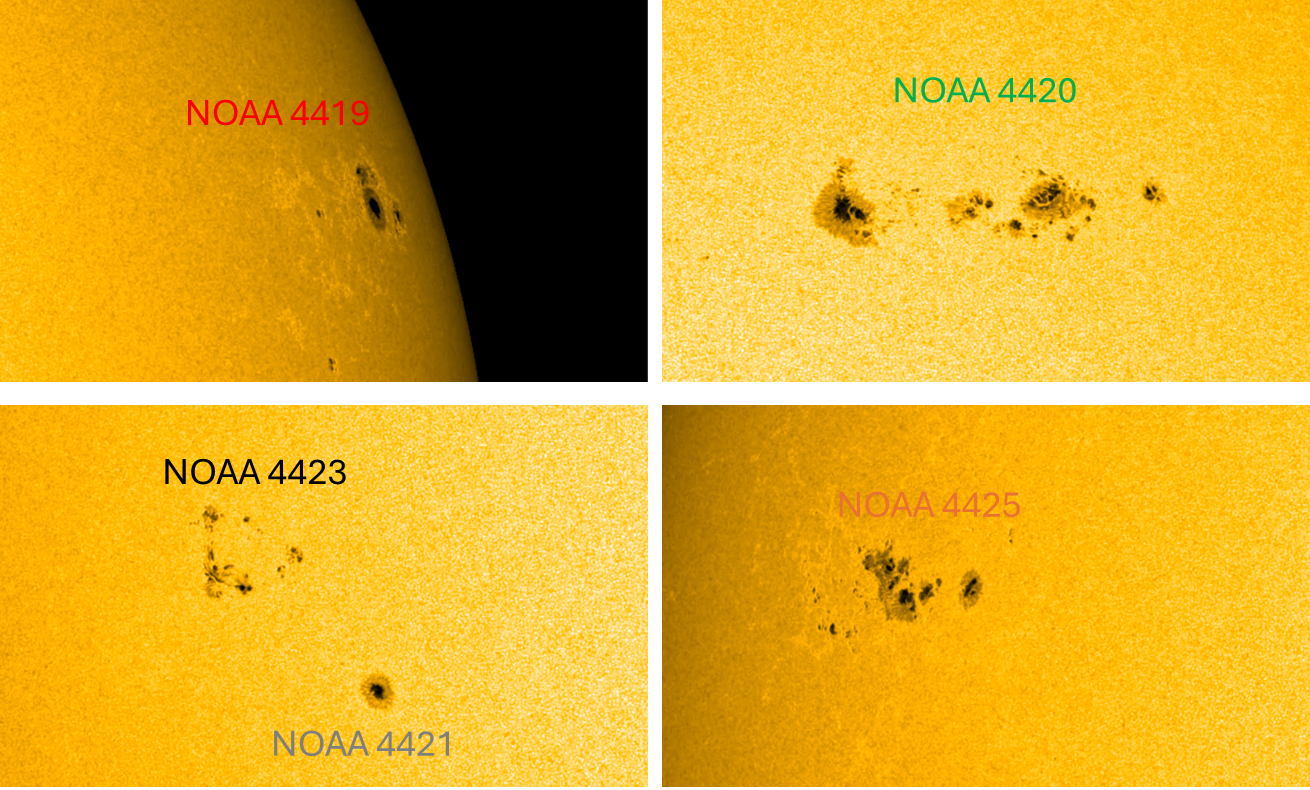
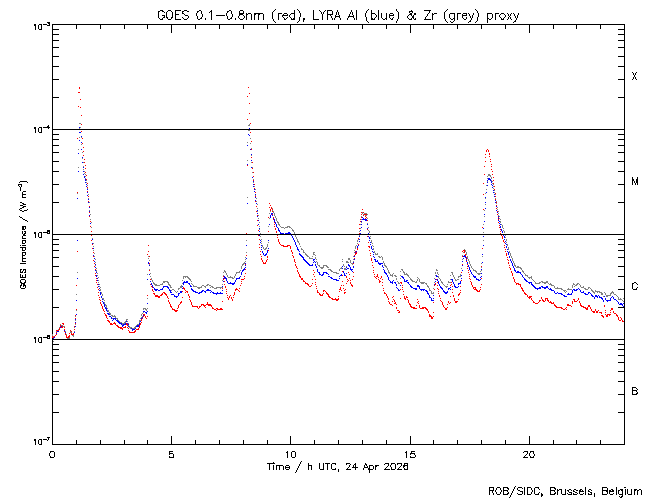
The emergence of these new sunspots resulted initially in the production of M-class flares on 23 April, the strongest being an M4.9 flare peaking at 17:08UTC. This enhanced flare activity was then followed by the two X-class flares on 24 April: An X2.4 flare peaking at 01:07 UTC, and an X2.5 flare peaking at 08:13 UTC. These flares are prominently visible in the GOES chart underneath. The coloured arrows link the M- and X-class flares to the source of the eruption (see the Noticeable Solar Events list). NOAA 4419 was clearly the source of most of the flares (as well as the most intense), but also NOAA 4420, 4423 and 4425 were important contributors to the number of M-class flares. The view in white light of these active regions can be found underneath.
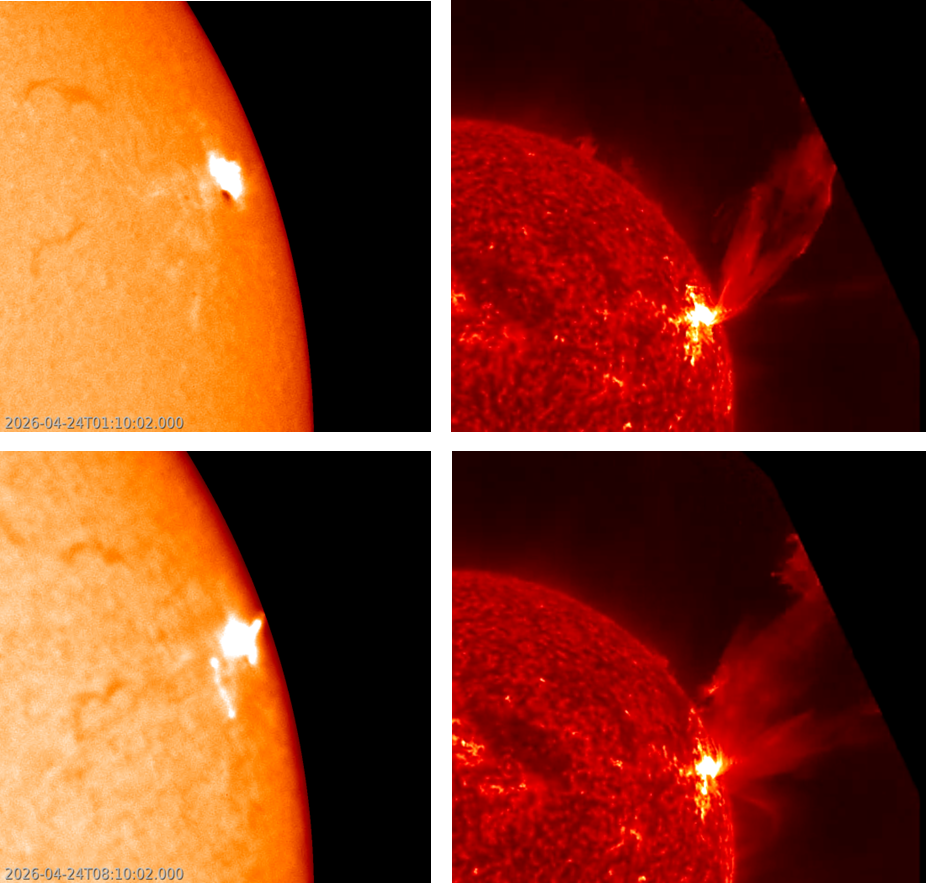
The subsequent compilation shows the location and size of the 2 X-class flares in H-alpha (red portion of the solar spectrum at 656.28 nm; GONG), with both flare events located to the northwest ("upper right") of NOAA 4419's main spot. On the right is the corresponding view in extreme ultraviolet (AIA 304), at temperatures near 80000 degrees. The eruptions are complex, and material is clearly ejected into space.
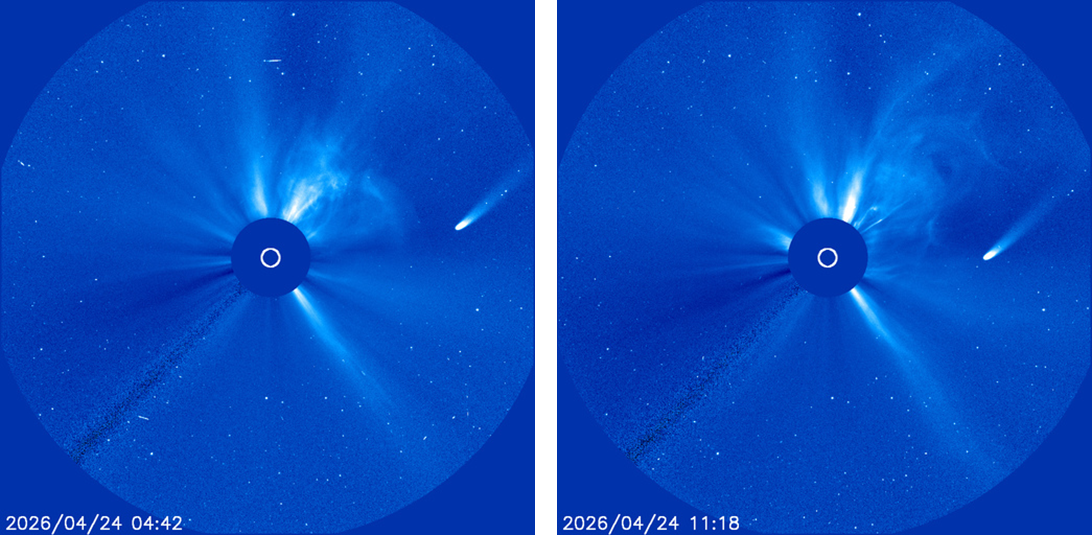
The coronagraph on board SOHO (LASCO C3) had a good view on the associated coronal mass ejections (CME ; magnetic clouds of charged particles) as shown underneath, with each image taken about 2-3 hours after the flare's peak. The feature on the right in each image is the comet PanSTARRS (C/2025 R3). The bulk of these CMEs is directed away from the Earth, but an earth-directed component could not be excluded at the time of the observations. No obvious disturbance in the solar wind parameters has been registered so far (3 days after the eruptions), indicating that both CMEs have most likely missed the Earth.
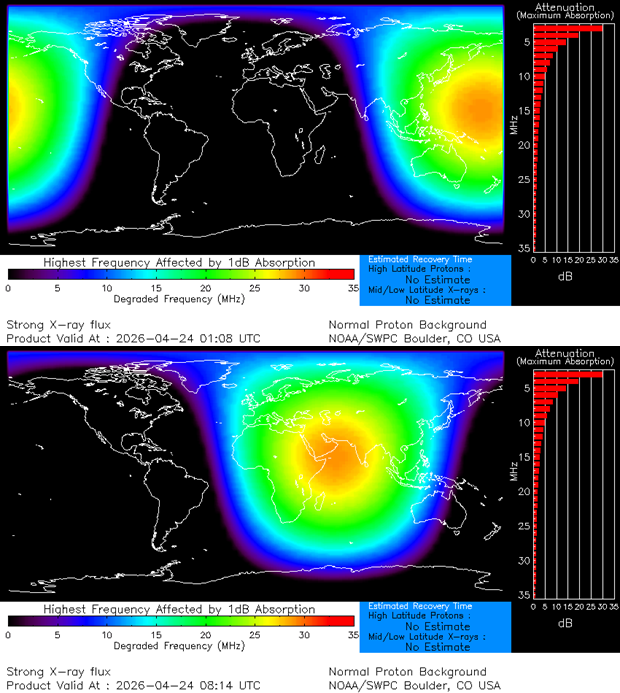
The ionizing radiation of the X-class flares itself affected the lower frequency portion of the High Frequency communication band (HF Com ; 3 - 30 MHz) on the dayside of the Earth. During the first X-class flare, this was mainly over the West-Pacific Ocean and near Japan, East- and South-East Asia, as well as Australia. The second X-class flare may have affected HF Com over the Persian Gulf, Iran, Saudi-Arabia, the Horn of Africa, India, and the northern portion of the Indian Ocean. The area where HF Com was most likely affected by these X-class flares can be seen in the D-RAP (NOAA/SWPC) maps underneath. Advisories to civil aviation have been issued (PECASUS ; https://pecasus.eu/).
E-SWAN School series prior to ESWW2026
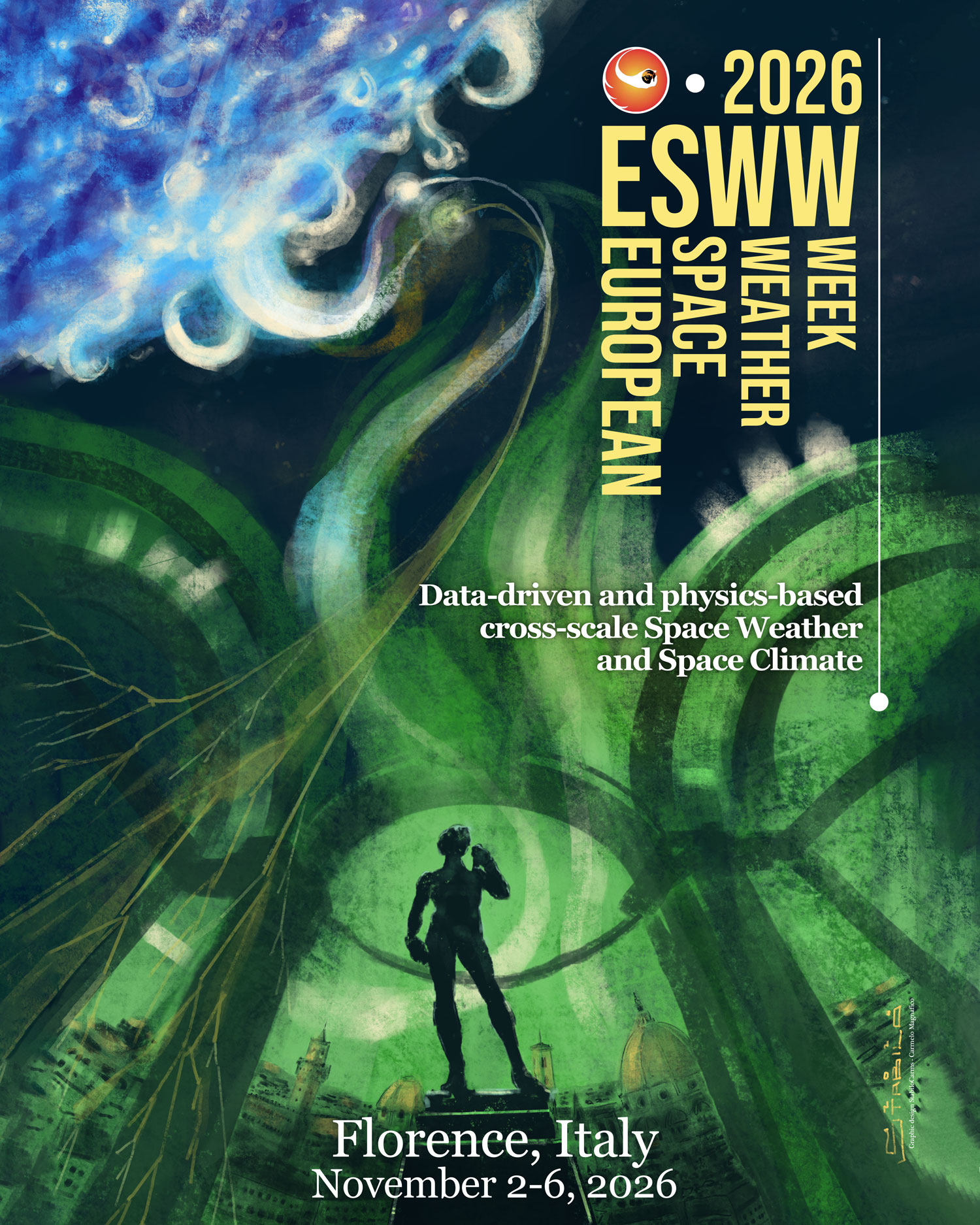
The E-SWAN EOCOM is happy to announce the opening of the applications for the 2026 edition of the E-SWAN school series which will take place prior to ESWW2026, from Thursday 29 Oct to Sunday 1 Nov 2026 in Firenze, Italy .
Information and application: https://esww2026.eswan.eu/training
Application deadline: 11 May 2026
Don't miss this opportunity to see the STCE and CCMC trainers in action!
Review of Solar and Geomagnetic Activity
WEEK 1321 from 2026 Apr 20
Solar Active Regions (ARs) and flares
The Solar flaring activity was at low to high levels throughout the week, with 56 C-class flares, 14 M-class flares and 2 X-class flares. There were 7 sunspot groups observed on the visible solar disk. SIDC SG 624 (NOAA AR 4207), SIDC SG 847 (NOAA AR 4420), 850 (NOAA AR 4423) and 805 (NOAA AR 4425) all produced M-class flares and most of the C-class flares. The largest flare was a X2.5 flare (SIDC Flare 7473) peaking on April 24 at 08:13 UTC, the second-largest flare a X2.4 flare (SIDC Flare 7462) peaking on April 24 at 01:07 UTC both were produced by SIDC SG 624.
Coronal mass ejections
One Coronal Mass Ejections (CMEs) was observed throughout the week with an Earth-directed component. This CME was observed LASCO-C2 data around 08:34 UTC on April 24, with an estimated speed of 1269 km/s. This CME is associated with a X2.5 flare (SIDC Flare 7473) peaking on April 24 at 08:13 UTC. It was predicted to arrive on April 26 as a likely glancing blow arrival, but no CME was seen in the solar wind data at that time. A filament located around N21E05 erupted on April 21st. The CME associated with this filament eruption travelled North and missed Earth.
Coronal Holes
Two positive polarity (SIDC CH 156 and 157) and three negative polarity (SIDC CH 147, 142, 149) coronal holes were present on the solar disk in the past week. Returning equatorial SIDC Coronal Hole 157 (equatorial coronal hole extending to the polar south with a positive polarity) started crossing the central meridian on April 21 and SIDC Coronal Hole 157 (equatorial coronal hole with a negative polarity) started crossing the central meridian on April 22.
Proton flux levels
The greater than 10 MeV proton flux remained below the 10 pfu threshold throughout the week.
Electron fluxes at GEO
The greater than 2 MeV electron flux, as measured by GOES-18 and GOES-19 fluctuated around the 1000 pfu threshold from the start of the week until April 24 after which it stayed below the threshold for the rest of the period. The 24-hour electron fluence was at moderate levels at the start of the week until April 25 and then stayed at normal level until the end of the week.
Solar wind
At the beginning of the week, the Earth was under the influence of a high-speed stream associated with SIDC Coronal Hole (CH) 147 before going to slow solar wind condition. From April 25 onward the Earth came under the influence of high-speed streams from SIDC CH 156 and 157 until the end of the week. The solar wind speed ranged from 351 km/s to 614 km/s and the total interplanetary magnetic field from 1 nT to 14 nT, with the Bz reaching a minimum of -13 nT. The phi-angle was in the negative sector at the start of the week until April 25 when it switched to the positive sector for the rest of the week.
Geomagnetism
The geomagnetic conditions reached minor storm conditions (Kp 5 and K BEL 5) at the start of the week from April 19 to April 21. Then they were quite to unsettled before reaching active conditions (Kp 4 and K BEL 4) from April 24th onward until the end of the week.
International Sunspot Number by SILSO

The daily Estimated International Sunspot Number (EISN, red curve with shaded error) derived by a simplified method from real-time data from the worldwide SILSO network. It extends the official Sunspot Number from the full processing of the preceding month (green line), a few days more than one solar rotation. The horizontal blue line shows the current monthly average. The yellow dots give the number of stations that provided valid data. Valid data are used to calculate the EISN. The triangle gives the number of stations providing data. When a triangle and a yellow dot coincide, it means that all the data is used to calculate the EISN of that day.
PROBA2 Observations
Solar Activity
Solar flare activity fluctuated from low to very high during the week.
In order to view the activity of this week in more detail, we suggest to go to the following website from which all the daily (normal and difference) movies can be accessed: https://proba2.oma.be/ssa
This page also lists the recorded flaring events.
A weekly overview movie (SWAP week 839) can be found here: https://proba2.sidc.be/swap/data/mpg/movies/weekly_movies/weekly_movie_2026_04_20.mp4.
Details about some of this week's events can be found further below.
If any of the linked movies are unavailable they can be found in the P2SC movie repository here: https://proba2.oma.be/swap/data/mpg/movies/.
Friday April 24
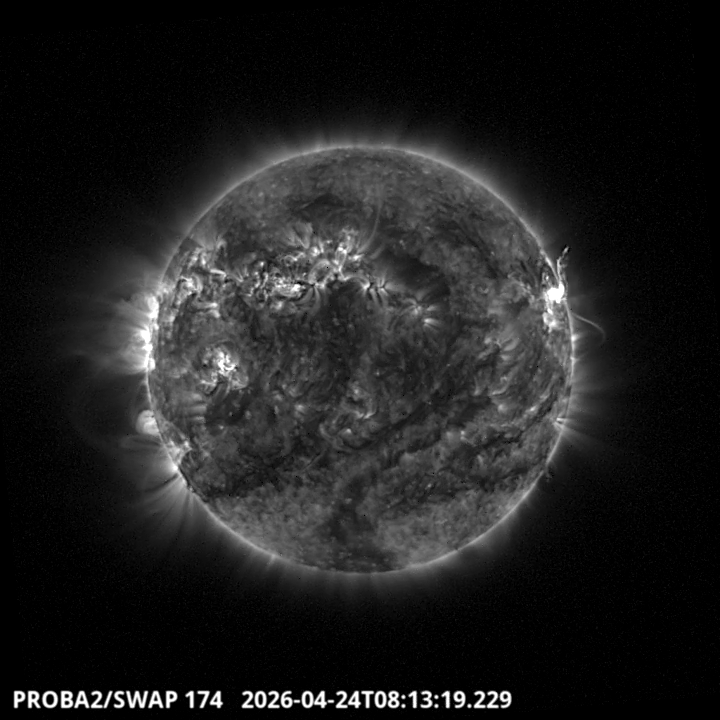
This week two X-flares originated from the same active region NOAA 4419 (SIDC 825), the largest one being an X2.5, which was observed by LYRA (top panel) and SWAP (bottom panel). The flare peaked on 2026-Apr-24 at 08:13 UT and occurred close to the western limb of the Sun.
Find a SWAP movie of the event here: https://proba2.sidc.be/swap/movies/20260424_swap_movie.mp4.
Noticeable Solar Events
| DAY | BEGIN | MAX | END | LOC | XRAY | OP | 10CM | TYPE | Cat | NOAA |
| 23 | 0424 | 0435 | 0448 | M1.6 | III/3 | 82 | 4419 | |||
| 23 | 0450 | 0459 | 0508 | N18E43 | M1.2 | 1 | 85 | 4420 | ||
| 23 | 0840 | 0848 | 0853 | N18W62 | M4.3 | SN | VI/1III/3II/2 | 82 | 4419 | |
| 23 | 1342 | 1400 | 1411 | N17W65 | M1.7 | SF | III/3 | 82 | 4419 | |
| 23 | 1700 | 1708 | 1714 | N17W65 | M4.9 | 1N | III/2 | 82 | 4419 | |
| 24 | 0051 | 0107 | 0113 | X2.4 | 82 | 4419 | ||||
| 24 | 0801 | 0813 | 0818 | N19W73 | X2.5 | 2B | III/3II/3 | 82 | 4419 | |
| 24 | 0857 | 0907 | 0919 | M1.9 | 4223 | |||||
| 24 | 1234 | 1301 | 1314 | S6E37 | M1.7 | 1F | 4423 | |||
| 24 | 1754 | 1815 | 1830 | N18W80 | M6.4 | 1F | III/1VI/1 | 82 | 4419 | |
| 25 | 0756 | 0759 | 0803 | S5E27 | M1.3 | SF | 88 | 4423 | ||
| 25 | 1422 | 1430 | 1432 | N7E73 | M1.1 | SF | III/2 | 4425 | ||
| 26 | 0008 | 0023 | 0035 | M1.3 | 4425 | |||||
| 26 | 1354 | 1403 | 1408 | N15W12 | M1.4 | S | 4420 | |||
| 26 | 1918 | 1924 | 1927 | M1.7 | 4420 | |||||
| 26 | 1954 | 2004 | 2007 | N5E55 | M2.2 | 1N | 4425 | |||
| 26 | 2251 | 2257 | 2302 | M6.0 | III/2II/2 | 4420 |
| LOC: approximate heliographic location | TYPE: radio burst type |
| XRAY: X-ray flare class | Cat: Catania sunspot group number |
| OP: optical flare class | NOAA: NOAA active region number |
| 10CM: peak 10 cm radio flux |
Geomagnetic Observations in Belgium
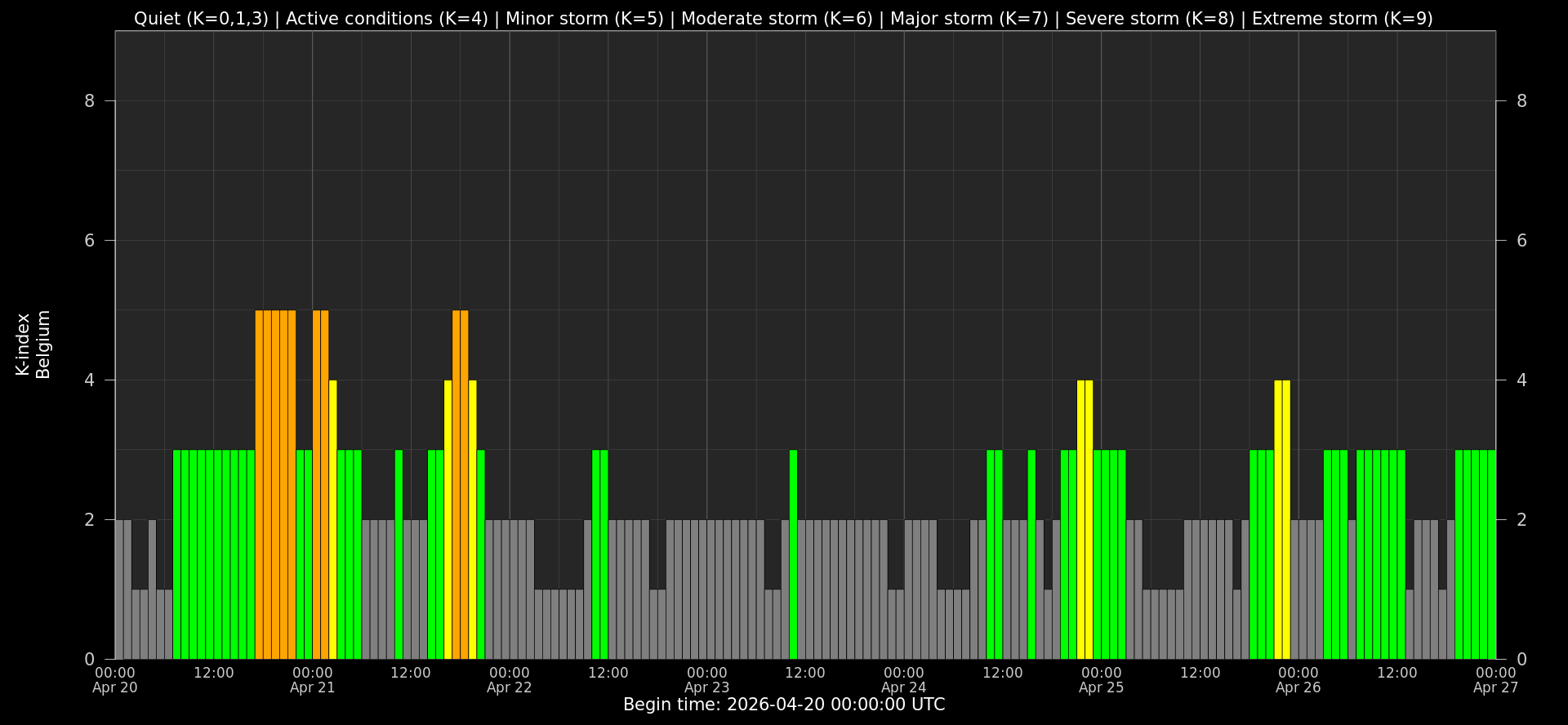
Local K-type magnetic activity index for Belgium based on data from Dourbes (DOU) and Manhay (MAB). Comparing the data from both measurement stations allows to reliably remove outliers from the magnetic data. At the same time the operational service availability is improved: whenever data from one observatory is not available, the single-station index obtained from the other can be used as a fallback system.
Both the two-station index and the single station indices are available here: http://ionosphere.meteo.be/geomagnetism/K_BEL/
The SIDC Space Weather Briefing (20 Apr 2026 - 26 Apr 2026)
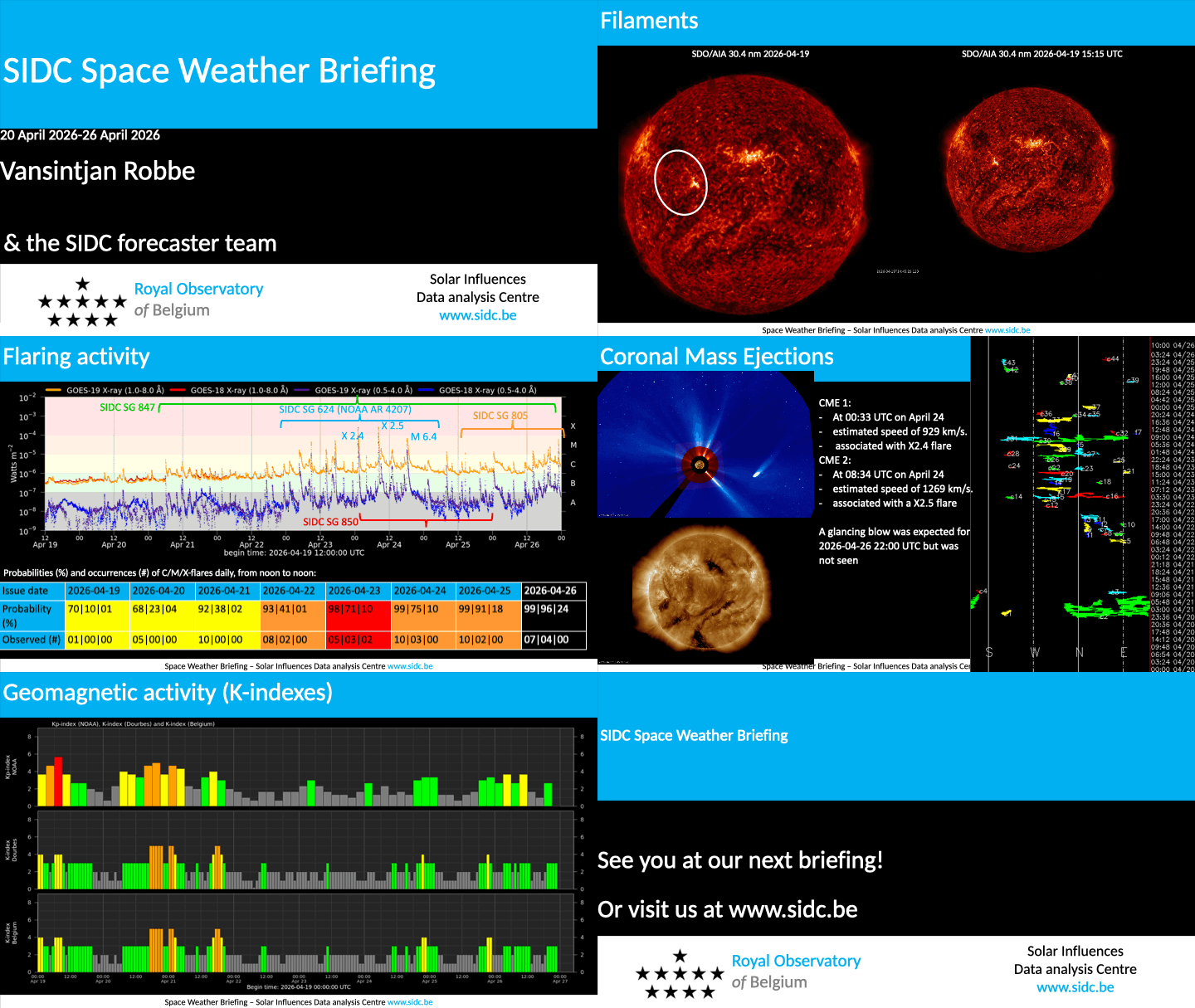
The forecaster on duty presented the SIDC briefing that gives an overview of space weather from November 20 to 26.
The pdf of the presentation: https://www.stce.be/briefings/20260427_SWbriefing.pdf
Upcoming Activities
Courses, seminars and events with the Sun-Space-Earth system and Space Weather as the main theme. We provide occasions to get submerged in our world through educational, informative and instructive activities.
* May 22-25, 2026, STCE show at Nerdland- In the eye of a solar storm (Dutch)
* Jun 15-17, 2026, STCE Space Weather Introductory Course, Brussels, Belgium - register: https://events.spacepole.be/event/256/ - Fully booked
* Oct 12-14, 2026, STCE Space Weather Introductory Course, Brussels, Belgium - register: https://events.spacepole.be/event/257/ - Reserved
* Oct 29- Nov 1, 2026, Prior to ESWW2026 - Space Weather Training Course in Firenze, Italy - Apply: https://events.spacepole.be/event/278/
* Nov 2-6, 2026, European Space Weather Week, Florence, Italy, https://esww2026.eswan.eu/
* Nov 23-25, 2026, STCE course: Role of the ionosphere and space weather in military communications, Brussels, Belgium - register: https://events.spacepole.be/event/259/
* Dec 7-9, 2026, STCE Space Weather Introductory Course for Aviation, Brussels, Belgium - register: https://events.spacepole.be/event/262/
To register for a course and check the seminar details, navigate to the STCE Space Weather Education Center: https://www.stce.be/SWEC
If you want your event in the STCE newsletter, contact us: stce_coordination at stce.be
Website: https://www.stce.be/SWEC