- Table of Content
- 1.The chronicles...
- 2.ESWW2026 Forec...
- 3.ESWW2026 OPS S...
- 4.ESWW2026 Sever...
- 5.Review of Sola...
- 6.International ...
- 7.PROBA2 Observa...
- 8.Noticeable Sol...
- 9.Geomagnetic Ob...
- 10.The SIDC Space...
- 11.Upcoming Activ...
2. ESWW2026 Forecasting Session
3. ESWW2026 OPS Session
4. ESWW2026 Severe Events Session
5. Review of Solar and Geomagnetic Activity
6. International Sunspot Number by SILSO
7. PROBA2 Observations
8. Noticeable Solar Events
9. Geomagnetic Observations in Belgium
10. The SIDC Space Weather Briefing
11. Upcoming Activities
The chronicles of NOAA 4436
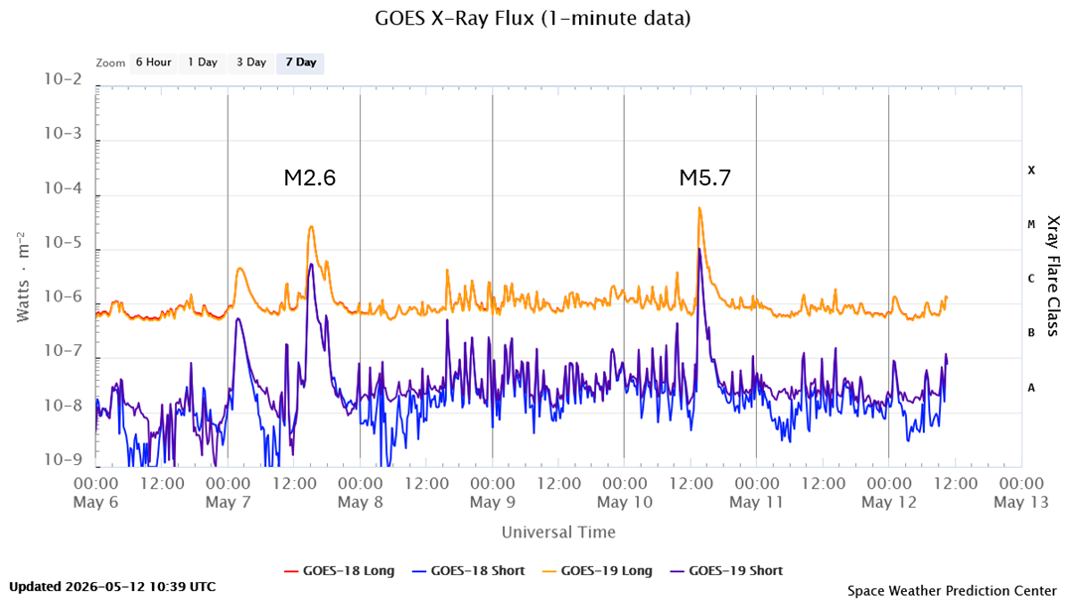
Flare activity was fairly calm last week, with only 2 M-class flares recorded: An M2.6 on 7 May (15:14 UTC), and an M5.7 (13:39 UTC) on 10 May (flare classification at https://www.stce.be/educational/classification#xray ). The flares are indicated on the plot underneath showing the solar emission in soft x-rays as observed by the GOES (https://www.swpc.noaa.gov/products/goes-x-ray-flux ) from 6 to 13 May.
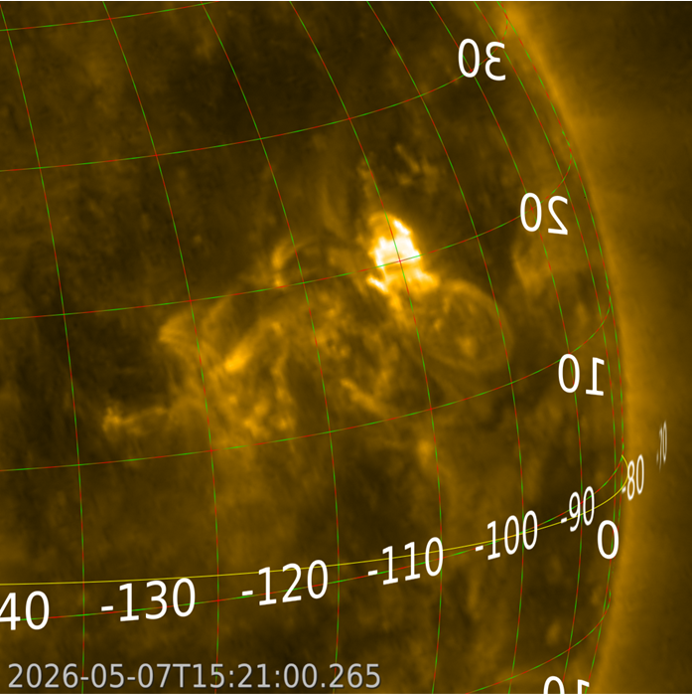
The second flare was clearly located in SIDC region 825 (NOAA 4436), while the first M-class flare took place from a region just behind the northeast limb. It was assumed this flare had the same source region. This was confirmed by imagery from Solar Orbiter's EUI (Extreme Ultraviolet Imager ; https://www.sidc.be/EUI/about/instrument ) as shown underneath. It shows zoomed-in imagery by EUI/FSI 174 (Full Sun Imager, at temperatures around 1 million degrees) around the time the flare was recorded by GOES (Earth). At that time, Solar Orbiter was observing the Sun's farside -again: as seen from Earth- and so had a good view on anything that happened over the Sun's east limb. From these observations, it became clear that NOAA 4436 was indeed the source region of the M2 flare, and that the region was still about 10 degrees behind the east limb. In the FSI imagery, the east limb as seen from Earth corresponds to the "-100" meridian (labeling issue due to line-of-sight effect). Obviously, the source region got its NOAA number only once it had turned onto the earth-facing side of the Sun.
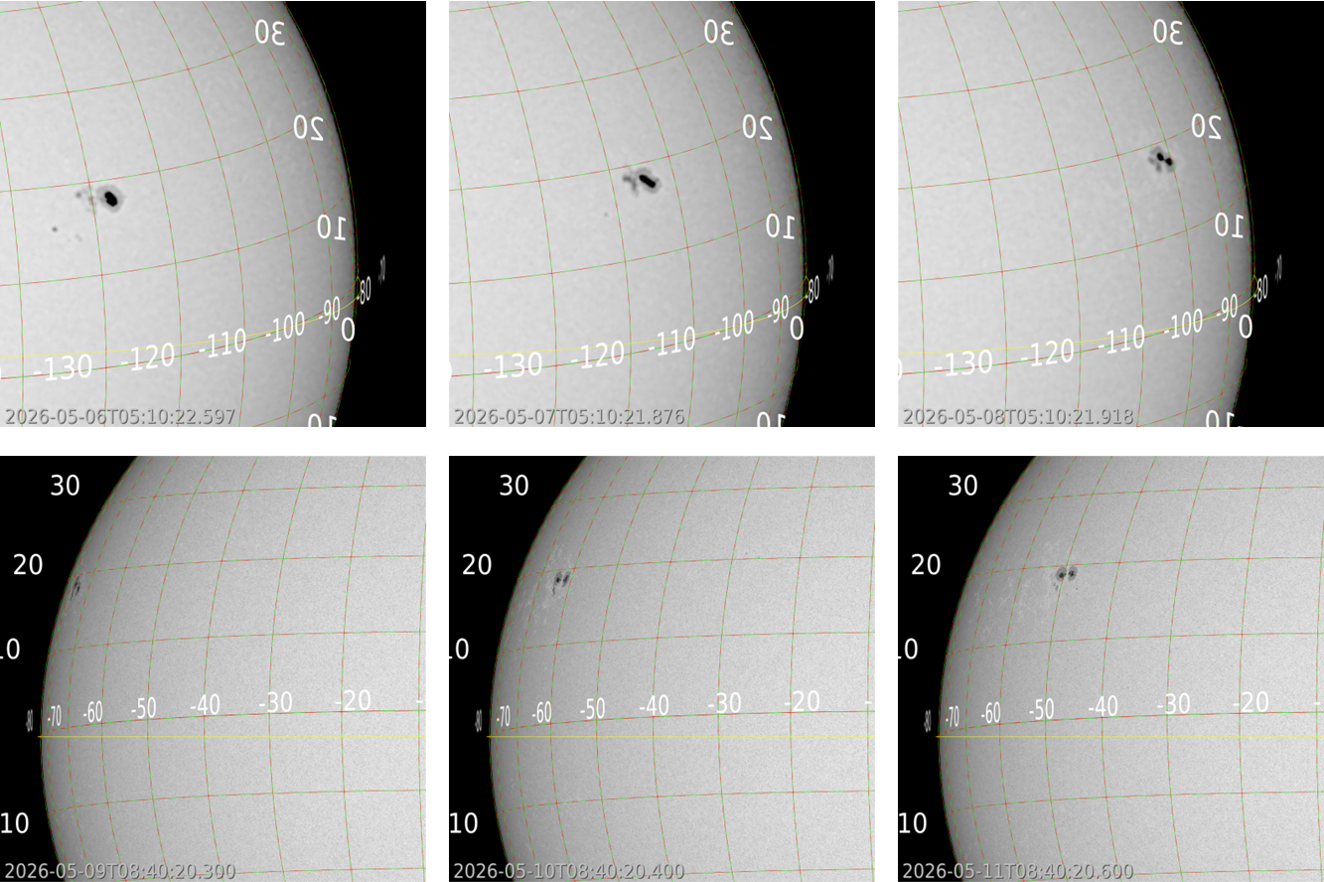
White-light images obtained by the Solar Orbiter's PHI instrument (Polarimetric and Helioseismic Imager ; https://www.mps.mpg.de/8334997/pictureoftheday ) also show that this was actually a new region emerging on the Sun's farside, about 5 degrees north and 15 degrees west of old NOAA 4419. So, NOAA 4436 is not the return of NOAA 4419, the latter can actually be seen disappearing. The PHI images also show how the big main, leading spot of NOAA 4436 actually splits in two around 7 May. It's no surprise then that for solar observers from Earth, who had their first view of this region only a day later, this split main spot initially looked like a bipolar region. In the compilation underneath, which covers pictures of the active region from 6 to 11 May, the top row images are made with the PHI instrument (solar farside), whereas the bottom row images were obtained by SDO/HMI. Needless to say, and quite obvious once you know how NOAA 4436 came to be: the two, nearly touching each other, main spots in the SDO images of 10 and 11 May clearly had the same magnetic polarity.
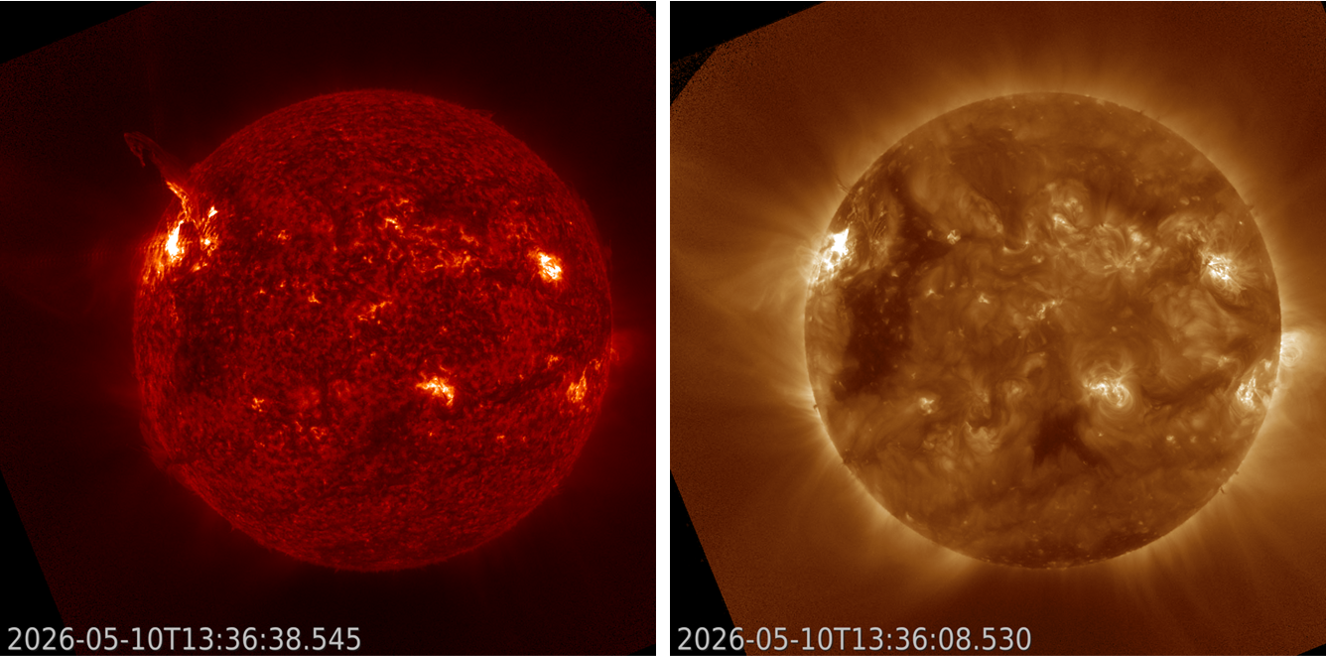
As the M2.6 flare took place while the source region was still behind the solar limb, one could expect that the actual intensity of the eruption was a lot higher, because a portion of the flare site was hidden by the solar disk. So, it's a good thing that Solar Orbiter also has an instrument with which the x-ray intensity can be proxied. According to its STIX instrument (Spectrometer and Telescope for Imaging X-rays ; https://datacenter.stix.i4ds.net/view/flares/list ), the proxied intensity of the flare was M3.1, with the uncertainty ranging from M1.8 to M5.6. That is indeed somewhat higher, but not that much and certainly not of the X-class level. A few days later, the M5.7 flare occurred just behind the west limb as seen from Solar Orbiter, so STIX had an almost unhampered view of the eruption. In this case, the proxied intensity was M4.4, with an uncertainty range from M2.5 to M8.1. The images underneath show the M5.7 eruption as observed with GOES/SUVI instrument, showing the eruption at temperatures of around 80.000 degrees (left ; 30.4 nm) and around 1.2 million degrees (right ; 19.5 nm).
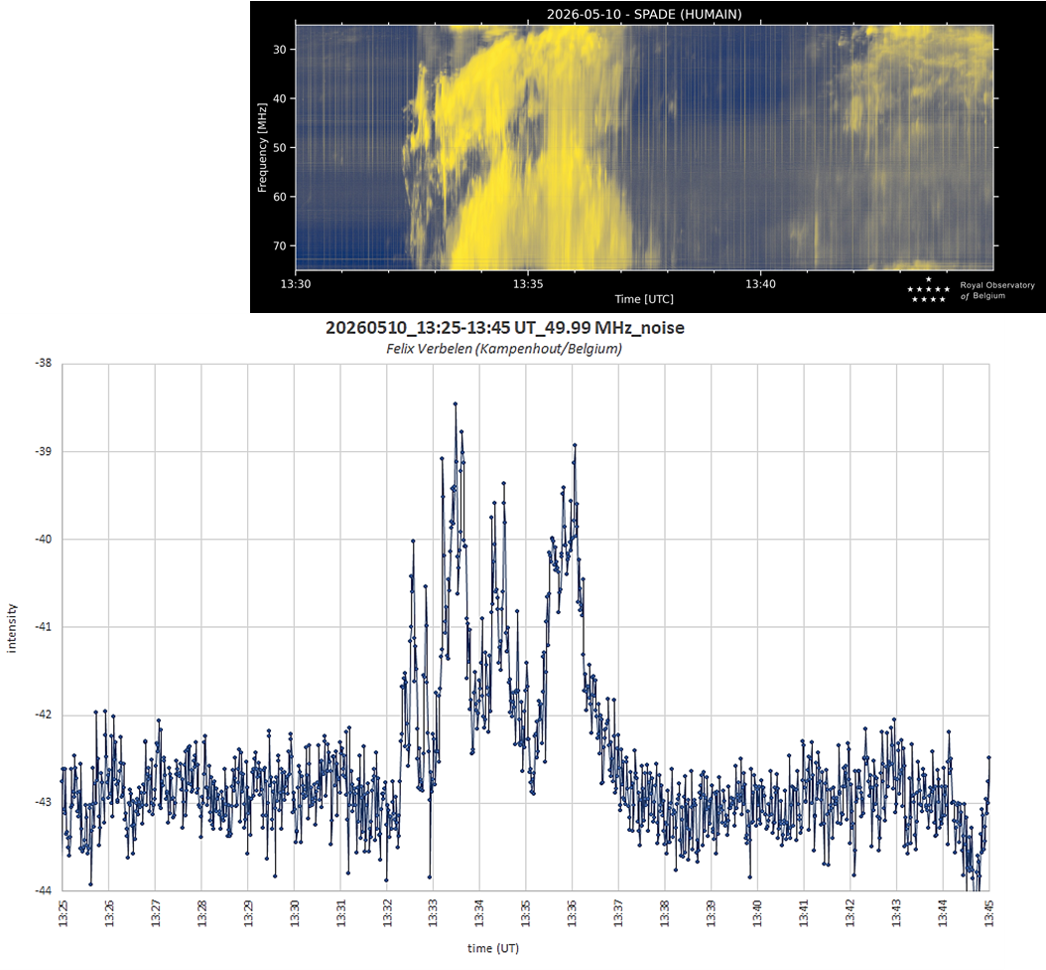
Solar radio bursts were detected by the radio astronomy station at Humain (HuRAS - https://www.sidc.be/humain/ah_overview), recording in particular a Type II radio bursts (see the STCE SWx Classification page https://www.stce.be/educational/classification#radio ) for a few minutes on 10 May around 13:35 UTC, i.e. near the peak time of the M5 flare. A zoom on the 25-75 MHz band between 13:30 and 13:45 UTC is provided by the HuRas/SPADE instrument (Small Phased Array DEmonstrator - https://www.sidc.be/humain/spade_latest). It is the top image in the compilation below, showing a highly detailed radio spectrogram with the horizontal axis representing time and the vertical axis representing frequency (lowest frequencies on top). It is co-aligned in time with radio observations from the Belgian radio amateurs (VVS ; Felix Verbelen). They use a radio beacon at Ypres with similar frequency and power source as that what BRAMS is using in Dourbes (see the website of the Belgian RAdio Meteor Stations at https://brams.aeronomie.be/ ). The correspondence of the observed disturbance between SPADE near 50 MHz and VVS is excellent! The enhancement of the radio noise due to the solar eruption makes it more difficult to observe the faint reflections from the radio meteors.
ESWW2026 Forecasting Session
CALL FOR ABSTRACTS
ESWW2026 Session OTH2 - Operational Space Weather Forecasting: Systems, Workflows, and Coordination Across Forecast Centres
We would like to draw your attention to our ESWW 2026 session "OTH2 – Operational Space Weather Forecasting: Systems, Workflows, and Coordination Across Forecast Centres", which will take place during the European Space Weather Week 2026, in Florence, Italy, from 2 to 6 November 2026.
This session focuses on the practical organisation of operational space weather forecasting centres and services. It aims to bring together forecasters, service managers, tool developers, and researchers to discuss how operational systems are structured, maintained, coordinated, and improved in practice.
We particularly welcome contributions addressing topics such as:
* 24/7 forecasting workflows and operational organisation
* integration of observations, models, pipelines, and toolchains
* alert generation, thresholds, dissemination, and user-oriented products
* operational platforms and forecasting environments
* reliability, scalability, resilience, reproducibility, and maintainability
* interoperability and coordination across forecasting centres
* best practices and common challenges in sustained service delivery
The session is intended to move beyond individual event analyses and provide a structured view of how operational forecasting systems function on a day-to-day basis, including the infrastructures, procedures, and coordination mechanisms that support continuous and reliable service provision.
We strongly encourage operational centres, service providers, and teams involved in space weather forecasting systems to submit an abstract and share their experience with the wider community.
Important deadlines:
* Oral abstracts and Live Forecast proposals: 15 May 2026
* Poster abstracts: 14 September 2026
Session information:
https://esww.aeronomie.be/conference/sessions
Abstract submission:
https://esww.aeronomie.be/conference/abstract-submission
We hope to see many of you contributing to this session and helping strengthen the exchange of operational experience across the space weather forecasting community.
On behalf of the OTH2 conveners
Teresa Nieves-Chinchilla, Judith de Patoul, Krista Hammond, Patrick Perron
ESWW2026 OPS Session
CALL FOR ABSTRACTS
ESWW2026 OPS Open Session, contributions related to Defence and Security
We would like to encourage you to consider submitting an abstract to the OPS Open Session at ESWW 2026, which explicitly welcomes contributions related to Defence and Security.
This is an opportunity to continue and broaden the discussion initiated during the ESWW 2025 Topical Discussion Meeting “Meeting Defence Needs: Tailoring Space Weather Services for Military Operations”. The discussion highlighted the growing need for space weather services that are not only scientifically robust, but also operationally relevant, secure, timely, and actionable for defence and security users.
The report of TDM1 is available here:
https://eswan.eu/ProjectDir/TDM01_Report_ESWW2025.pdf
If enough high-quality abstracts are submitted on Defence and Security, the Programme Committee may consider spinning the topic off into a dedicated session.
Relevant contributions may include, but are not limited to:
- Space weather impacts on defence and security operations
- GNSS, SatCom, HF communication, radar, ISR, and navigation impacts
- Arctic, high-latitude, maritime, airborne, and remote operations
- Critical infrastructure resilience and civil-military coordination
- Forecasting workflows, thresholds, warnings, and decision support
- Training, exercises, user engagement, and operational translation
- Secure data exchange, service continuity, validation, and impact modelling
- Policy, governance, sovereignty, preparedness, and risk management
The deadlines are:
- Oral abstracts: 15 May 2026
- Poster abstracts: 14 September 2026
Session information is available here:
https://esww.aeronomie.be/conference/sessions
We hope this call will help make Defence and Security more visible within the ESWW programme and support a constructive exchange between researchers, service providers, operational centres, policy actors, and end users.
On behalf of Jesse Andries, Michaela Brchnelova, and Patrick Perron
ESWW2026 Severe Events Session
CALL FOR ABSTRACTS
ESWW2026 P1 Plenary session - Insights from an Operational Perspective: Challenges and Lessons Learned from Severe Events in Solar Cycle 25
We would like to invite you to consider submitting an abstract for P1 Plenary session entitled �Insights from an Operational Perspective: Challenges and Lessons Learned from Severe Events in Solar Cycle 25� occurring at this year�s European Space Weather Week in Florence. The session will be based on a panel discussion on forecasting, operational challenges, mitigation plans and end-user dissemination and communication with panelists covering major space weather service provision centres worldwide. A full description of the session is provided in the attached �P1PlenarySessionAbstract� pdf document and can be found online: https://esww.aeronomie.be/conference/sessions
Oral submissions are limited to a few selected number of panelists (with submission deadline May 21st).
Poster submissions are welcome until September 14th via the link: https://esww.aeronomie.be/calls/call-for-abstracts
The guidelines provided by ESWW for abstract submissions can be found below:
https://esww.aeronomie.be/info-guidelines/guidelines-for-abstract-submission
Should you have any questions, please do not hesitate to contact us.
We are looking forward to seeing you at this year's European Space Weather Week!
What you need to know:
Dates: Nov. 2 - 6, 2026
Location: Florence, Italy
ESWW Website: https://esww.aeronomie.be/
**Deadline for panelist abstracts: May 21st
**Deadline for poster abstracts: Sept 14th
On behalf of the session conveners
Review of Solar and Geomagnetic Activity
Solar Active Regions (ARs) and flares
The solar flaring activity over the past week was low to moderate with daily C-class flaring and 3 M-class flares registered.
An M1.8 flare (SIDC Flare 7608) with peak time at 01:33 UTC on May 04 was produced by SIDC Sunspot Group 851 (NOAA Active Region 4424) while the region had rotated behind the west limb.
An M2.6 flare (SIDC Flare 7622) with peak time at 15:14 UTC was registered on May 07 from behind the east limb and an M5.7 flare (SIDC Flare 7671) with peak time 13:39 UTC on May 10 was associated with the returning SIDC Sunspot Group 825 (NOAA Active Region 4436), classified as magnetic type beta.
The most magnetically complex region through the week was SIDC Sunspot Group 860 (NOAA Active Region 4432), which developed beta-gamma magnetic configuration and was a notable driver for the observed C-class flaring. The remaining regions were predominantly simple and/or quiet.
Coronal mass ejections
A partial halo coronal mass ejection (CME) related to an M5.7 flaring (SIDC Flare 7671) produced by SIDC Sunspot Group 825 (NOAA Active Region 4436) was detected in the LASCO/C2 coronagraph imagery on May 10 at 13:48 UTC. The bulk of the CME is travelling eastwards and is expected to be further deflected by the presence of a large negative polarity coronal hole nearby, the recurrent (SIDC CH 147). Yet a minor glancing blow remains possible on May 13, possibly mixed with an expected high speed stream arrival.
No other Earth-directed CMEs were detected in the available coronagraph imagery throughout the week.
Coronal Holes
Several coronal holes were present on the visible disc throughout the week. A recurrent positivity-polarity equatorial coronal hole (SIDC Coronal Hole 158) crossed the central meridian on May 04. A weak positive-polarity coronal hole (SIDC Coronal Hole 161) crossed the central meridian in the northern hemisphere late on May 08, but was estimated to have low to no impact at Earth. A recurrent mid-latitude positive polarity coronal hole (SIDC Coronal Hole 159) crossed the central meridian in the southern hemisphere on May 10. Finally a large recurrent negative-polarity coronal hole (SIDC Coronal Hole 147) has returned on the visible disc on May 09 and is expected to reach a geo-effective location over the next days.
Proton flux levels
The greater than 10 MeV GOES proton flux as measured by GOES 18 was at nominal levels throughout the entire week.
Electron fluxes at GEO
The greater than 2 MeV electron flux as measured by GOES 19 was below the 1000 pfu threshold for the entire week. The corresponding 24-hour electron fluence was at nominal levels.
Solar wind
The solar wind conditions (as measured by ACE) have registered the signatures of one to two mild transient arrivals starting at 14:55 UTC on May 04. These are possibly related to two faint and slow coronal mass ejections (CMEs) observed in the SOHOS/LASCO C2 field of view around 12:30 UTC and 18:30 UTC on Apr 30. Related to these ICMEs prolonged periods of significant southward component of the interplanetary magnetic field were observed, while the total interplanetary magnetic field peaked at 11.6 nT. The solar wind speed remained slow.
The ICMEs influence waned by May 06 and the solar wind parameters returned to nominal slow solar wind background until an expected high-speed stream (HSS) arrival on May 08 preceded by a co-rotating interaction region on May 07. The magnitude of the interplanetary magnetic field (B) was substantially elevated, reaching a maximum value of 20.11 nT. The north-south (Bz) component was predominantly positive (northward) and registered a minimum value of -12.3 nT.
The B field phi angle was predominantly in the positive sector (directed away from the Sun) reflecting the polarity of the geo-effective coronal hole (SIDC Coronal Hole 158). The solar wind speed has increased to about 600 km/s. The HSS influence diminished by May 10 and predominantly slow solar wind conditions were registered that day.
Geomagnetism
The geomagnetic conditions at the beginning of the week started at quiet to unsettled levels. As a result of the ICME arrivals moderate storm levels (NOAA Kp = 6.33) were registered globally between 18:00 and 21:00 UTC on May 04 with only minor storm levels detected locally over Belgium.
The geomagnetic conditions returned to quiet levels by UTC afternoon on May 05. Quiet to unsettled levels were registered on May 07 and May 08 in response to the high-speed stream arrival with isolated active periods registered locally over Belgium. The geomagnetic conditions returned to quiet levels from May 09 onwards.
International Sunspot Number by SILSO

The daily Estimated International Sunspot Number (EISN, red curve with shaded error) derived by a simplified method from real-time data from the worldwide SILSO network. It extends the official Sunspot Number from the full processing of the preceding month (green line), a few days more than one solar rotation. The horizontal blue line shows the current monthly average. The yellow dots give the number of stations that provided valid data. Valid data are used to calculate the EISN. The triangle gives the number of stations providing data. When a triangle and a yellow dot coincide, it means that all the data is used to calculate the EISN of that day.
PROBA2 Observations
Solar Activity
Solar flare activity fluctuated from low to moderate during the week.
In order to view the activity of this week in more detail, we suggest to go to the following website from which all the daily (normal and difference) movies can be accessed here: https://proba2.oma.be/ssa
This page also lists the recorded flaring events.
A weekly overview movie (SWAP week 841) can be found here: https://proba2.sidc.be/swap/data/mpg/movies/weekly_movies/weekly_movie_2026_05_04.mp4.
Details about some of this week's events can be found further below.
If any of the linked movies are unavailable they can be found in the P2SC movie repository here: https://proba2.oma.be/swap/data/mpg/movies/.
Sunday May 10
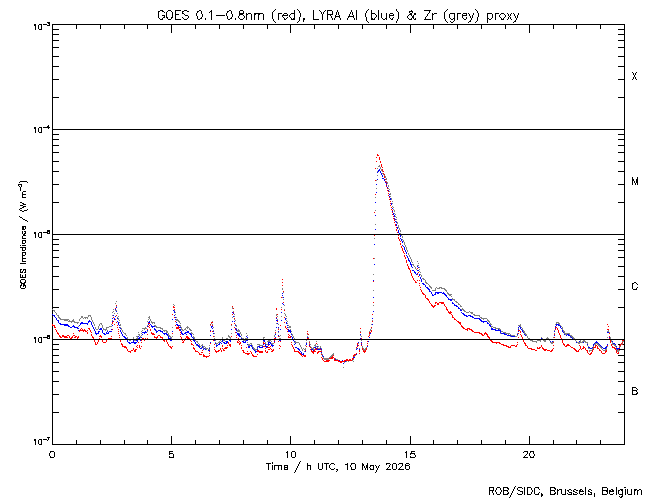
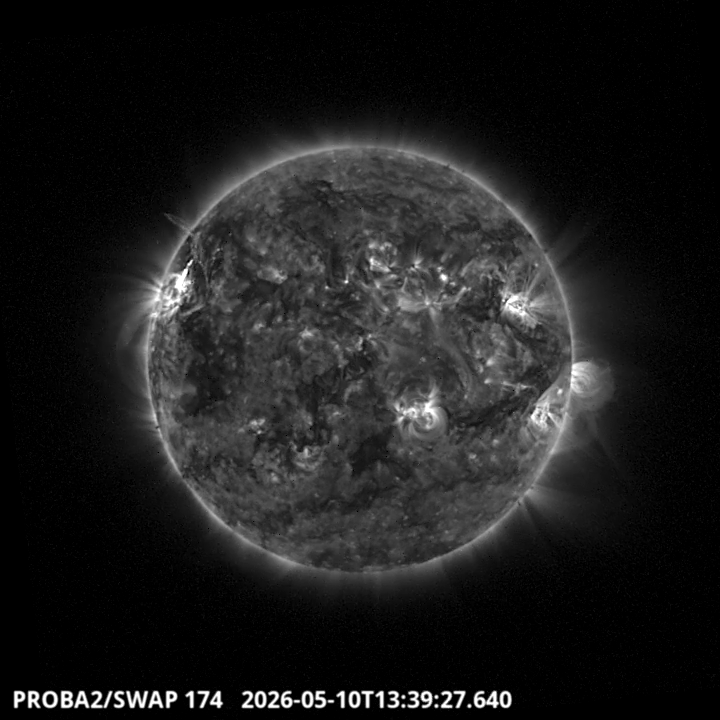
The largest flare of this week was an M5.7, and it was observed by LYRA (top panel) and SWAP (bottom panel). The flare peaked on 2026-May-10 at 13:39 UT and occurred in the north-eastern quadrant of the Sun, originating from active region NOAA4436 (SIDC 825).
Find a SWAP movie of the event here: https://proba2.sidc.be/swap/movies/20260510_swap_movie.mp4.
Noticeable Solar Events
| DAY | BEGIN | MAX | END | LOC | XRAY | OP | 10CM | TYPE | Cat | NOAA |
| 04 | 0113 | 0133 | 0144 | M1.8 | 89 | 4424 | ||||
| 07 | 1420 | 1514 | 1540 | M2.6 | ||||||
| 10 | 1319 | 1339 | 1402 | N19E62 | M5.7 | 2B | VI/2II/3 | 4436 |
| LOC: approximate heliographic location | TYPE: radio burst type |
| XRAY: X-ray flare class | Cat: Catania sunspot group number |
| OP: optical flare class | NOAA: NOAA active region number |
| 10CM: peak 10 cm radio flux |
Geomagnetic Observations in Belgium

Local K-type magnetic activity index for Belgium based on data from Dourbes (DOU) and Manhay (MAB). Comparing the data from both measurement stations allows to reliably remove outliers from the magnetic data. At the same time the operational service availability is improved: whenever data from one observatory is not available, the single-station index obtained from the other can be used as a fallback system.
Both the two-station index and the single station indices are available here: http://ionosphere.meteo.be/geomagnetism/K_BEL/
The SIDC Space Weather Briefing
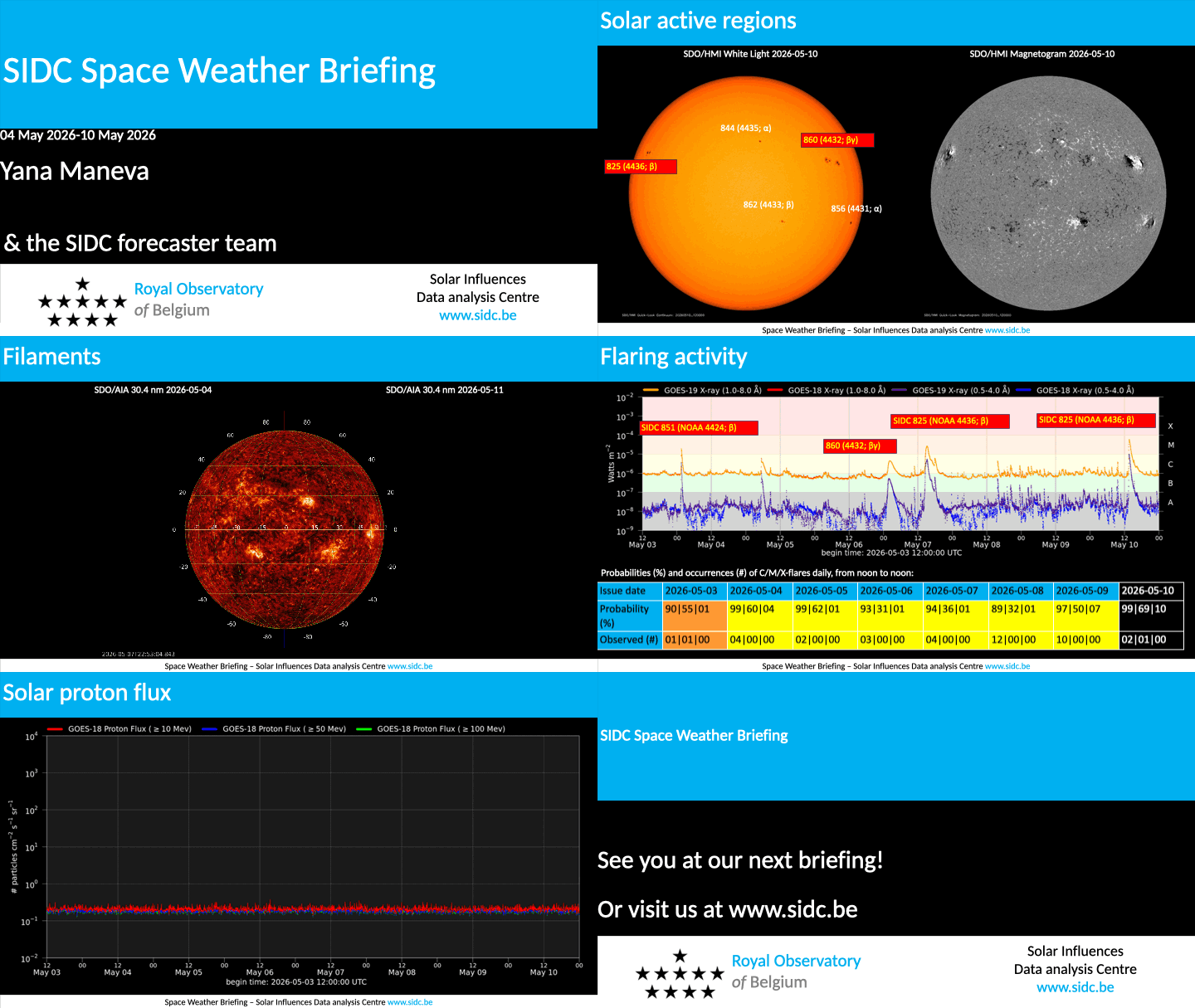
The forecaster on duty presented the SIDC briefing that gives an overview of space weather from May 4 to 10.
The pdf of the presentation: https://www.stce.be/briefings/20260511_SWbriefing.pdf
Upcoming Activities
Courses, seminars and events with the Sun-Space-Earth system and Space Weather as the main theme. We provide occasions to get submerged in our world through educational, informative and instructive activities.
* May 22-25, 2026, STCE show at Nerdland- In the eye of a solar storm (Dutch)
* Jun 15-17, 2026, STCE Space Weather Introductory Course, Brussels, Belgium - register: https://events.spacepole.be/event/256/ - Fully booked
* Oct 12-14, 2026, STCE Space Weather Introductory Course, Brussels, Belgium - register: https://events.spacepole.be/event/257/ - Reserved
* Oct 29- Nov 1, 2026, Prior to ESWW2026 - Space Weather Training Course in Firenze, Italy - Apply: https://events.spacepole.be/event/278/
* Nov 2-6, 2026, European Space Weather Week, Florence, Italy, https://esww2026.eswan.eu/
* Nov 23-25, 2026, STCE course: Role of the ionosphere and space weather in military communications, Brussels, Belgium - register: https://events.spacepole.be/event/259/
* Dec 7-9, 2026, STCE Space Weather Introductory Course for Aviation, Brussels, Belgium - register: https://events.spacepole.be/event/262/
To register for a course and check the seminar details, navigate to the STCE Space Weather Education Center: https://www.stce.be/SWEC
If you want your event in the STCE newsletter, contact us: stce_coordination at stce.be

Website: https://www.stce.be/SWEC