- Table of Content
- 1.The best of......
- 2.Spot the CSC!
- 3.Eclipse observ...
- 4.Review of Sola...
- 5.International ...
- 6.PROBA2 Observa...
- 7.Noticeable Sol...
- 8.Geomagnetic Ob...
- 9.The SIDC Space...
- 10.Upcoming Activ...
2. Spot the CSC!
3. Eclipse observations in Humain
4. Review of Solar and Geomagnetic Activity
5. International Sunspot Number by SILSO
6. PROBA2 Observations
7. Noticeable Solar Events
8. Geomagnetic Observations in Belgium
9. The SIDC Space Weather Briefing
10. Upcoming Activities
The best of... 2025!
A compilation of the most memorable space weather moments of 2025 can be found at the STCE's dedicated solar cycle highlights webpage: https://www.stce.be/highlights Using the versatile Space Weather JHelioviewer (SWHV : https://swhv.oma.be/user_manual/ ) software, a ***MOVIE*** was created containing one or more clips of each event. Usually, images from SDO, GOES, STEREO, and SOHO have been used, occasionally supplemented with imagery from Solar Orbiter, PROBA2, ROB/USET and the GONG/H-alpha network. The movie can be found on YouTube https://www.youtube.com/watch?v=7CQS-qRtLbs , whereas the page with the accompanying information is at https://www.stce.be/news/832/welcome.html
We wish you a happy viewing!

Spot the CSC!
ESA released a fun image taken by the Proba-3 mission. During routine operations to get the two spacecraft into formation from safe orbit, the Occulter Spacecraft took this stunning image of the Coronagraph Spacecraft (CSC) with the Earth in the background. Test your eyes and see if you can spot it!
https://www.esa.int/ESA_Multimedia/Images/2026/07/Earth_and_Proba-3_s_Coronagraph_play_hide_and_seek

Eclipse observations in Humain
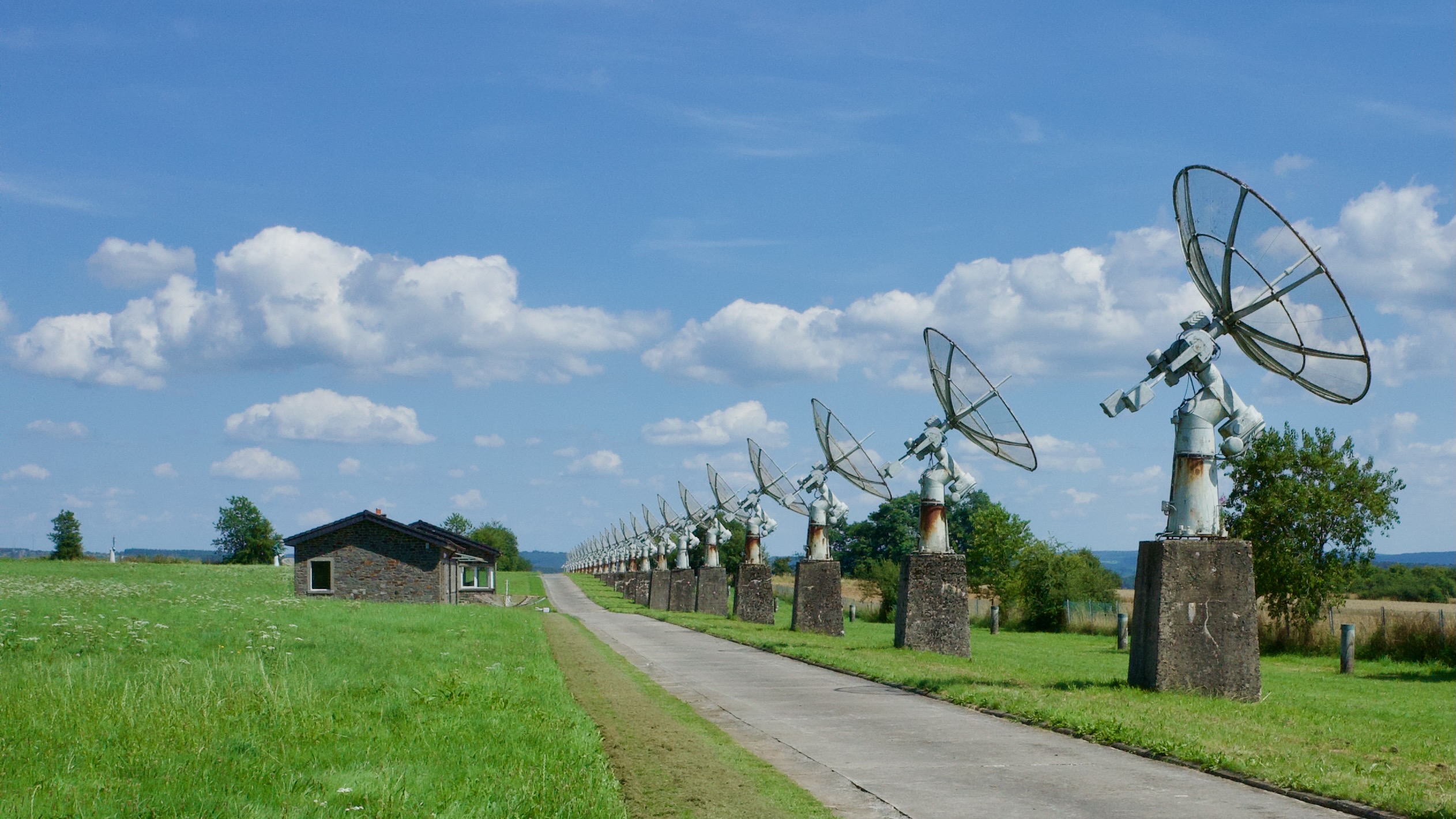
The STCE will gather at its radio astronomy station in Humain on August 12, 2026, to observe the solar eclipse.
What and when?
On Wednesday, August 12, a partial solar eclipse will be visible from Belgium. The Moon will cover nearly 90% of the Sun. While this is not a total solar eclipse, it will still be very impressive —especially when observed from an operational scientific research station.
The eclipse begins at 7:19 p.m. and reaches its peak at 8:14 p.m. At that moment, the sun will be low above the horizon. Because the eclipse occurs at sunset, it’s a challenge to find an observation site with an unobstructed view of the western horizon. In urban areas, buildings and trees often block the view. The site in Humain was specifically chosen in the 1950s to allow radio telescopes to track the Sun from sunrise to sunset. This makes it the perfect location to observe this solar eclipse.
Around 250 enthusiasts will gather at the site in Humain starting at 5 p.m. Scientists will explain this solar eclipse and solar eclipses in general, as well as how they observe them using various satellites. Visitors will also get a unique glimpse into how the radio telescopes and the control center operate. This is only the second time this facility has been opened to the public.
The highlight, of course, is the near-total solar eclipse, which the audience will observe through telescopes set up on site. Until 10:30 p.m., there will be time to enjoy the night sky above the darkened site. With a little luck, we may catch a glimpse of Venus or a shooting star (Perseids).
Why is a solar eclipse interesting from a scientific point of view? The birthplace of solar storms
During a total solar eclipse, we can admire the Sun’s atmosphere—a layer called the corona that extends from the Sun’s surface far into space—for a few minutes from Earth. The region close to the Sun’s surface is where the solar wind and plasma clouds are accelerated and solar flares originate. It is an area that has been little studied because it is difficult to observe.
Making Progress with Proba-3
Natural solar eclipses are rare and last only a few minutes, with a zone of totality that is sometimes difficult to reach and clouds that can obscure the Sun. That is why scientists have designed special telescopes capable of observing solar eclipses from space. We call these coronagraphs. Traditional coronagraphs have limitations: the region just above the Sun’s surface remains out of view.
That is why ESA designed Proba-3. This impressive dual-satellite system can capture long-duration solar eclipses on its own: 6 hours straight. A disc-shaped satellite flies in front of the Sun. The ASPIICS telescope on a second satellite then observes the solar atmosphere from within the shadow of the disk. Because of the large distance between the two satellites, this coronagraph is able to study the solar atmosphere close to the surface.
Thanks to observations of the solar eclipse on August 12 from Earth and via satellites, scientists can improve their models of the solar atmosphere. It is an excellent opportunity to refine our understanding of the solar wind.
Scientists will present an ASPIICS image from late July. Between July 30 and August 12, the Sun rotated 180 degrees. Since we know that the large-scale magnetic structures in the solar atmosphere will change very little during that short period, this image is the mirror image of what we expect to see on August 12.
As early as the morning of August 12, at 10:43 a.m., the Sun will be doubly eclipsed for ASPIICS: the Sun, the Moon, the disk-shaped satellite, and ASPIICS will all be aligned! The unique images this will produce will be shown in an ESA live stream.
Support from the EUI Space Instrument Aboard Solar Orbiter
The EUI (Extreme Ultraviolet Imager) instrument on the Solar Orbiter spacecraft will take close-ups of the lower solar atmosphere during the solar eclipse.
At the time of the solar eclipse, Solar Orbiter will be located east of the Sun in the sky, far away from Earth. Thus, while the EUI will not be flying in the Moon’s shadow, it will be able to capture detailed top-down observations of the solar atmosphere that we will be able to see from Earth.
Proba-2 Will Observe the Solar Eclipse Three Times
The Proba-2 satellite, on the other hand, orbits Earth so quickly that it will pass through the Moon’s shadow three times. The SWAP and LYRA instruments on board will therefore observe three partial solar eclipses, with a maximum eclipse of 68% for the SWAP telescope.
Looking forward
Due to the high level of enthusiasm, we were quickly forced to close registration to the public. We now eagerly await the observations from our telescopes and hope for a clear sky on the 12th.
Review of Solar and Geomagnetic Activity
WEEK 1335 from 2026 Jul 27
Solar Active Regions (ARs) and flares
The solar flaring activity was at low to moderate levels throughout the week, with 17 C-class flares and 2 M-class flares. There were 16 sunspot groups observed on the visible solar disk.
SIDC SG 886 (NOAA AR 4494) and 860 (NOAA AR 4492) produced M-class flares and together with 927 (NOAA AR 4498) and 929 (NOAA AR 4499) most of the C-class flares. The largest flare was an M1.9 flare (SIDC Flare 8298) peaking on July 30 at 17:00 UTC, which was produced by SIDC Sunspot Group 860, the second-largest flare was a M1.0 flare (SIDC Flare 8279) peaking on July 27 at 02:43 UTC produced by SIDC Sunspot Group 886.
Coronal mass ejections
One Halo Coronal Mass Ejection (CME) (SIDC CME 701) was observed during the week with an Earth directed component. This CME was observed LASCO-C2 data around 16:36 UTC on July 30, with an estimated speed of 1522 km/s. This CME is associated with a M1.9 flare (SIDC 8298). It arrived at Earth at 11:29 UTC on August 02. It was associated with a type II and type IV radio burst.
Coronal Holes
One positive polarity (SIDC CH 159) and one negative polarity (SIDC CH 142) coronal hole were present on the solar disk in the past week. SIDC Coronal Hole 159 (mid-latitude coronal hole with a positive polarity), which first reached the central meridian on July 27 crossed the central meridian for the duration of the week. No High-Speed Stream (HHS) associated with this Coronal Hole was seen in the solar wind data at Earth during the week.
Proton flux levels
The greater than 10 MeV proton flux crossed above the 10 pfu threshold at 18:30 UTC on July 30 and then gradually trended downward until returning to background levels by the end of the week.
The 50 MeV proton flux and 100 MeV proton flux also became elevated but stayed below the 10 pfu threshold. This proton event is associated with SIDC CME 701.
Electron fluxes at GEO
The greater than 2 MeV electron flux, as measured by GOES-18 and GOES-19 fluctuated around the 1000 pfu threshold from the start of the week until August 02 after which it stayed below the threshold for the rest of the period.
The 24-hour electron fluence was at moderate levels at the start of the week until April 25 and then stayed at normal level until the end of the week.
Solar wind
At the beginning of the week, the Earth was under the waning influence of a high-speed stream associated with SIDC Coronal Hole 142 before going to slow solar wind conditions. The Earth came under the influence of an ICME at 15:30 UTC on July 27 from a CME that left the Sun on July 24 (CME SIDC 699) and again came under the influence of an ICME at 11:29 UTC on August 02 from a CME that left the sun on July 30 (SIDC CME 701).
The solar wind speed ranged from 240 km/s to 441 km/s and the total interplanetary magnetic field ranged from 1 nT to 21 nT, with the Bz reaching a minimum of -17 nT. The phi-angle was in the negative sector at the start of the week until July 29 when it switched to the positive sector for the rest of the week.
Geomagnetism
At the start of the week the geomagnetic conditions were quite unsettled until August 02 when they reached moderate storm conditions globally (Kp 6-) and minor storm conditions locally (K BEL 5).
International Sunspot Number by SILSO

The daily Estimated International Sunspot Number (EISN, red curve with shaded error) derived by a simplified method from real-time data from the worldwide SILSO network. It extends the official Sunspot Number from the full processing of the preceding month (green line), a few days more than one solar rotation. The horizontal blue line shows the current monthly average. The yellow dots give the number of stations that provided valid data. Valid data are used to calculate the EISN. The triangle gives the number of stations providing data. When a triangle and a yellow dot coincide, it means that all the data is used to calculate the EISN of that day.
PROBA2 Observations
Solar Activity
Solar flare activity fluctuated from low to moderate during the week.
In order to view the activity of this week in more detail, we suggest to go to the following website from which all the daily (normal and difference) movies can be accessed: https://proba2.oma.be/ssa
This page also lists the recorded flaring events.
A weekly overview movie (SWAP week 853) can be found here: https://proba2.sidc.be/swap/data/mpg/movies/weekly_movies/weekly_movie_2026_07_27.mp4.
Details about some of this week's events can be found further below.
If any of the linked movies are unavailable they can be found in the P2SC movie repository here: https://proba2.oma.be/swap/data/mpg/movies/.
Thursday July 30


The largest flare of this week was a long M1.9, and it was observed by LYRA (top panel) and SWAP (bottom panel). The flare peaked on 2026-Jul-30 at 17:00 UT and occurred in the north-eastern quadrant of the Sun, originating from active region NOAA4500 (SIDC 931).
Find a SWAP movie of the event here: https://proba2.sidc.be/swap/movies/20260730_swap_movie.mp4.
Noticeable Solar Events
| DAY | BEGIN | MAX | END | LOC | XRAY | OP | 10CM | TYPE | Cat | NOAA |
| 27 | 0232 | 0243 | 0248 | S4W4 | M1.0 | SF | II/2I/2 6 | 87 | 4494 | |
| 30 | 1553 | 1700 | 2151 | N20E50 | M1.9 | SF | V/2I/2 1II/2 | 1 | 4500 |
| LOC: approximate heliographic location | TYPE: radio burst type |
| XRAY: X-ray flare class | Cat: Catania sunspot group number |
| OP: optical flare class | NOAA: NOAA active region number |
| 10CM: peak 10 cm radio flux |
Geomagnetic Observations in Belgium

Local K-type magnetic activity index for Belgium based on data from Dourbes (DOU) and Manhay (MAB). Comparing the data from both measurement stations allows to reliably remove outliers from the magnetic data. At the same time the operational service availability is improved: whenever data from one observatory is not available, the single-station index obtained from the other can be used as a fallback system.
Both the two-station index and the single station indices are available here: http://ionosphere.meteo.be/geomagnetism/K_BEL/
The SIDC Space Weather Briefing
The forecaster on duty presented the SIDC briefing that gives an overview of space weather from July 27 to August 2.
The pdf of the presentation: https://www.stce.be/briefings/20260803_SWbriefing.pdf

Upcoming Activities
Courses, seminars and events with the Sun-Space-Earth system and Space Weather as the main theme. We provide occasions to get submerged in our world through educational, informative and instructive activities.
* Aug 12, 2026, Solar eclipse and night sky viewing, Humain Radioastronomy Station, Belgium - https://200year.observatory.be - register:https://events.spacepole.be/event/294/
* Oct 12-14, 2026, STCE Space Weather Introductory Course, Brussels, Belgium - register: https://events.spacepole.be/event/257/ - Fully booked
* Oct 15, 2026, Post Space Weather Introductory Course, Brussels, Belgium - register: https://events.spacepole.be/event/286/
* Oct 29- Nov 1, 2026, Prior to ESWW2026 - Space Weather Training Course in Firenze, Italy - Applications closed
* Nov 2-6, 2026, European Space Weather Week, Florence, Italy, https://esww2026.eswan.eu/
* Nov 23-25, 2026, STCE course: Role of the ionosphere and space weather in military communications, Brussels, Belgium - register: https://events.spacepole.be/event/259/
* Dec 7-9, 2026, STCE Space Weather Introductory Course for Aviation, Brussels, Belgium - register: https://events.spacepole.be/event/262/
To register for a course and check the seminar details, navigate to the STCE Space Weather Education Center: https://www.stce.be/SWEC
If you want your event in the STCE newsletter, contact us: stce_coordination at stce.be

Website: https://www.stce.be/SWEC