- Table of Content
- 1.Space Pole Ope...
- 2.Review of Sola...
- 3.International ...
- 4.PROBA2 Observa...
- 5.Geomagnetic Ob...
- 6.The SIDC Space...
- 7.Upcoming Activ...
2. Review of Solar and Geomagnetic Activity
3. International Sunspot Number by SILSO
4. PROBA2 Observations
5. Geomagnetic Observations in Belgium
6. The SIDC Space Weather Briefing
7. Upcoming Activities
Space Pole Open Door Days
What goes on inside the walls of the Space Pole institutes in Uccle?
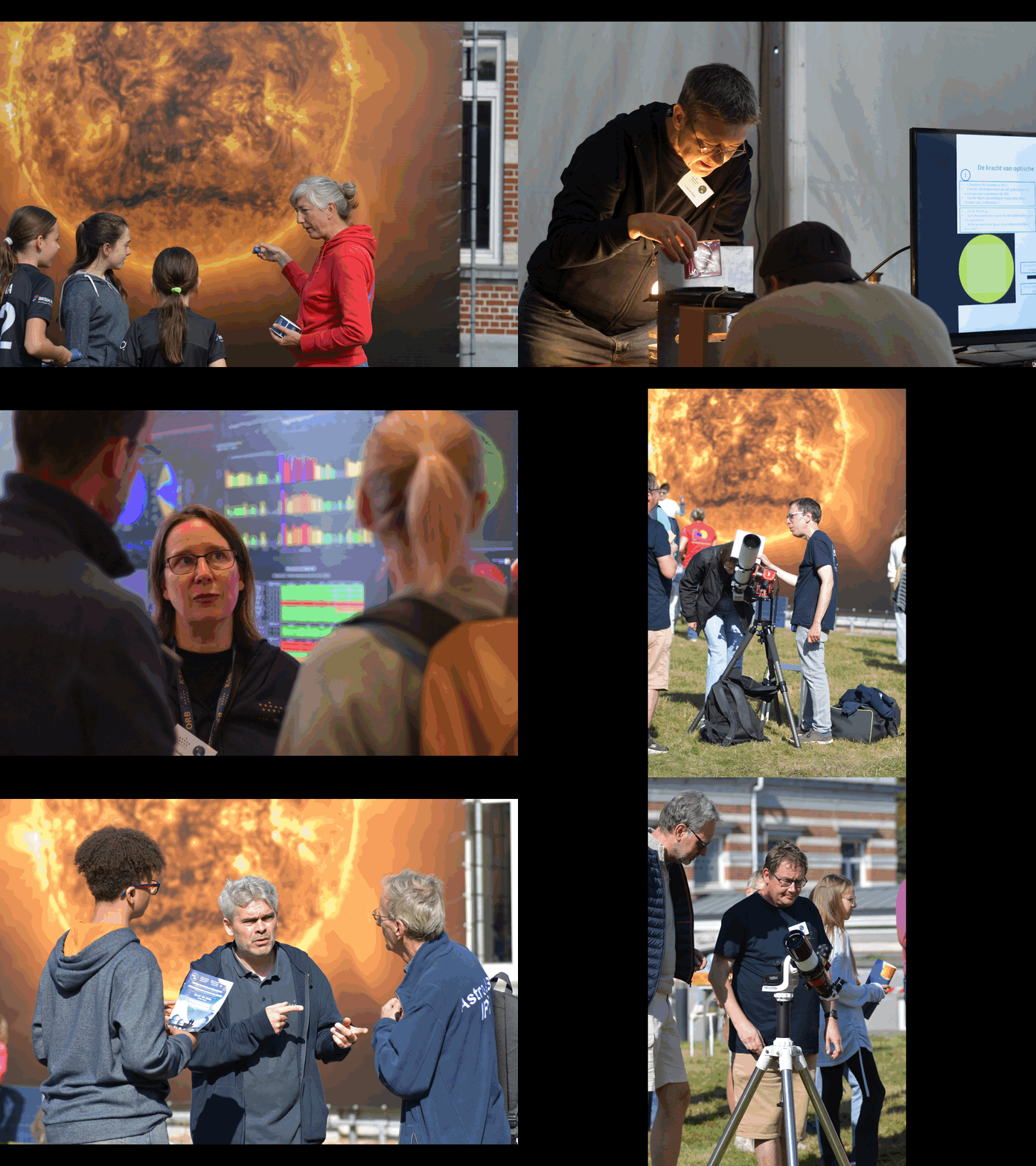
On 26 and 27 September, we opened our doors tot the public, and almost 9000 visitors came by to find out and help us celebrate the 20th anniversary of the STCE and the 200th anniversary of the Royal Observatory of Belgium!
The public could explore mock-ups, instruments, experiments, observations, dome movies, and interactive games, but above all, scientists, engineers and other staff were present to introduce the visitors to their work, their projects and their passion for science and space. For the public it was a rare opportunity to ask them your questions and to see science in a different light.
Some impressions:
Review of Solar and Geomagnetic Activity
Solar Active Regions (ARs) and flares
The solar flaring activity was at very low to low levels throughout the week, with 19 C-class flares. There were 12 sunspot groups observed on the visible solar disk. SIDC 962 (NOAA 4535), SIDC 966 (NOAA 4536) and SIDC 964 (NOAA 4534) produced most of the C-class flares.
The largest flare was a C3.7 flare (SIDC Flare 8588) peaking on September 20 at 22:34 UTC, which was produced by SIDC Sunspot Group 964.
Coronal mass ejections
No earth directed Coronal mass ejection (CMEs) were observed throughout the week.
Coronal Holes
Two positive polarity (SIDC CH 159 and 179), and one negative polarity (SIDC CH 181) coronal hole were present on the solar disk in the past week. SIDC Coronal Hole 159 started crossing the central meridian on September 19 and SIDC Coronal Hole 181 started crossing the central meridian on September 22.
A High-Speed Stream (HHS) associated with SIDC Coronal Hole 159 was seen in the solar wind data at Earth during the week.
Proton flux levels
The greater than 10 MeV proton flux was at background levels throughout the week.
Electron fluxes at GEO
The greater than 2 MeV electron flux, as measured by GOES-18 and GOES-19 rose and started fluctuating around the 1000 pfu threshold from September 26 onward until the end of the week.
The 24-hour electron fluence was at normal levels at the start of the week until September 26 and then stayed at normal level until the end of the week.
Solar wind
At the beginning of the week, the Earth was under slow solar wind conditions. The Earth came under the influence of a HSS associated with SIDC Coronal Hole 159 on September 23.
The solar wind speed ranged from 274 km/s to 557 km/s and the total interplanetary magnetic field ranged from 2 nT to 15 nT, with the Bz reaching a minimum of -13 nT. The phi-angle was in the negative sector at the start of the week until September 23 when it switched to the positive sector for the rest of the week.
Geomagnetism
At the start of the week the geomagnetic conditions were quite unsettled until September 24 when they reached active conditions globally and locally (Kp 4 and K BEL 4).
International Sunspot Number by SILSO
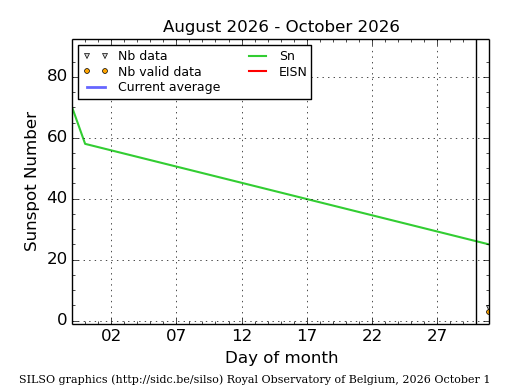
The daily Estimated International Sunspot Number (EISN, red curve with shaded error) derived by a simplified method from real-time data from the worldwide SILSO network. It extends the official Sunspot Number from the full processing of the preceding month (green line), a few days more than one solar rotation. The horizontal blue line shows the current monthly average. The yellow dots give the number of stations that provided valid data. Valid data are used to calculate the EISN. The triangle gives the number of stations providing data. When a triangle and a yellow dot coincide, it means that all the data is used to calculate the EISN of that day.
PROBA2 Observations
Solar flare activity remained low during the whole week.
In order to view the activity of this week in more detail, we suggest to go to the following website from which all the daily (normal and difference) movies can be accessed: https://proba2.oma.be/ssa
This page also lists the recorded flaring events.
A weekly overview movie can be found at https://proba2.sidc.be/swap/data/mpg/movies/weekly_movies/weekly_movie_2026_09_21.mp4.
Saturday September 26
Details about this week's strongest event can be found further below.
If any of the linked movies are unavailable they can be found in the P2SC movie repository here: https://proba2.oma.be/swap/data/mpg/movies/.
The largest event of this week was a C3.1 flare peaking on September 26 at 16:55, that was observed by LYRA.
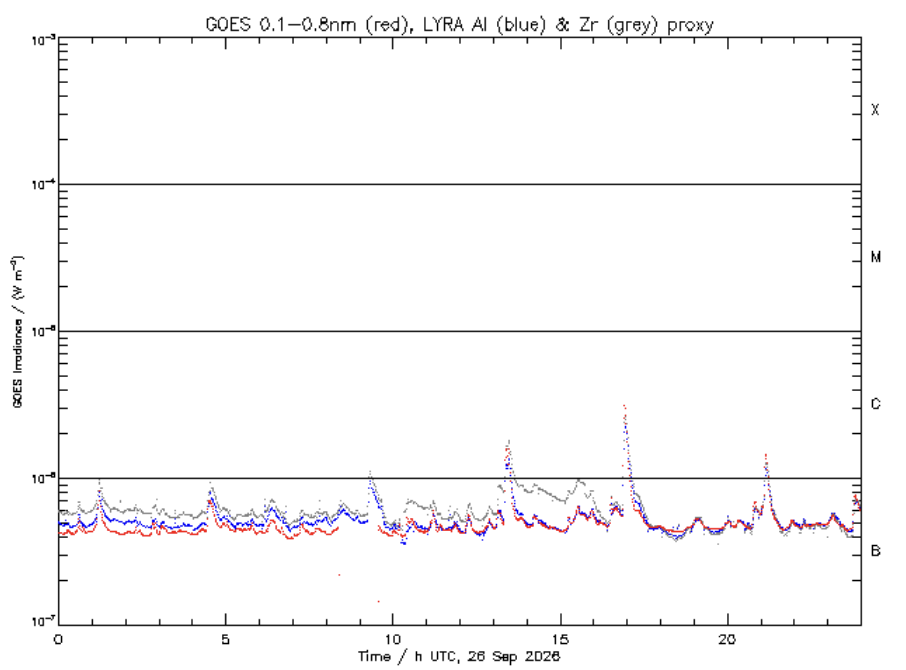
The flare probably originated from active region NOAA3534 located on the west limb and was immediately followed by the eruption of a faint twisted flux rope observed by SWAP (see the running difference image below) around 18:50.
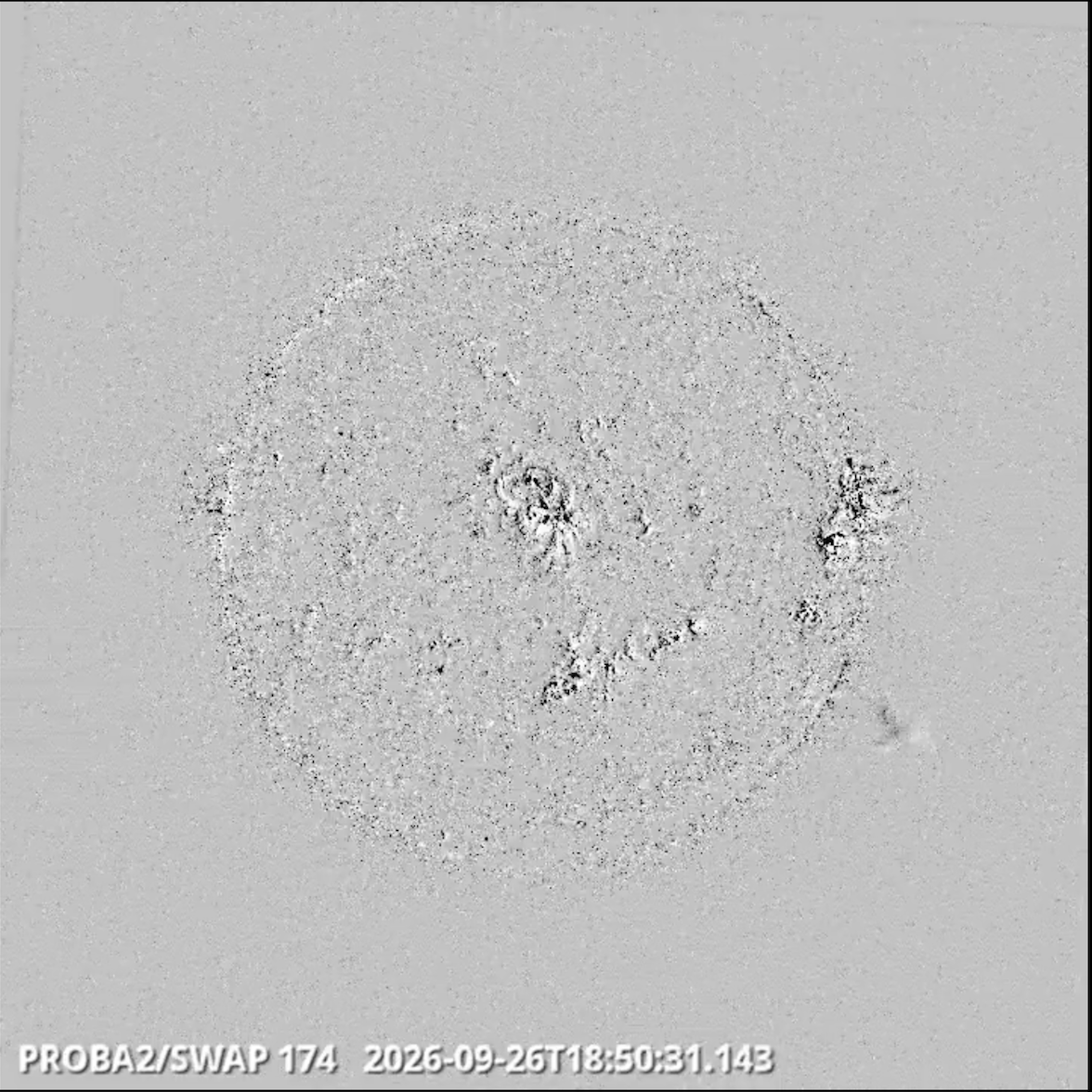
Find a SWAP movie of the event here: https://proba2.sidc.be/swap/movies/20260926_swap_diff.mp4.
Geomagnetic Observations in Belgium
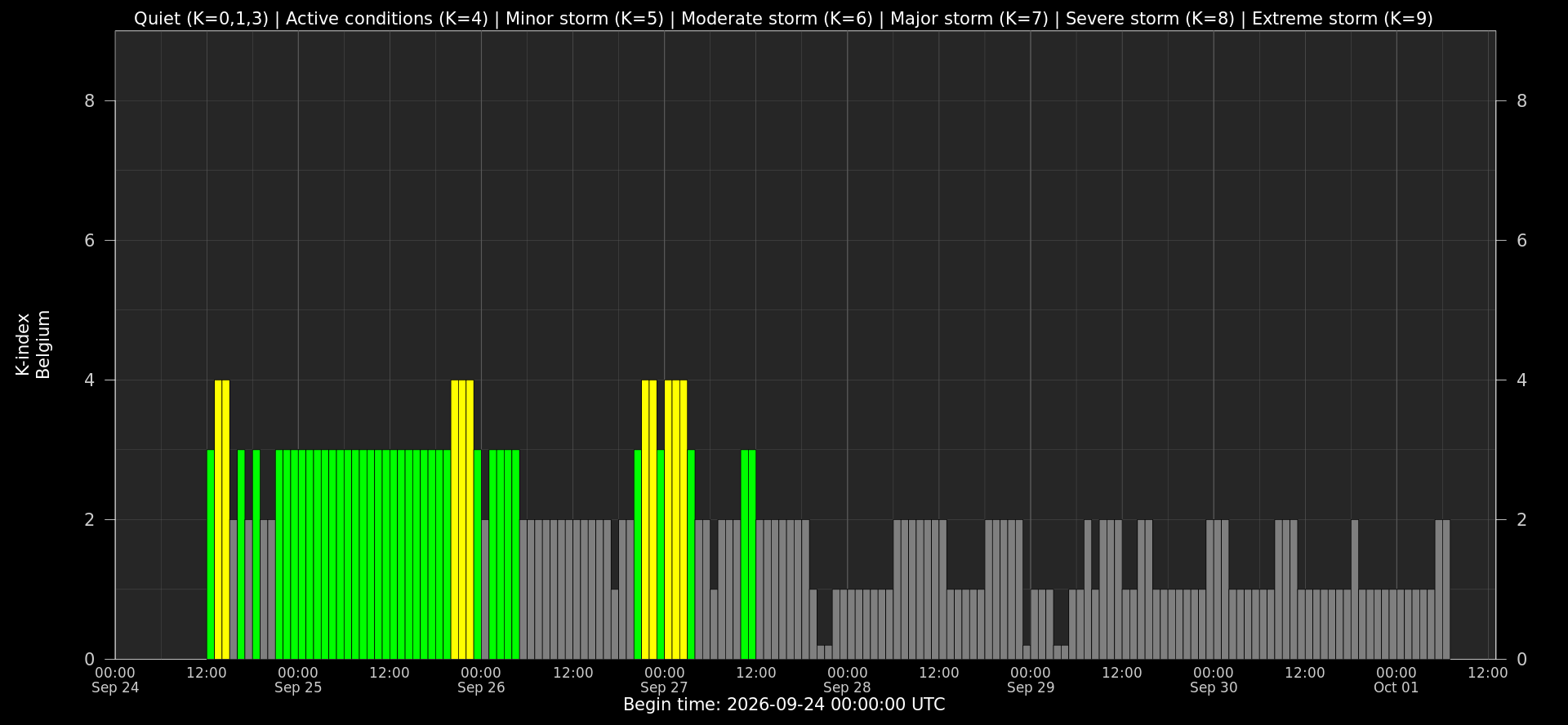
Local K-type magnetic activity index for Belgium based on data from Dourbes (DOU) and Manhay (MAB). Comparing the data from both measurement stations allows to reliably remove outliers from the magnetic data. At the same time the operational service availability is improved: whenever data from one observatory is not available, the single-station index obtained from the other can be used as a fallback system.
Both the two-station index and the single station indices are available here: http://ionosphere.meteo.be/geomagnetism/K_BEL/
The SIDC Space Weather Briefing
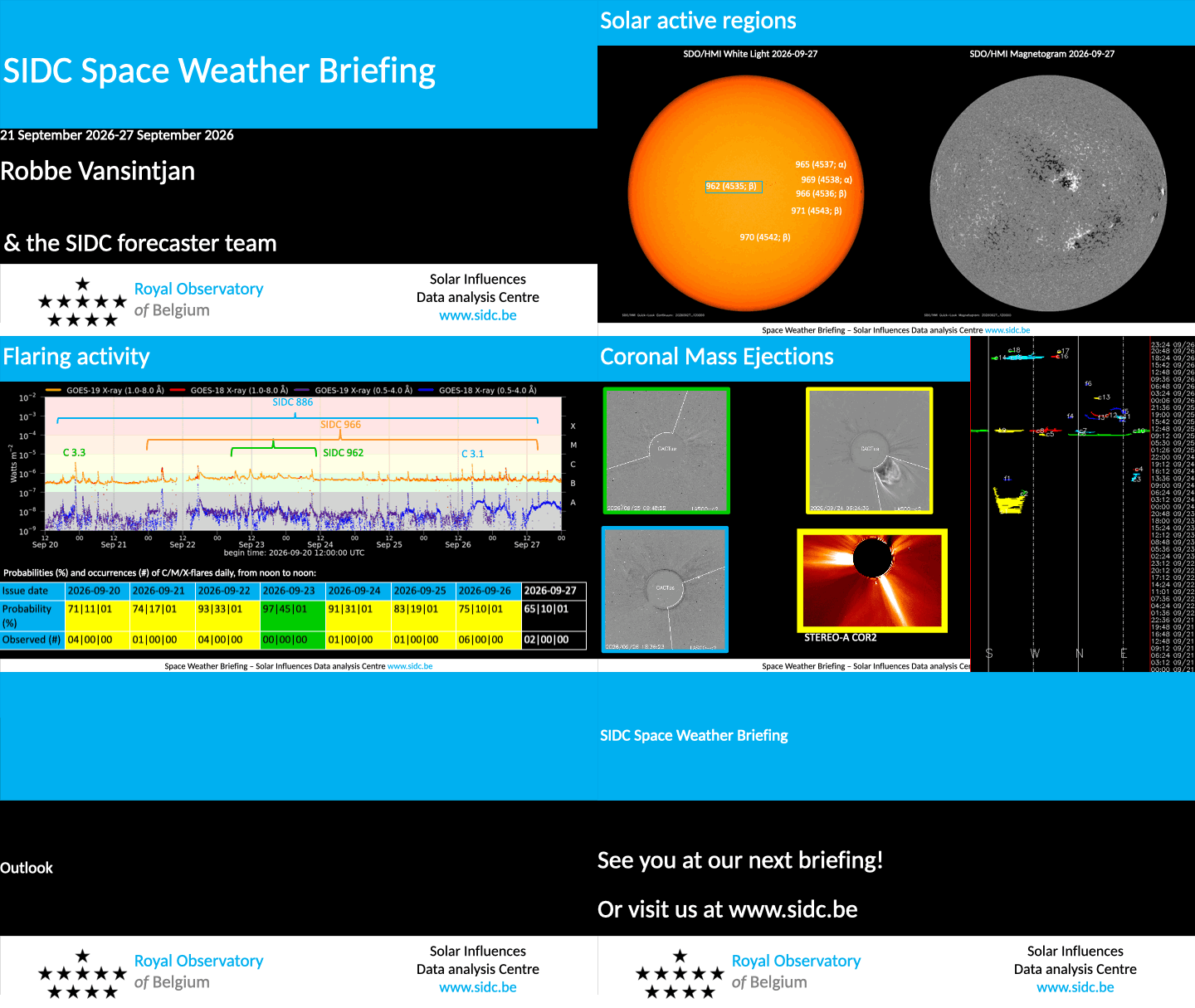
The forecaster on duty presented the SIDC briefing that gives an overview of space weather from September 21 to 27.
The pdf of the presentation: https://www.stce.be/briefings/20260928_SWbriefing.pdf
Upcoming Activities
Courses, seminars and events with the Sun-Space-Earth system and Space Weather as the main theme. We provide occasions to get submerged in our world through educational, informative and instructive activities.
* Oct 12-14, 2026, STCE Space Weather Introductory Course, Brussels, Belgium - register: https://events.spacepole.be/event/257/ - Fully booked
* Oct 15, 2026, Post Space Weather Introductory Course, Brussels, Belgium - register: https://events.spacepole.be/event/286/
* Oct 16, 2026, Watching the Sun: a 200-year journey, guided tour Solar Physics, Ukkel, Belgium - register https://events.spacepole.be/category/2/
* Oct 29 - Nov 1, 2026, Prior to ESWW2026 - Space Weather Training Course in Firenze, Italy - Applications closed
* Nov 2-6, 2026, European Space Weather Week, Florence, Italy, https://esww2026.eswan.eu/
* Nov 13, 2026, Watching the Sun: a 200-year journey, guided tour Solar Physics, Ukkel, Belgium - register https://events.spacepole.be/category/2/
* Nov 23-25, 2026, STCE course: Role of the ionosphere and space weather in military communications, Brussels, Belgium - register: https://events.spacepole.be/event/259/
* Nov 30, 2026, Watching the Sun: a 200-year journey, guided tour Solar Physics, Ukkel, Belgium - register https://events.spacepole.be/category/2/
* Dec 7-9, 2026, STCE Space Weather Introductory Course for Aviation, Brussels, Belgium - register: https://events.spacepole.be/event/262/ - Fully booked
To register for a course and check the seminar details, navigate to the STCE Space Weather Education Center: https://www.stce.be/SWEC
If you want your event in the STCE newsletter, contact us: stce_coordination at stce.be
Website: https://www.stce.be/SWEC