- Table of Content
- 1.Large and larg...
- 2.Solar Eclipse ...
- 3.Review of Sola...
- 4.International ...
- 5.PROBA2 Observa...
- 6.Noticeable Sol...
- 7.Geomagnetic Ob...
- 8.SIDC Space Wea...
- 9.Upcoming Activ...
2. Solar Eclipse viewing in Humain
3. Review of Solar and Geomagnetic Activity
4. International Sunspot Number by SILSO
5. PROBA2 Observations
6. Noticeable Solar Events
7. Geomagnetic Observations in Belgium
8. SIDC Space Weather Briefing
9. Upcoming Activities
Large and larger
Last week, 2 big sunspot groups dominated the outlook of the solar disk. The largest one was NOAA 4478 (SIDC sunspot group 886 https://www.sidc.be/services/event-chains/sunspots ) which was located in the southern solar hemisphere, whereas the somewhat smaller NOAA 4479 (SIDC sunspot group 860) was located in the northern solar hemisphere. Both were new groups that started their life resp. on the Sun's farside (STCE newsitem - https://www.stce.be/news/823/welcome.html ) and on the Earth facing solar hemisphere. Using eclipse glasses, they were easily visible with the naked eye for a few days when they were close to the central meridian. According to the NOAA statistics, NOAA 4478 reached an area of about 9 times the surface area of the Earth. That's not as large as the big sunspot group of May 2024, but it is -in size- the best of the rest as far as sunspot groups of this solar cycle is concerned. NOAA 4479 had only about half the sunspot area of NOAA 4478. The SDO/HMI images underneath show the development of NOAA 4479 and the decay of NOAA 4478's trailing portion on 28 and 30 June and on 2 July.

In terms of flare activity, it was NOAA 4479 that had the upper hand. Over the last week, it produced 36 of the 48 M- and X-class flares (unassigned not included). That is much more than any of the other groups (see the pie-diagram underneath). In fact, this number is so high that NOAA 4479 is already in the Top 30 of sunspot groups that produced most of such events during the entire GOES era, i.e. during the last half century (STCE newsitem - https://www.stce.be/news/805/welcome.html ). Also remarkable is that the region produced more than half of its M-class flares on just 2 days (4-5 July). The strongest flare (X1.1 - https://www.stce.be/news/825/welcome.html ) was produced on 30 June while the region was still developing.

Quite a few of these flares were associated with a coronal mass ejection (CME), some of which had an earth-directed component. The arrival of a few of these CMEs eventually resulted in a strong (Kp = 7 ; Potsdam: https://kp.gfz.de/en/ ) geomagnetic storm on 4 July. In Belgium, the local K_BEL index (http://ionosphere.meteo.be/geomagnetism/K_BEL/index.php ) reached only moderate levels (K_BEL = 6 ; see diagram underneath). This was too weak for any polar lights to be visible from Belgium, in particular because the most intense portion of the geomagnetic storm took place during the morning and noon hours on 4 July. In the United States, aurora were seen and photographed as far south as Colorado and California (https://www.spaceweather.com/ ).

Solar Eclipse viewing in Humain
On Wednesday August 12, 2026, a solar eclipse will be visible throughout a large part of Europe. For viewers in Belgium, almost 90% of the solar surface will be covered by the Moon. The eclipse will thus not be total here, but still very impressive!
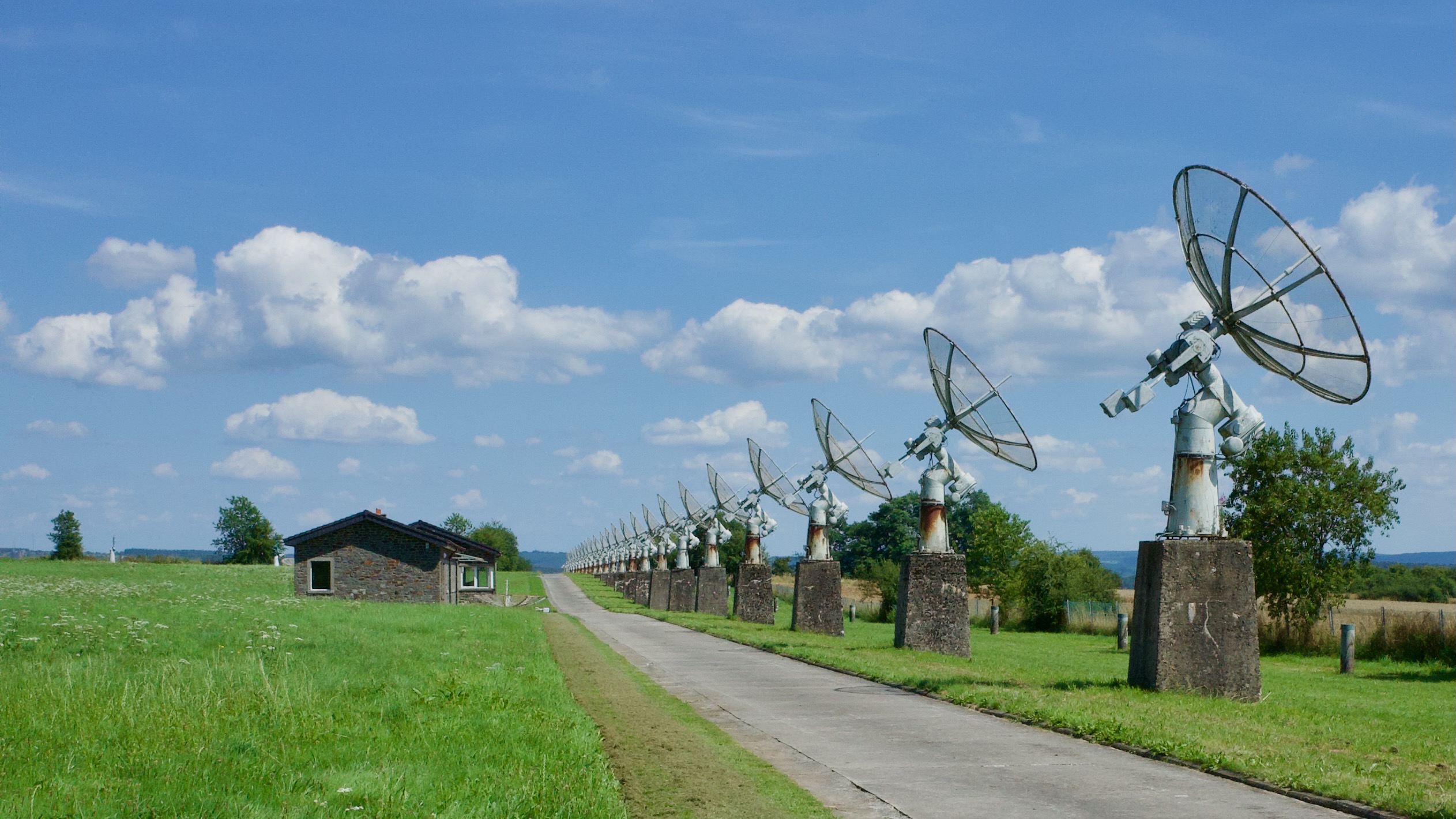
This eclipse will reach its maximum just before sunset, which is why the Royal Observatory of Belgium has decided to open its Radioastronomy station in Humain (Marche-en-Famenne) for this occasion. At this location, visitors will have a clear view of the horizon, and will be able to enjoy the eclipse fully (weather permitting).
Come early and grab the opportunity to also visit de radioastronomy station before the eclipse. This is a site that very rarely opens to the public, which makes this a unique opportunity to learn more about the solar observations we make there.
We finish the evening by setting up telescope for night time observations. Maybe you can catch a glimpse of the planet Venus!
When?
On August 12, 2026. We open the site from 17h onwards. The eclipse will start at 19:19 and reach its maximum at 20:14 (local time).
The site will close to the public at 22h30.
Where?
Address: Rue de l'Observatoire, 6900 Marche-en-Famenne, Belgium
As the site is scarcely lit at night, please bring a small torch.
Register:
For organizational reasons, the number of participants for this event is limited. Reservation is mandatory, but free of charge. Booking is done through the registration form at the bottom of the following page: https://events.spacepole.be/event/294/. Each visitor needs to be registered separately.
Important note: as we are strongly dependent on the weather, this event may be cancelled at short notice. Please provide a valid e-mail address while registering so that we may warn you in case of cancellation.
Review of Solar and Geomagnetic Activity
WEEK 1331 from 2026 Jun 29
Solar Active Regions (ARs) and flares
Solar flaring activity was high over the week, with 2 X-class flares and more than 40 M-class flares identified. The strongest flares were an X1.1 flare (SIDC Flare 8067), peaking on June 30 at 20:50 UTC, and an X1.3 flare (SIDC Flare 8130), peaking on July 04 at 20:41 UTC. Both were produced by SIDC Sunspot Group 860 (NOAA Active Region 4479). This region was the dominant source of flaring activity during the week and produced most of the M-class flares, while maintaining a complex beta-gamma-delta magnetic configuration as it crossed the disk and approached the west limb. SIDC Sunspot Group 886 (NOAA Active Region 4478) was also complex and active, producing several M-class flares, including an M8.5 flare on July 01 and an M6.3 flare on July 03. SIDC Sunspot Group 899 (NOAA Active Region 4475) produced an M5.8 flare on June 30 before rotating towards the west limb. SIDC Sunspot Group 901 (NOAA Active Region 4480) also contributed to M-class flaring activity before rotating over the west limb. By the end of the period, SIDC Sunspot Groups 907, 908, 909, and 910 had newly emerged on the visible disk, with SIDC Sunspot Group 910 (NOAA Active Region 4482) rotating onto the east limb.
Coronal mass ejections
Several Coronal Mass Ejections (CMEs) were observed during the week. SIDC CME 679 was a wide halo CME associated with the X1.1 flare (SIDC Flare 8067) from SIDC Sunspot Group 860 (NOAA Active Region 4479) on June 30. It had a plane-of-sky speed of about 750 km/s and an estimated true speed of about 1000 km/s, and produced a solar wind shock near Earth on July 03 at 11:20 UTC. Three successive Earth-directed CMEs, SIDC CME 680, SIDC CME 681, and SIDC CME 682, were observed on July 01 and July 02 from SIDC Sunspot Group 860 (NOAA Active Region 4479). They were associated with the M1.3, M3.5, and M4.2 flares, respectively, and were expected to arrive around July 05 at 12:00 UTC, with an uncertainty of about 12 hours. SIDC CME 683 was associated with the M6.7 flare (SIDC Flare 8104) from SIDC Sunspot Group 860 on July 03 and had an estimated true speed of about 850 km/s. Its arrival is expected around July 07 at 18:00 UTC, with an uncertainty of about 12 hours. A further CME associated with the X1.3 flare (SIDC Flare 8130) on July 04 became visible in GOES/CCOR-1 from around 22:30 UTC, during SOHO/LASCO and STEREO data gaps.
Coronal Holes
SIDC Coronal Hole 159, a recurrent positive polarity coronal hole associated with an extension of the southern polar coronal hole, crossed the central meridian around June 30. Its extension reached southern mid-latitudes, but the probability of a clear high-speed stream arrival at Earth was considered low due to its southern location. Later in the period, SIDC Coronal Hole 170, an equatorial coronal hole with negative magnetic polarity, emerged on the eastern side of the visible solar disk.
Proton flux levels
The greater than 10 MeV proton flux remained below the 10 pfu threshold throughout the week. A slight enhancement was observed near the end of the period following an M-class flare, but no proton event occurred.
Electron fluxes at GEO
The greater than 2 MeV electron flux was at moderate levels at the beginning of the week and was briefly above the 1000 pfu threshold early in the period. It decreased below the threshold around June 30 at 18:00 UTC and remained below the threshold afterwards. The 24-hour electron fluence was at moderate levels at the beginning of the period and then returned to normal levels. By the end of the week, the greater than 2 MeV electron flux was at normal levels and the 24-hour electron fluence remained below the alert threshold.
Solar wind
Solar wind conditions were initially in a slow solar wind regime, with speeds decreasing from about 450 km/s to about 370 km/s and a weak interplanetary magnetic field. Around June 30 at 11:00 UTC, a shock-like enhancement was observed, with the solar wind speed increasing from about 330 km/s to about 430 km/s and the total interplanetary magnetic field increasing from about 4 nT to 12 nT. This disturbance was possibly associated with the arrival of an ICME related to SIDC CME 678. Solar wind conditions then remained slightly disturbed until July 03, when a clear solar wind shock was observed near Earth at 11:20 UTC. This shock was associated with the arrival of the interplanetary structure related to SIDC CME 679. The solar wind speed later increased to 550-640 km/s, the total interplanetary magnetic field reached about 24.5 nT, and Bz turned strongly southward, reaching about -19 nT early on July 04. Solar wind conditions remained disturbed on July 05, with the magnetic field gradually decreasing and Bz rotating northward.
Geomagnetism
Geomagnetic conditions were mostly quiet to unsettled at the beginning of the week. Unsettled to active intervals followed the shock-like solar wind enhancement on June 30. The strongest geomagnetic response occurred on July 04, following the arrival and passage of the interplanetary structure associated with SIDC CME 679. NOAA Kp reached 7 during the 03:00 to 06:00 UTC interval on July 04, corresponding to major storm conditions. Locally, K BEL reached 6 during the 05:00 to 07:00 UTC interval, corresponding to moderate storm conditions. The storm was mainly driven by the prolonged southward Bz interval within the enhanced interplanetary magnetic field. Geomagnetic activity decreased afterwards.
International Sunspot Number by SILSO

The daily Estimated International Sunspot Number (EISN, red curve with shaded error) derived by a simplified method from real-time data from the worldwide SILSO network. It extends the official Sunspot Number from the full processing of the preceding month (green line), a few days more than one solar rotation. The horizontal blue line shows the current monthly average. The yellow dots give the number of stations that provided valid data. Valid data are used to calculate the EISN. The triangle gives the number of stations providing data. When a triangle and a yellow dot coincide, it means that all the data is used to calculate the EISN of that day.
PROBA2 Observations
Solar Activity
Solar flare activity fluctuated from moderate to high during the week.
In order to view the activity of this week in more detail, we suggest to go to the following website from which all the daily (normal and difference) movies can be accessed: https://proba2.oma.be/ssa
This page also lists the recorded flaring events.
A weekly overview movie (SWAP week 849) can be found here: https://proba2.sidc.be/swap/data/mpg/movies/weekly_movies/weekly_movie_2026_06_29.mp4.
Details about some of this week's events can be found further below.
If any of the linked movies are unavailable they can be found in the P2SC movie repository here: https://proba2.oma.be/swap/data/mpg/movies/.
Tuesday June 30


The largest flare of this week was an X1.3 on 2026-Jul-04 from active region NOAA4482 (SIDC SSG 860) at the eastern limb, but probably due to the high solar activity, SWAP and LYRA data were corrupted at that time. The second largest flare was an X1.1 earlier in the week, and it was observed by LYRA (top panel) and SWAP (bottom panel). The flare peaked on 2026-Jun-30 at 20:50 UT and occurred in the north-western quadrant of the Sun, originating from active region NOAA4479 (SIDC SSG 860).
Find a SWAP movie of the event here: https://proba2.sidc.be/swap/movies/20260630_swap_movie.mp4.
Noticeable Solar Events
| DAY | BEGIN | MAX | END | LOC | XRAY | OP | 10CM | TYPE | Cat | NOAA |
| 29 | 2113 | 2140 | 2152 | M1.4 | 62 | 4479 | ||||
| 30 | 0039 | 0116 | 0136 | M1.3 | 58 | 4475 | ||||
| 30 | 1237 | 1257 | 1323 | S8W54 | M5.8 | 3 | 58 | 4475 | ||
| 30 | 2034 | 2050 | 2100 | N14W19 | X1.1 | 2B | II/3IV/3 | 62 | 4479 | |
| 01 | 0619 | 0627 | 0630 | N17W21 | M1.1 | SF | 62 | 4479 | ||
| 01 | 0637 | 0643 | 0647 | N19W24 | M1.0 | 1 | 62 | 4479 | ||
| 01 | 0728 | 0735 | 0738 | N17W21 | M1.5 | SN | 62 | 4479 | ||
| 01 | 0807 | 0817 | 0820 | N17W21 | M2.5 | SB | 62 | 4479 | ||
| 01 | 1004 | 1008 | 1011 | N19W24 | M1.3 | 1 | VI/1 | 62 | 4479 | |
| 01 | 1422 | 1431 | 1436 | M1.1 | 62 | 4479 | ||||
| 01 | 1439 | 1454 | 1512 | N15W27 | M2.6 | 2N | 62 | 4479 | ||
| 01 | 1844 | 1943 | 1955 | N15W32 | M3.5 | 2B | 62 | 4479 | ||
| 01 | 2015 | 2022 | 2028 | S10W75 | M1.8 | SF | 58 | 4475 | ||
| 01 | 2257 | 2309 | 2313 | S10W25 | M8.5 | 2B | III/3 | 63 | 4478 | |
| 02 | 0137 | 0156 | 0204 | N16W30 | M4.2 | SF | III/2 | 62 | 4479 | |
| 01 | 2349 | 0002 | 0016 | M1.1 | 63 | 4478 | ||||
| 02 | 1021 | 1026 | 1028 | S19W49 | M2.8 | SN | VI/2III/3 | 64 | 4480 | |
| 02 | 2303 | 2312 | 2316 | M1.2 | 62 | 4479 | ||||
| 03 | 1303 | 1313 | 1316 | S16W64 | M1.4 | 1F | 64 | 4480 | ||
| 03 | 1749 | 1811 | 1832 | M6.7 | V/2III/2II/2CTM/2 | 62 | 4479 | |||
| 03 | 1857 | 1859 | 1903 | S7W51 | M6.3 | 2B | III/2II/2 | 63 | 4478 | |
| 03 | 1959 | 2008 | 2019 | S1W40 | M1.5 | SF | 63 | 4478 | ||
| 03 | 2350 | 0005 | M2.0 | 64 | 4480 | |||||
| 04 | 0013 | 0023 | 0032 | N16W71 | M2.3 | SF | 62 | 4479 | ||
| 04 | 0059 | 0113 | 0121 | N16W71 | M2.1 | SF | 62 | 4479 | ||
| 04 | 0152 | 0201 | 0208 | M1.2 | ||||||
| 04 | 0321 | 0332 | 0340 | N15W76 | M3.7 | 1N | VI/2 | 62 | 4479 | |
| 04 | 0341 | 0342 | 0343 | N15W76 | M4.0 | 1 | 62 | 4479 | ||
| 04 | 0504 | 0515 | 0522 | N14W74 | M1.3 | S | 62 | 4479 | ||
| 04 | 0748 | 0807 | 0814 | M1.8 | 62 | 4479 | ||||
| 04 | 0748 | 0807 | 0814 | N13W84 | M1.8 | SF | 64 | 4480 | ||
| 04 | 0841 | 0852 | 0856 | N14W80 | M1.0 | SF | 62 | 4479 | ||
| 04 | 1104 | 1112 | 1119 | N14W83 | M3.2 | 1N | 62 | 4479 | ||
| 04 | 1341 | 1351 | 1358 | N14W83 | M3.2 | 1 | VI/2 | 62 | 4479 | |
| 04 | 1602 | 1606 | 1611 | N14W82 | M1.1 | S | 62 | 4479 | ||
| 04 | 1836 | 1848 | 1903 | N13W81 | M1.9 | 1N | 62 | 4479 | ||
| 04 | 1923 | 1936 | 1940 | M1.5 | 63 | 4478 | ||||
| 04 | 2029 | 2041 | 2047 | X1.3 | VI/2II/1 | 4482 | ||||
| 04 | 2216 | 2224 | 2229 | N13W81 | M1.1 | 1F | 62 | 4479 | ||
| 04 | 2346 | 2348 | 2353 | M1.0 | 62 | 4479 | ||||
| 05 | 0024 | 0031 | 0036 | N16W83 | M1.3 | SF | 62 | 4479 | ||
| 05 | 0419 | 0432 | 0439 | N18W78 | M1.3 | SF | 61 | 4480 | ||
| 05 | 0441 | 0447 | 0452 | M1.0 | 62 | 4479 | ||||
| 05 | 0521 | 0539 | 0549 | N18W80 | M2.7 | S | 62 | 4479 | ||
| 05 | 1056 | 1100 | 1102 | M1.4 | 62 | 4479 | ||||
| 05 | 1104 | 1110 | 1130 | N14W84 | M1.0 | SF | 62 | 4479 | ||
| 05 | 1641 | 1645 | 1648 | N13W87 | M1.4 | SF | III/2II/1 | 62 | 4479 | |
| 05 | 1751 | 1757 | 1802 | M5.3 | 62 | 4479 | ||||
| 05 | 1856 | 1907 | 1911 | M1.4 | III/1 | 62 | 4479 | |||
| 05 | 2114 | 2122 | 2138 | M1.0 | III/1 | 62 | 4479 |
| LOC: approximate heliographic location | TYPE: radio burst type |
| XRAY: X-ray flare class | Cat: Catania sunspot group number |
| OP: optical flare class | NOAA: NOAA active region number |
| 10CM: peak 10 cm radio flux |
Geomagnetic Observations in Belgium

Local K-type magnetic activity index for Belgium based on data from Dourbes (DOU) and Manhay (MAB). Comparing the data from both measurement stations allows to reliably remove outliers from the magnetic data. At the same time the operational service availability is improved: whenever data from one observatory is not available, the single-station index obtained from the other can be used as a fallback system.
Both the two-station index and the single station indices are available here: http://ionosphere.meteo.be/geomagnetism/K_BEL/
SIDC Space Weather Briefing
The forecaster on duty presented the SIDC briefing that gives an overview of space weather from June 29 to July 5.
The pdf of the presentation: https://www.stce.be/briefings/20260706_SWbriefing.pdf

Upcoming Activities
Courses, seminars and events with the Sun-Space-Earth system and Space Weather as the main theme. We provide occasions to get submerged in our world through educational, informative and instructive activities.
* July 8, 2026, Watching the Sun: a 200 year journey, public visits of the solar physics and space weather department, NL/FR/EN, Brussels, Belgium - https://200year.observatory.be/en-gb/coupole
* Aug 3, 2026, STCE seminar: Magnetosphere-Ionosphere Coupling in the Auroral Zones of Earth and Jupiter, Brussels, Belgium
* Aug 6, 2026, Watching the Sun: a 200 year journey, public visits of the solar physics and space weather department, NL/FR/EN, Brussels, Belgium - https://200year.observatory.be/en-gb/coupole
* Aug 12, 2026, Solar eclipse and night sky viewing, Humain Radioastronomy Station, Belgium - https://200year.observatory.be - register: https://events.spacepole.be/event/294/
* Oct 12-14, 2026, STCE Space Weather Introductory Course, Brussels, Belgium - register: https://events.spacepole.be/event/257/ - Fully booked
* Oct 15, 2026, Post Space Weather Introductory Course, Brussels, Belgium - register: https://events.spacepole.be/event/286/
* Oct 29- Nov 1, 2026, Prior to ESWW2026 - Space Weather Training Course in Firenze, Italy - Applications closed
* Nov 2-6, 2026, European Space Weather Week, Florence, Italy, https://esww2026.eswan.eu/
* Nov 23-25, 2026, STCE course: Role of the ionosphere and space weather in military communications, Brussels, Belgium - register: https://events.spacepole.be/event/259/
* Dec 7-9, 2026, STCE Space Weather Introductory Course for Aviation, Brussels, Belgium - register: https://events.spacepole.be/event/262/
To register for a course and check the seminar details, navigate to the STCE Space Weather Education Center: https://www.stce.be/SWEC
If you want your event in the STCE newsletter, contact us: stce_coordination at stce.be

Website: https://www.stce.be/SWEC