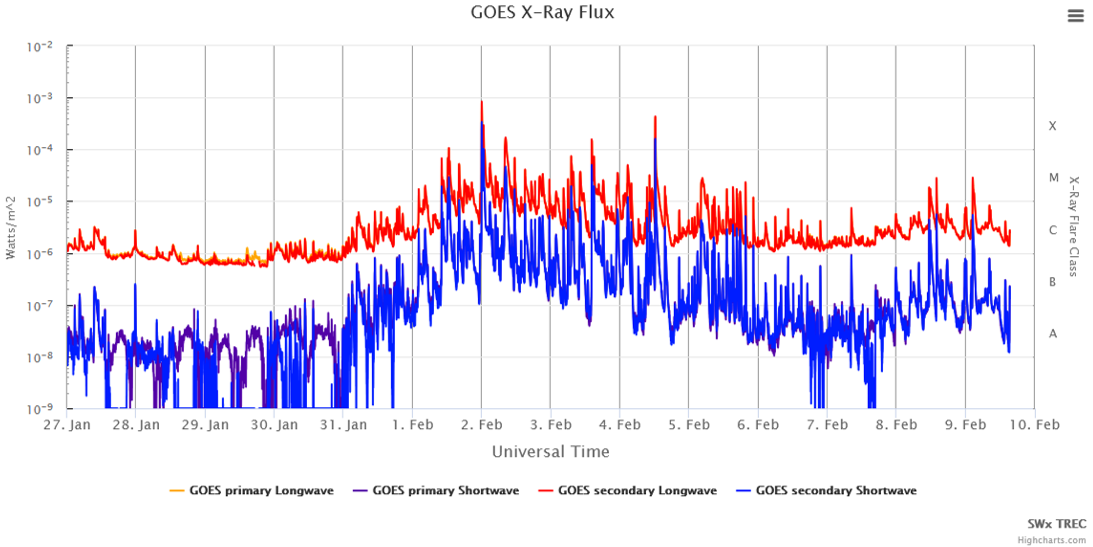
The passage of NOAA 14366 over the solar disk has not gone unnoticed, as extensively discussed in these STCE newsflashes. This can best be seen in the GOES soft-x-ray curve underneath (LASP/University of Colorado). As soon as this sunspot group started to develop on 31 January, there was also a strong increase in the recorded soft x-ray flux as well as in the number of produced solar flares. So far, this active region has produced 66 M- and 6 X-class flares (see "flare classes"). Most of this flare activity took place between 1 and 5 February, with a little burp on 8 and 9 February. In fact, the very large majority of the M- and X-class peaks in the graph can be attributed to enhanced activity in NOAA 14366.
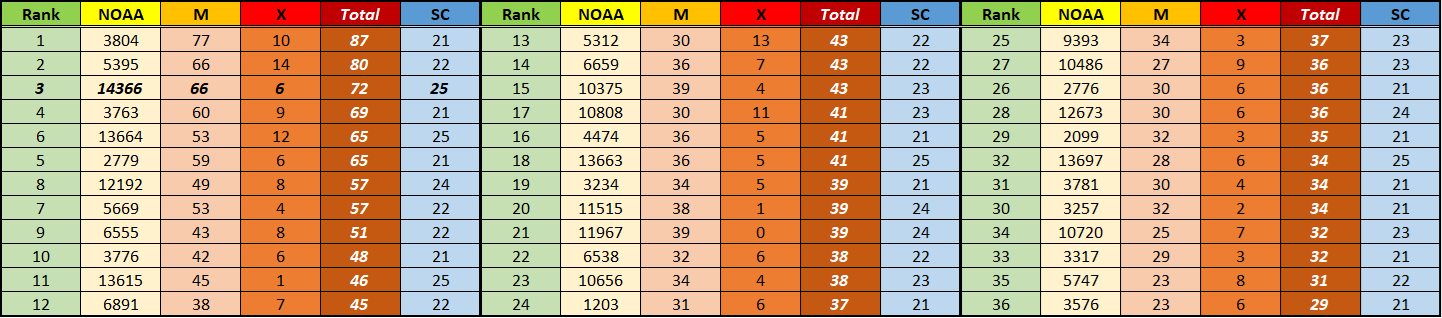
It's no surprize then that this sunspot group has been the most prolific M- and X-class flare producer so far this solar cycle (SC25). Though it has not produced as many X-class flares as the famous active region NOAA 13664 in May 2024, it is on top for the other flare statistics. The table underneath shows the Top 36 of active regions (NOAA number) that have produced the most M- and X-class flares. Also the solar cycle (SC) to which they belong has been mentioned. Note that all the flare intensities prior to SC25 have been upscaled by a factor 1.43 to allow comparison of the flare numbers on equal footing with the current GOES measurements (see the NOAA/SWPC note). Following an analysis of the flaring statistics as recorded by the GOES family during the last half century, NOAA 14366 occupies already the third spot! Only the famous NOAA 5395 in March 1989 and NOAA 3804 in July 1982 were able to produce more M- and X-class flares.
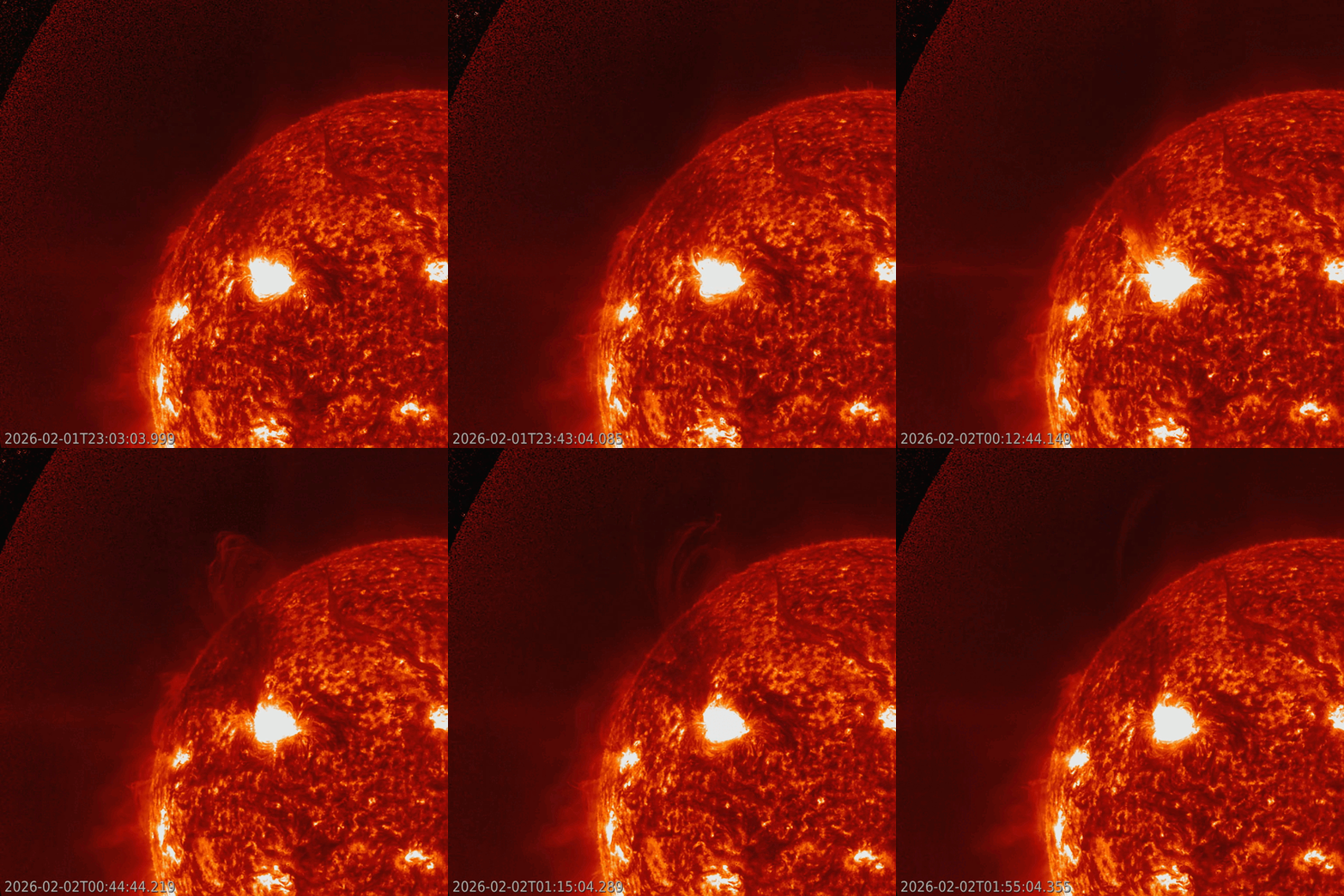
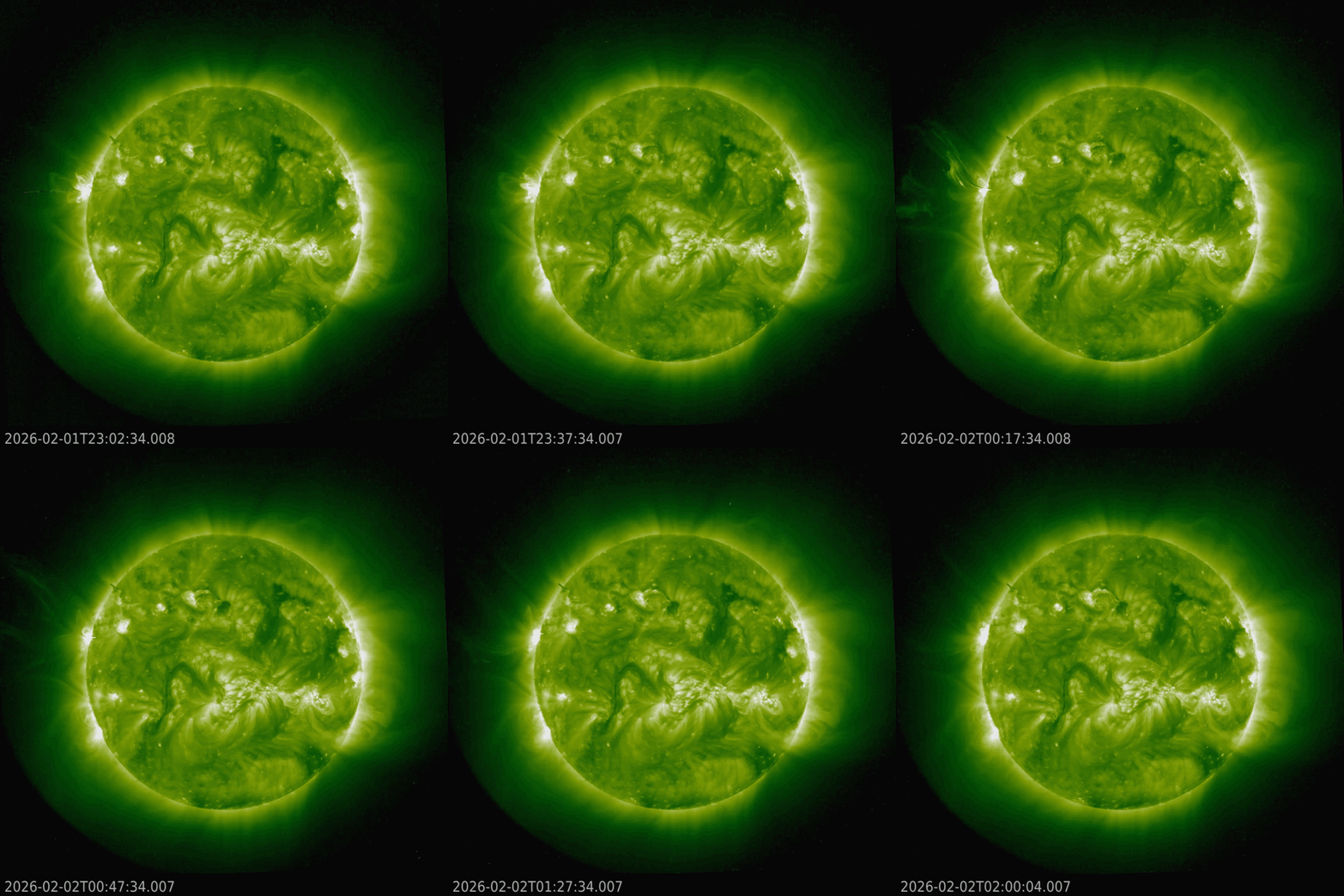
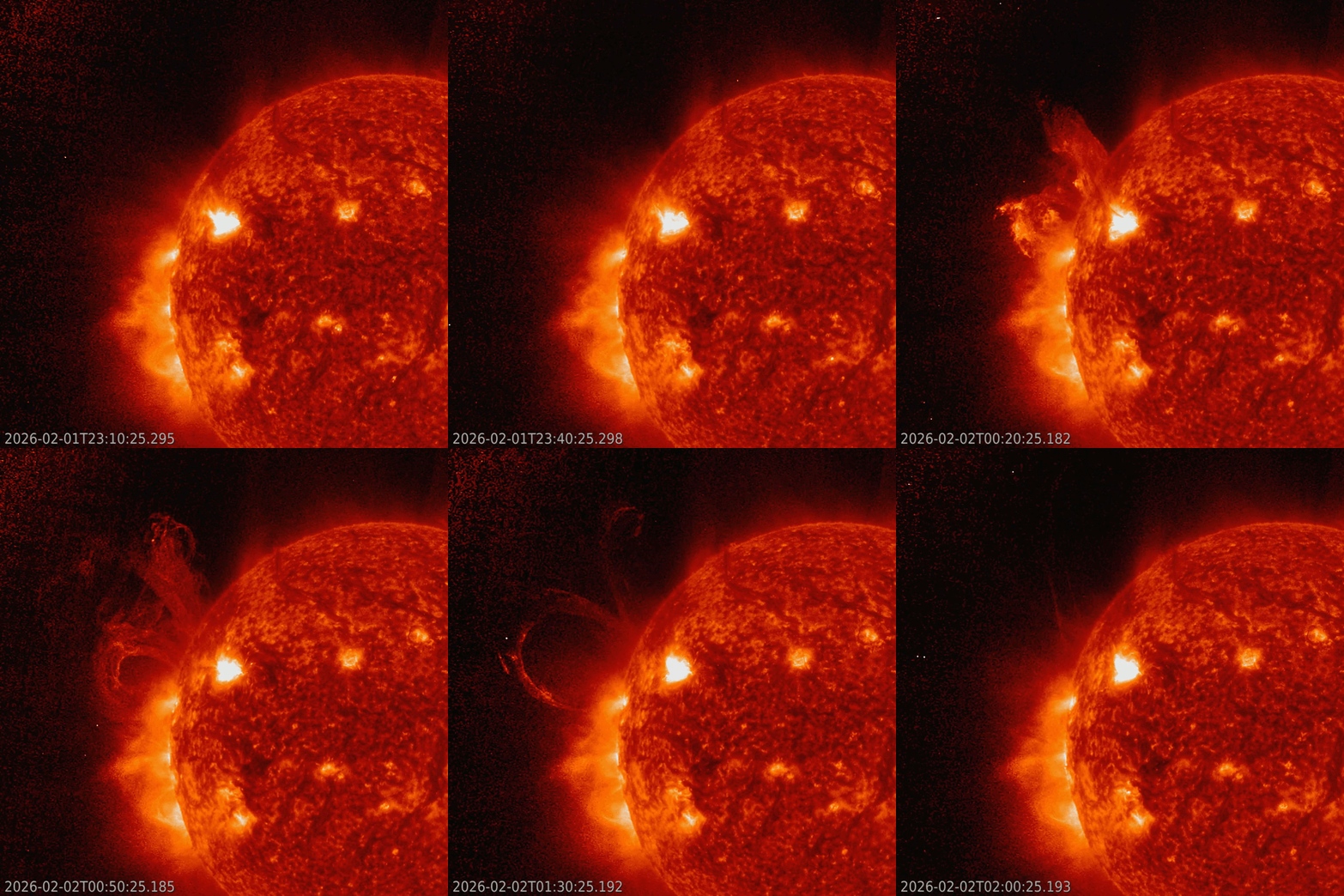
The strongest flare that NOAA 14366 has produced so far was the X8.1 late on 1 February. This is the third strongest so far this solar cycle, after the X9.0 flare produced by NOAA 13842 on 3 October 2024 (STCE newsitem) and the X8.7 by NOAA 13664 on 14 May 2024 (STCE newsitem). The compilation underneath shows this X8.1 flare as observed by 4 different spacecraft in the extreme ultraviolet (different wavelengths and zooms): SDO/AIA (upper left), GOES/SUVI (upper right), STEREO-A/EUVI (lower left) and Solar Orbiter/EUI (lower right). The latter two show the location of the eruption more to the east limb (left") because STEREO-A and Solar Orbiter are leading the Earth by respectively 51 and 15 degrees.
 |
 |
 |
 |