- Table of Content
- 1.2nd ICAO Space...
- 2.Review of sola...
- 3.PROBA2 Observa...
- 4.International ...
- 5.Geomagnetic Ob...
- 6.SIDC Space Wea...
- 7.Upcoming Activ...
2. Review of solar and geomagnetic activity
3. PROBA2 Observations (13 Jul 2026 - 19 Jul 2026)
4. International Sunspot Number by SILSO
5. Geomagnetic Observations in Belgium
6. SIDC Space Weather Briefing
7. Upcoming Activities
2nd ICAO Space Weather User Workshop
Introduction
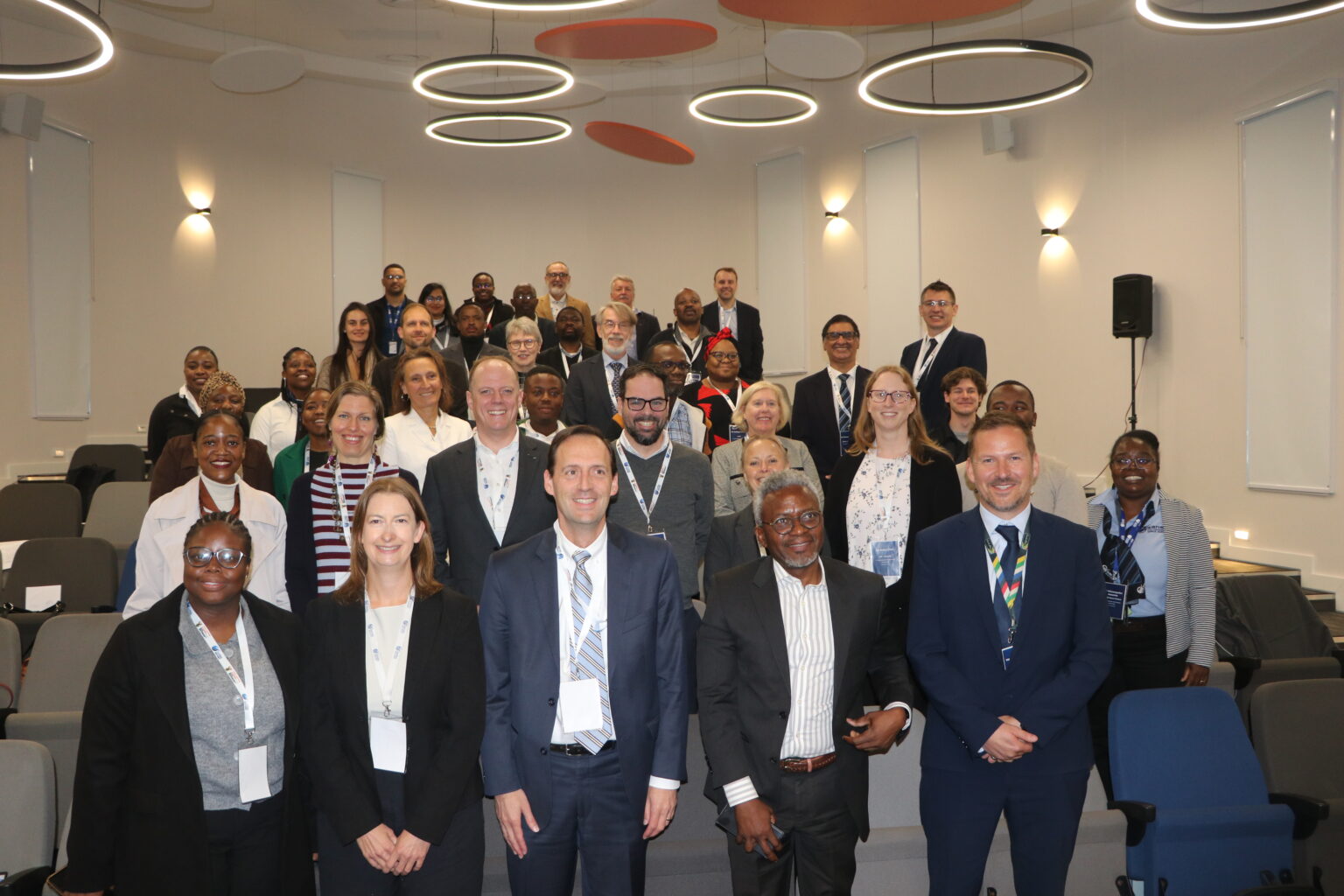
On 8-9 June 2026, ICAO -the International Civil Aviation Organization- (https://www.icao.int/ ) organised a 2nd Space Weather User Workshop on the provision and use of space weather information for international civil air navigation. Once again, the team at STCE (https://www.stce.be/index.php ) contributed significantly to the workshop preparations and realization.
General Information
ICAO, the International Civil Aviation Organization, is a specialized agency of the United Nations that coordinates the principles and techniques of international air navigation. As a member of the PECASUS consortium (https://pecasus.eu/ ), STCE is responsible for generating space weather (SWx) advisories for the benefit of civil aviation. On 8-9 June 2026, ICAO organised a 2nd Space Weather User Workshop gathering multiple airlines with major representation from the South African sector and facilitating an open dialogue between airliners, air traffic organisations, regulators and global SWx centres. The workshop was hosted by the South African National Space Agency (SANSA) with the main goal of engaging aviation stakeholders in discussions on the ICAO Space Weather Information Service (SWIS). Short introductions to the SWIS services including recent space weather activity, advisory statistics and aviation impacts were presented together with focused panel discussions identifying the current level of understanding of the services, together with future needs and possible service gaps.
A dedicated interactive space weather exercise based on recent space weather activity during January 2026 was provided to further trigger discussions, promote understanding and train users response to ongoing space weather activity.
The discussions focused on the operational use of SWx advisories for GNSS (Global Navigation Satellite Systems, such as GPS and Galileo), High Frequency communications (HF ; 3-30 MHz), and radiation, and previous and upcoming format changes to make the advisories more precise for flight operations. Cases of simultaneously ongoing GNSS and HF COM outages, combined with possible radiation events were of particular interest to the end-user community.
Some of the workshop outcomes include the need to further increase the awareness of and provide training on space weather services among the aviation community, the necessity to engage more with aircraft manifacturers to better understand the space weather risks on aviation systems, and the need to collaborate with other ICAO panels to further improve the existing regulatory framework.
STCE contributions
The STCE contributed in various ways:
- A combined talk on "Introduction to SWX and the ICAO SWX Information Service (SWIS)" was presented by Yana Maneva (ROB/SIDC (https://www.sidc.be/index.php/ ), STCE/PECASUS), Robyn Fiori (Natural Resources Canada - ACFJ) and Mpho Tshisaphungo (SANSA - Regional ICAO SWXC).
- STCE prepared an interactive SWX Exercise moderated by Yana Maneva engaging with end-users on the current status of the service provision with real examples from the recent event in January 2026.
- STCE provided SWIS Education and Guidance Material, including a new version of the ICAO Flyer which can be consulted at https://www.stce.be/sites/default/files/article_file/SWXFlyer_26June2026.pdf
- Within the ICAO MOG User Engagement Ad Hoc Group together with various partners from ICAO, ACFJ, SWPC, IFALPA and IATA among others, the STCE/SIDC continues to engage in service improvements, to prepare tools and training for future space weather workshops and respond actively to the needs of the aviation end-user community. Clarifications on the advisory service and the ongoing support of more accurate impact area definitions (based on 6 corners polygons) help dispatchers, pilots and ANSPs (Air Navigation Service Providers) to improve their risk estimations and choose workable routes, altitudes and HF frequencies (3-30 MHz). STCE continues to reflect these changes in its pilots guidance material and forecaster workflows to keep aviation users aligned with the evolving ICAO SWIS.
The full workshop program is available at https://www.stce.be/sites/default/files/article_file/2nd-SWX-User-Workshop-Agenda-FINAL-20260606.pdf
The latest version of the ICAO flyer is available in the STCE Shop (ICAO SWx Information Service) at https://www.stce.be/content/icao-space-weather-information-service
This newsitem was written with the kind contribution of Dr Yana Maneva.
Review of solar and geomagnetic activity
WEEK 1333 from 2026 Jul 13
Solar Active Regions (ARs) and flares
During last week, solar flaring activity has been low, with only C-class flares recorded. The strongest flare was a C8.9 flare (SIDC Flare 8205) from beyond the east limb, peaking at 21:55 UTC on July 15. There was a total of 9 numbered active regions on the visible disk, mostly with magnetic types alpha and beta. SIDC Sunspot Group 916 (NOAA Active Region 4489) developed a beta-gamma magnetic type on July 19.
Coronal mass ejections
A few Coronal Mass Ejections (CMEs) were detected during the week, but the source region was either near the limbs or backsided, and none was Earth-directed. Some selected events are the following. SIDC CME 687 was observed in LASCO/C2 coronagraph imagery, lifting off from the southeast limb starting from 19:36 UTC on July 13. SIDC CME 688 was observed in LASCO/C2 coronagraph imagery, lifting off from the southwest limb starting from 03:22 UTC on July 15. It was most likely associated with a prominence eruption over the southwest limb. A wide Coronal Mass Ejection (SIDC CME 690) was observed in LASCO/C2 coronagraph imagery, lifting off from the east limb, starting from 00:10 UTC on July 17. It was most likely associated with a C1.5 flare (SIDC flare 8207, peaking at 00:02 UTC) from beyond the east limb. SIDC CME 691 was observed in LASCO/C2 and STEREO-A coronagraph imagery, lifting off from the east limb, starting from around 17:50 UTC on July 17. Three Coronal Mass Ejections (CMEs) were observed in LASCO/C2 coronagraph imagery between July 18-19. SIDC CME 692 lifted off from the east limb, starting from 19:36 UTC on July 18. SIDC CME 693 lifted off from the east limb, starting from 01:26 UTC on July 19. A slow CME (SIDC CME 694) lifted off from the east limb, starting from around 07:00 UTC on July 19.
Coronal holes
Two coronal holes with positive magnetic polarity and one with negative polarity crossed the central meridian during last week. A southern, positive polarity coronal hole (SIDC Coronal Hole 173) crossed the central meridian during the UTC afternoon of July 12. A northern, positive polarity coronal hole (SIDC Coronal Hole 174) crossed the central meridian on July 15. A southern, negative polarity coronal hole (SIDC Coronal 149, part of a larger L-shaped coronal hole) crossed the central meridian on July 19.
Proton flux levels
The greater than 10 MeV proton flux was below the 10 pfu threshold throughout the week.
Electron fluxes at GEO
The greater than 2 MeV electron flux as measured by GOES 18 was above the 1000 pfu alert threshold during the week, following a diurnal variation. The greater than 2 MeV electron flux as measured by GOES 19 was enhanced but remained below the 1000 pfu threshold throughout the week. The 24-hour electron fluence was at moderate levels on July 13 and decreased back to nominal levels for the rest of the week.
Solar wind
At the beginning of the week, the solar wind parameters (SOLAR-1 and ACE) reflected a gradual return to slow solar wind conditions. The solar wind speed decreased from 520 km/s to around 430 km/s. The interplanetary magnetic field was between from 2 nT and 7 nT. The Bz component varied between -3 nT and 4 nT. The interplanetary magnetic field angle phi was predominantly in the negative sector. An enhancement in the solar wind parameters followed on July 14, possibly reflecting the impact of a glancing blow (associated with SIDC CME 686), combined potentially with a high-speed stream from the southern, positive polarity coronal holes (SIDC Coronal Holes 172 and 173). The solar wind speed increased from 350 km/s to around 500 km/s. The interplanetary magnetic field reached a maximum of 14 nT. The Bz component reached a minimum of -8 nT. The interplanetary magnetic field angle phi was initially negative (directed towards the Sun) and has switched to positive (away from the Sun) since 18:00 UTC on July 14. A return to slow solar wind conditions followed on July 17, with the solar wind speed decreasing to 300 km/s.
Geomagnetism
Geomagnetic conditions globally reached minor storm levels (NOAA Kp 5- ) between 12:00 UTC and 15:00 UTC on July 12. A period of mostly quiet conditions followed until July 15, when unsettled (NOAA Kp 3) and active conditions (NOAA Kp 4) were recorded. Quiet conditions followed until the end of the week. Geomagnetic conditions locally reached active levels (K Bel 4) between 14:00 UTC and 20:00 UTC on July 12. Geomagnetic conditions locally remained quiet to unsettled for the rest of the week, with isolated intervals of active levels.
PROBA2 Observations (13 Jul 2026 - 19 Jul 2026)
Solar Activity
Solar flare activity fluctuated from very low to low during the week.
In order to view the activity of this week in more detail, we suggest to go to the following website from which all the daily (normal and difference) movies can be accessed: https://proba2.oma.be/ssa
This page also lists the recorded flaring events.
A weekly overview movie (SWAP week 851) can be found here: https://proba2.sidc.be/swap/data/mpg/movies/weekly_movies/weekly_movie_2026_07_13.mp4.
Details about some of this week's events can be found further below.
If any of the linked movies are unavailable they can be found in the P2SC movie repository here: https://proba2.oma.be/swap/data/mpg/movies/.
Wednesday-Thursday July 15-16


On 2026-Jul-15 at 21:55 UT a C8.9 flare peaked at the eastern limb of the Sun close to the equator, and it was observed by LYRA (top panel) and SWAP (bottom panel). It was associated with a small coronal mass ejection, but the large post-flare loops were beautifully seen by SWAP, which continued to increase in height and erupt the next day, to create another narrow and faint CME.
Find SWAP movies of the event here: https://proba2.sidc.be/swap/movies/20260715_swap_movie.mp4 and here: https://proba2.sidc.be/swap/movies/20260716_swap_movie.mp4.
International Sunspot Number by SILSO

The daily Estimated International Sunspot Number (EISN, red curve with shaded error) derived by a simplified method from real-time data from the worldwide SILSO network. It extends the official Sunspot Number from the full processing of the preceding month (green line), a few days more than one solar rotation. The horizontal blue line shows the current monthly average. The yellow dots give the number of stations that provided valid data. Valid data are used to calculate the EISN. The triangle gives the number of stations providing data. When a triangle and a yellow dot coincide, it means that all the data is used to calculate the EISN of that day.
Geomagnetic Observations in Belgium

Local K-type magnetic activity index for Belgium based on data from Dourbes (DOU) and Manhay (MAB). Comparing the data from both measurement stations allows to reliably remove outliers from the magnetic data. At the same time the operational service availability is improved: whenever data from one observatory is not available, the single-station index obtained from the other can be used as a fallback system.
Both the two-station index and the single station indices are available here: http://ionosphere.meteo.be/geomagnetism/K_BEL/
SIDC Space Weather Briefing
The forecaster on duty compiled the SIDC briefing that gives an overview of space weather from 13 July to 19 July 2026.
The pdf of the presentation: https://www.stce.be/briefings/20260720_SWbriefing.pdf

Upcoming Activities
Courses, seminars and events with the Sun-Space-Earth system and Space Weather as the main theme.
We provide occasions to get submerged in our world through educational, informative and instructive activities.
* Aug 3, 2026, STCE seminar: Magnetosphere-Ionosphere Coupling in the Auroral Zones of Earth and Jupiter, Brussels, Belgium
* Aug 6, 2026, Watching the Sun: a 200 year journey, public visits of the solar physics and space weather department, NL/FR/EN, Brussels, Belgium - https://200year.observatory.be/en-gb/coupole
* Aug 12, 2026, Solar eclipse and night sky viewing, Humain Radioastronomy Station, Belgium - https://200year.observatory.be - register:https://events.spacepole.be/event/294/
* Oct 12-14, 2026, STCE Space Weather Introductory Course, Brussels, Belgium - register: https://events.spacepole.be/event/257/ - Fully booked
* Oct 15, 2026, Post Space Weather Introductory Course, Brussels, Belgium - register: https://events.spacepole.be/event/286/
* Oct 29-Nov 1, 2026, Prior to ESWW2026 - Space Weather Training Course in Firenze, Italy - Applications closed
* Nov 2-6, 2026, European Space Weather Week, Florence, Italy, https://esww2026.eswan.eu/
* Nov 23-25, 2026, STCE course: Role of the ionosphere and space weather in military communications, Brussels, Belgium - register: https://events.spacepole.be/event/259/
* Dec 7-9, 2026, STCE Space Weather Introductory Course for Aviation, Brussels, Belgium - register: https://events.spacepole.be/event/262/
* Feb 15-17, 2027, STCE Space Weather Introductory Course, Brussels, Belgium - register: https://events.spacepole.be/event/296/
* Mar 15-17, 2027, STCE course: Role of the ionosphere and space weather in military communications, Brussels, Belgium - register: https://events.spacepole.be/event/300/
* Apr 12-14, 2027, STCE Space Weather Introductory Course, Brussels, Belgium - register: https://events.spacepole.be/event/297/
* May 24-26, 2027, STCE Space Weather Introductory Course, Brussels, Belgium - register: https://events.spacepole.be/event/298/
