In 2019, the Solar Cycle Prediction Panel convened to gather and combine predictions for the still infant Solar Cycle 25. The results of this gathering were published shortly thereafter: the Solar Cycle Prediction Panel expected the cycle maximum value of the smoothed monthly sunspot number to be in a very narrow range between 105-125 with the peak occurring between November 2024 and March 2026.
Seven years later, we can now say we have reached and passed the maximum and the predictions from 2019 appear to have been significantly lower than reality. Of course, in terms of prediction accuracy, the closer we are to the actual maximum, the more the various prediction methods will converge. Indeed, in 2024, SILSO predicted a maximum SN between 138 and 161 that would take place sometime between May and October 2024, while NOAA predicted a similar range between 137 and 164 but within a broader time window between February 2024 and January 2025. The results have been confirmed by SILSO in 2025 (Link to data): the maximum value of the monthly smoothed sunspot number for Solar Cycle 25 was reached in October 2024 and is 161 (see figure 1), versus 159 for September and 157 for November 2024.


Figure 1- Solar Cycle 25 and its maximum seen in October 2024, as well as the 12-months ahead predictions that show a decreasing trend for September 2025 and February 2026, thus confirming the trend.
The results are confirmed by a simple calculation on the Lyra (Ref1, Ref2) and GOES (Ref) data, by using a similar method. Instead of a 13 months-smoothed value, we use a +/- 198 days window on the daily data (which corresponds to 6,5 months on each side) and find:
-
LYRA ch2-3 (Al) peaks with 0.0047 W/m2 on 01 Oct 2024
-
LYRA ch2-4 (Zr) peaks with 0.0020 W/m2 on 29 Sep 2024
-
GOES peaks with 1.815e-6 W/m2 also on 01 Oct 2024
-
The daily sunspot number (smoothed in the same way) peaks with 159 on 20 Oct 2024, just 19-21 days later than LYRA and GOES.
These numbers can be seen in Figure 2 below and are all consistent with a 13 months-smoothed peak in October 2024 for solar cycle 25.
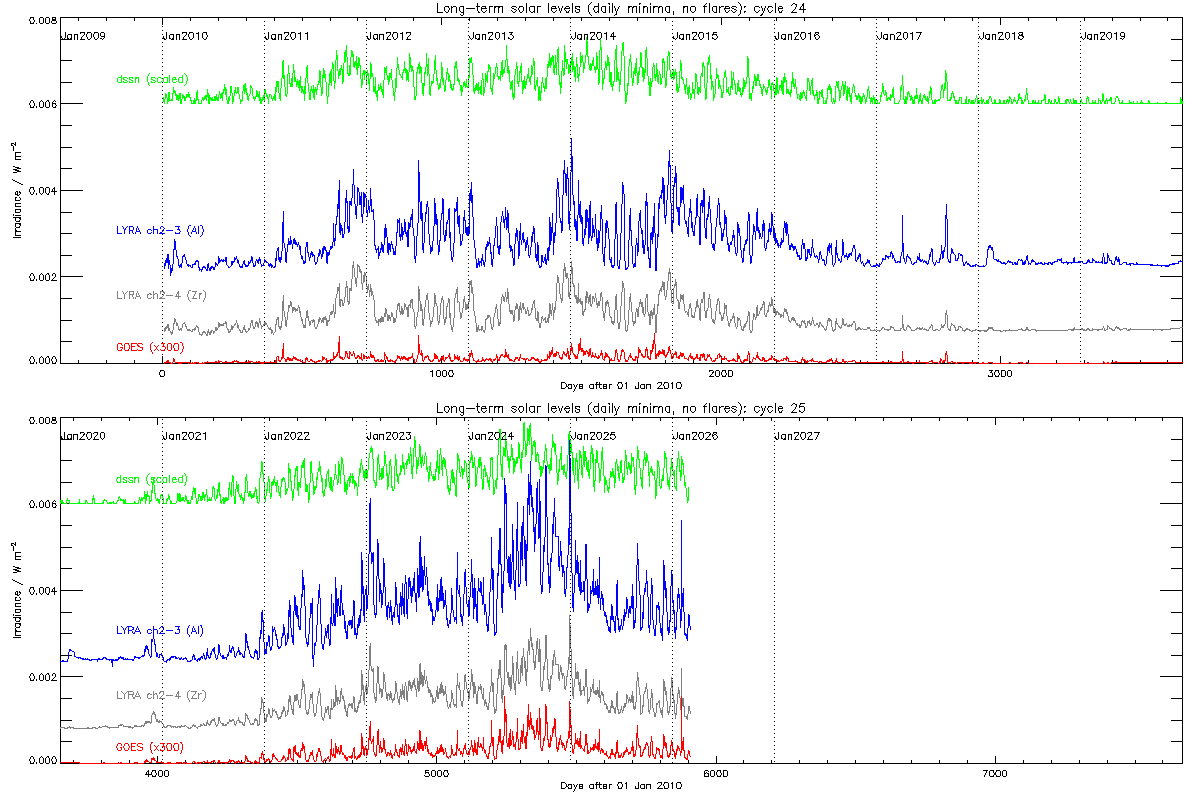
Figure 2 - +/- 198 days smoothed daily total Sunspot Numbers (https://sidc.be/SILSO/datafiles), LYRA channels 2-3 and 2-4 and GOES flux all scaled over solar cycle 25.
What this entails for the SIDC team, is that, at this stage of the Solar Cycle, the Sun is very active, and will remain at a similar level of activity well into 2026. Since the beginning of 2024, many large and complex active regions have crossed the solar disk regularly driving the daily sunspot number to well above 250 as can be attested by the SIDC/USET image for 7 August 2024 (figure 3).

Figure 3- White light image of the photosphere of the Sun taken on August 7 2024.
These active regions have often been the source of strong solar flares, and the associated solar eruptions, when they are not confined and are earth-directed, strongly affect the Earth’s magnetic field. The important aurorae thus created are sometimes visible from countries further away from the polar regions, such as in May 2024 when the colorful display was also visible from Belgium (see this newsitem). While storms of this magnitude occur approximately once every 12.5 years, the length of this specific storm was unusual, expected only once every 41 years (Ref). There were also important storms in October 2024, June 2025 (Arrived!) and more recently in January 2026 (Anatomy of an Aurora). These major solar storms and their impact on Earth help improve the accuracy of Space Weather forecasting as they enable us to sample solar events with the full range of instruments at our disposal today (Abstract).
2026 still holds a lot of sunspots to count and a interesting activity for the Space Weather Team!