UPDATED - For older posts, please scroll down
UPDATE 13 November 2025 at 09:00UTC - The coronal mass ejection (CME) related to the X5 flare from 11 November arrived at the DSCOVR spacecraft on 12 November at 18:53 UTC ("CME3" in the annotated chart underneath). The solar wind speed increased to values around 950 km/s, significantly faster than "CME2" which was the source of the severe geomagnetic storm early on 12 November. However, the magnetic field strength of "CME3" was much weaker (39 nT vs 61 nT ; white curve) and its north-south orientation (Bz ; red curve) was mainly positive, preventing the build-up of a (extremely) severe storm. Eventually, Bz would reach -17 nT (CME 2: -55 nT !!) for a brief 2-hour period early on 13 November, resulting in "only" a strong geomagnetic storm (bottom panel of the chart).
Though the solar wind speed is currently still near 800 km/s, no strong negative Bz are expected any further. Hence, it is expected that geomagnetic storming will gradually decrease with no further chance on aurora visible from Belgium. The source of all these storms, sunspot group NOAA 4274, has been relatively quiet over the last 2 days and is showing signs of decay. A moderate to strong flare is still possible, but as the region is approaching the solar limb, any associated CME will be more and more directed away from the Earth.

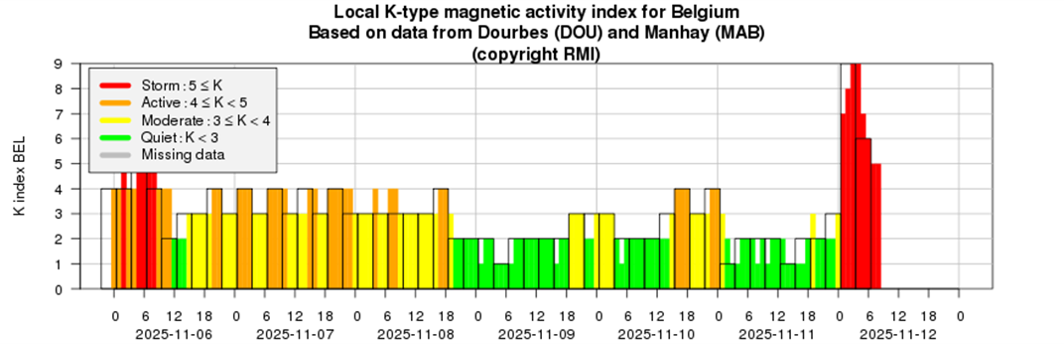
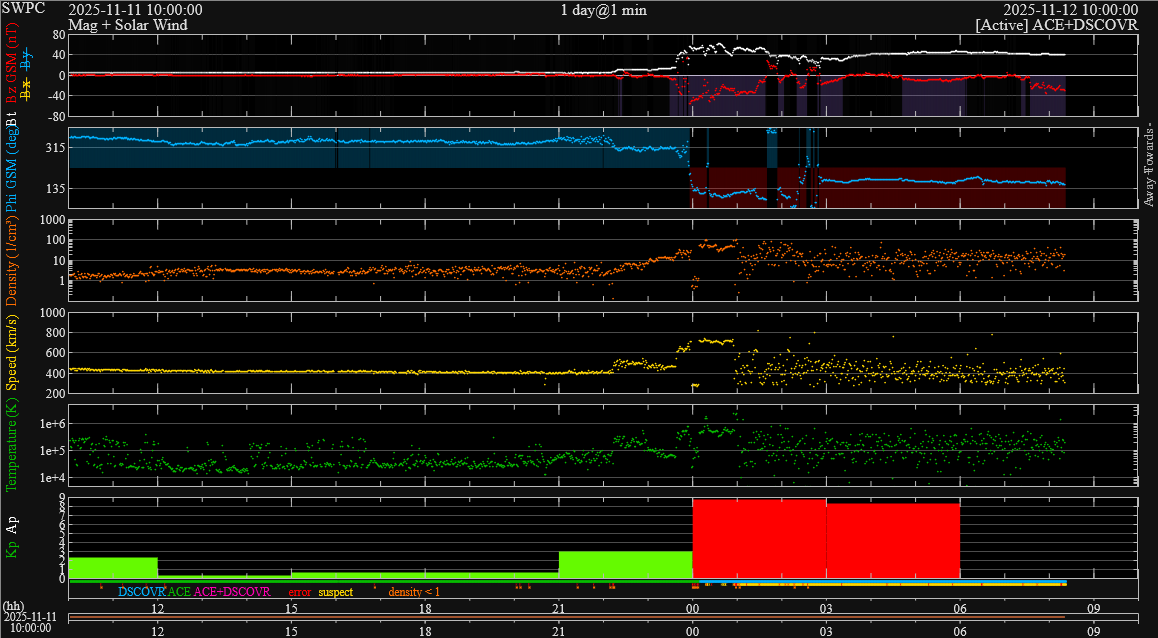
Original 12 November 2025 at 10:30UTC - The coronal mass ejections (CMES) from 9 and 10 November (see this STCE newsitem) arrived late on 11 November. DSCOVR recorded a first solar wind shock, associated with the CME from 9 November, around 22:15 UTC, the solar wind speed jumping from around 410 km/s to 500 km/s (yellow curve in graph underneath). The north-south component (Bz ; red curve) remained fairly close to 0 nT. A second shock in the solar wind parameters, this one related to the 10 November CME, was observed at 23:38 UTC. The solar wind speed jolted to 750 km/s. Bz reached a maximum negative value of -55 nT already at 23:56UTC. This is stronger than the 2024 storms, however Bz did not remain at this extreme value for a long time. It quickly returned to more tempered values between -30 and -40 nT (see also Note 1). The geomagnetic field got severely disturbed, with Kp reaching 9- during the 00:00-03:00 UTC interval, both at NOAA as at Potsdam. The local K index in Belgium (K_BEL) reached 9 during this interval (extremely severe storm ; diagram). It is common that local K indices deviate from the Kp index, which is based on a dozen of worldwide subauroral magnetometer stations.
The severe geomagnetic storm resulted in aurora (polar light) being visible at far southern latitudes, such as Texas and Florida in the United States, as well as New-Zealand (Spaceweather.com). In Belgium, despite the clouds, there were several reports from red aurora visible with the naked eye (VRT, HLN). The pictures underneath were taken by Nancy Narang from Uccle (Brussels), Belgium at 03:45 UTC and by Bart Medaer from Gierle, Belgium. It should be noted that this storm was not as strong as the May 2024 storm, and more comparable to -but shorter-lived than- the October 2024 storm. The Dst index (Disturbance storm time, another geomagnetic index ; WDC Kyoto) reached only -238 nT, much less than the -333 nT from the 10-11 October 2024 storm (Kp also 9-) and -406 nT from the 10-11 May 2024 storm (Kp = 9). Other impacts from this geomagnetic storm may have been felt in other domains such as HF communications and GNSS (Gloval Navigation Satellite Systems such as GPS and Galileo) applications (see Note 2).
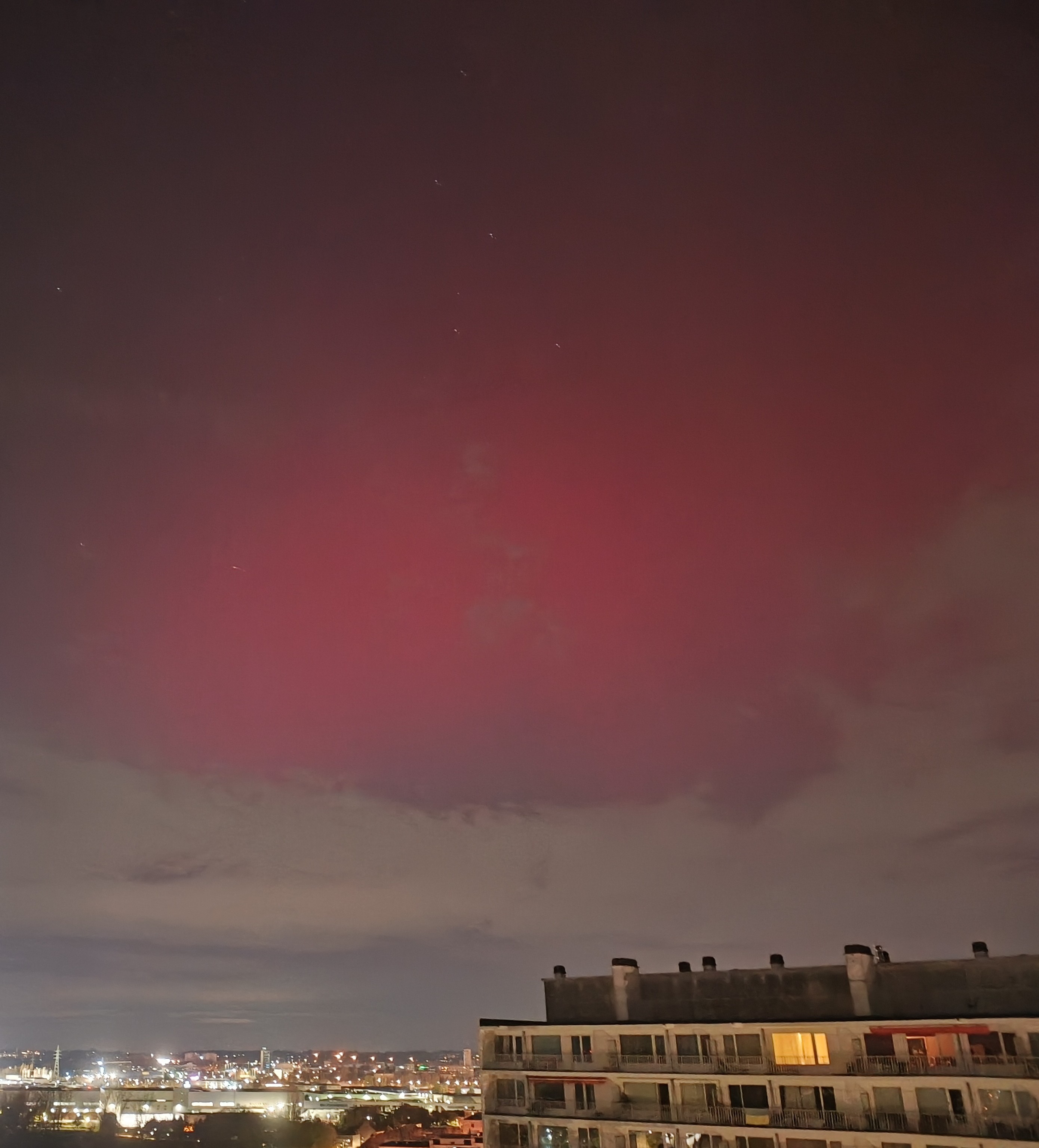
Credits: Nancy Narang
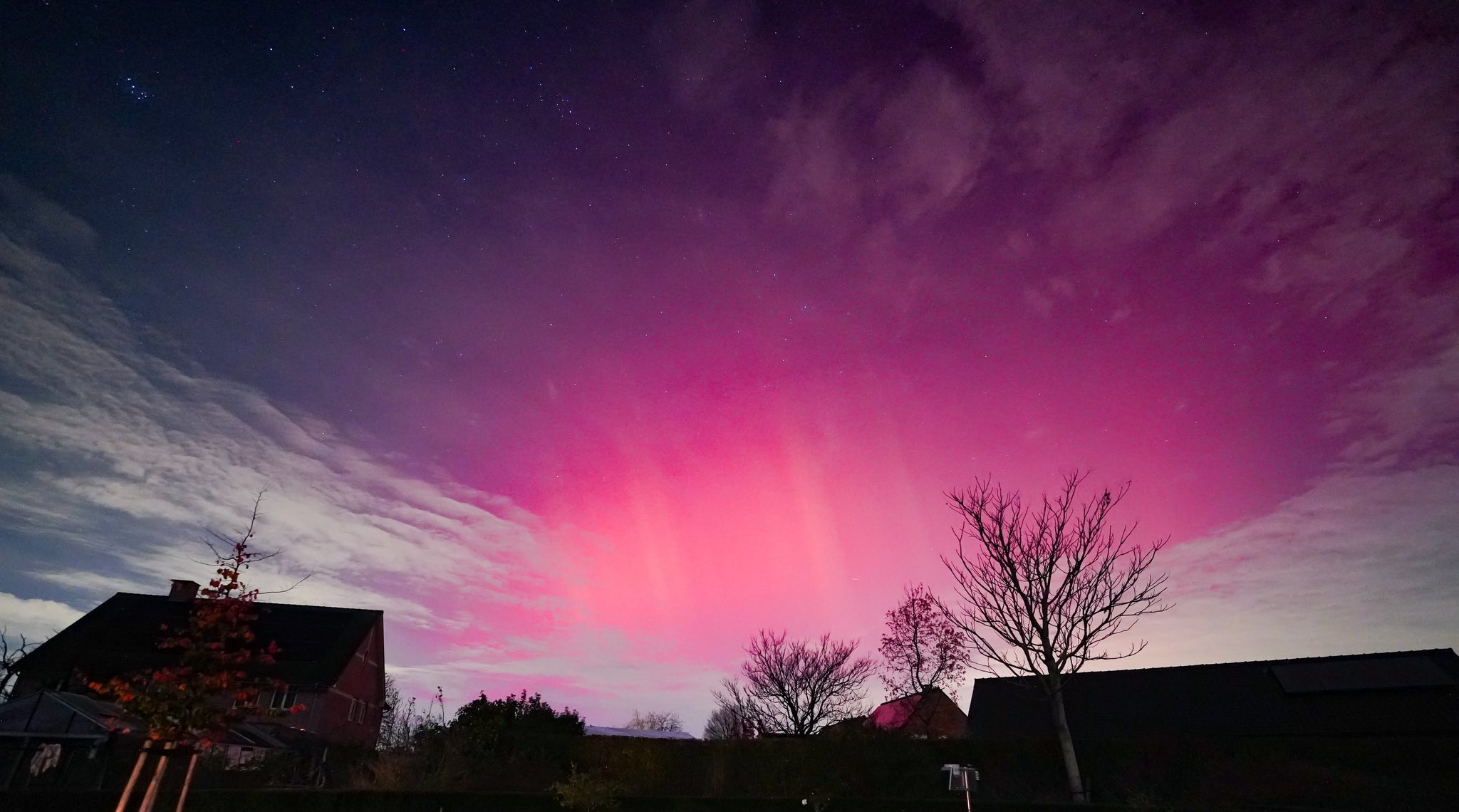
Credits: Bart Medaer
Though the severe geomagnetic storm seems to gradually subside now (+/- 10:00UTC), further strong to severe geomagnetic storming is still possible. Indeed, the CME associated with yesterday's X5.1 flare (STCE newsflash) is still on its way to Earth and is expected to arrive early on 13 November 2025 (SIDC forecaster PRESTO). Its arrival may further disturb the already agitated geomagnetic field. Severe geomagnetic storming remains possible over the next 24 hours, with a chance on further aurora over Belgium during this period. The CMEs originated from SIDC Sunspot Group 687 (NOAA AR 4274), which remains highly active, so additional strong flares, proton event, and further CMEs remain possible.
Note 1 - From around 01:00 UTC onwards, the instrument onboard the DSCOVR and ACE spacecraft providing the speed, density and temperature of the solar wind broke down. This is in principle a temporary nuissance which happens during adverse space weather. The wind speed and density parameters can still be followed at the SOHO/CELIAS website.
Note 2 - The GOES recorded a strong proton event following the passage of the 2 interplanetary CMEs, reaching a maximum of 1460 pfu at 02:15 UTC. This event was not due to solar activity, but to the passage of the CMEs. Hence it is called a Energetic Storm Particle (ESP) event. See this STCE newsitem for more details, and this diagram illustrating the evolution of the proton fluxes at various proton energies (GOES). The two bumps early on 12 November are due to the passage of the two CMEs.