UPDATED - For older posts, please scroll down
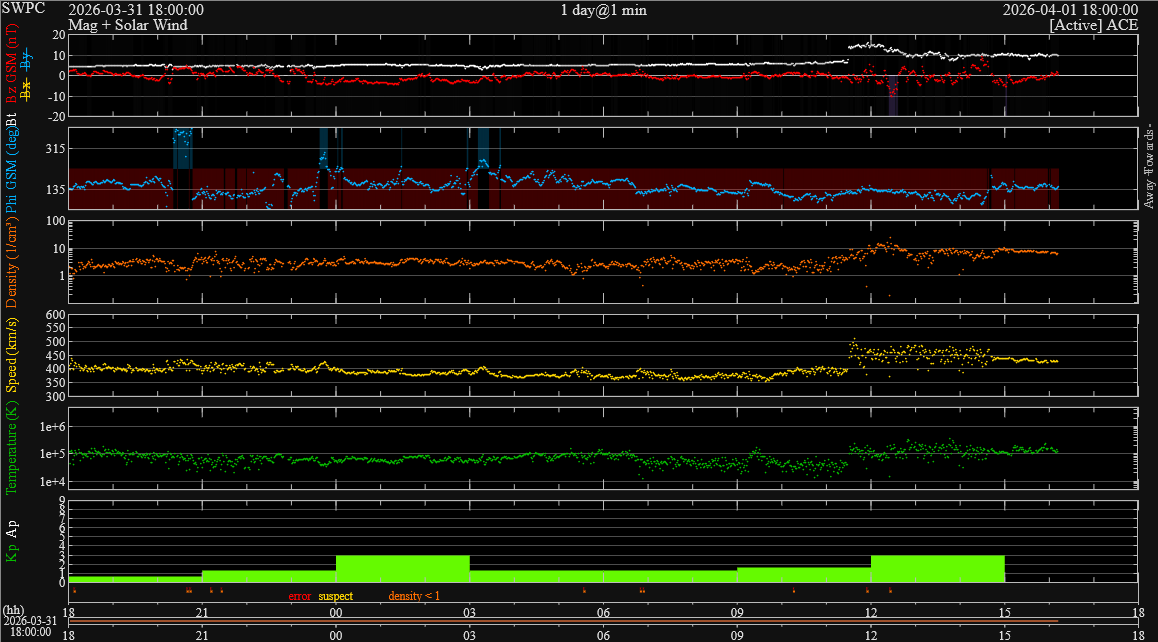
UPDATE 1 April 2026 at 16:30UTC - From the PRESTO alert issued by the SIDC SWx forecaster on 1 April at 14:45UTC: "A solar wind shock was observed at Earth on 01 April around 11:30 UTC. This is evidenced by a sudden increase in solar wind parameters, with the solar wind speed (yellow curve) rising from approximately 370 km/s to about 510 km/s, and a concurrent enhancement of the total interplanetary magnetic field (Bt - white curve) from around 6-7 nT to about 16 nT. The Bz component (red curve) showed also increased variability, including periods of southward orientation.
These signatures are consistent with the arrival of the interplanetary coronal mass ejection (ICME) ... associated with the X1.4 flare ... which peaked on 30 March at 03:19 UTC ... .
Geomagnetic conditions are expected to become active to storm levels in the coming hours, depending on the persistence and orientation of the southward IMF component (Bz)."
The ICME arrived much later than expected, and is also much weaker. Obviously, under these conditions, no aurora will be visible from Belgium tonight.
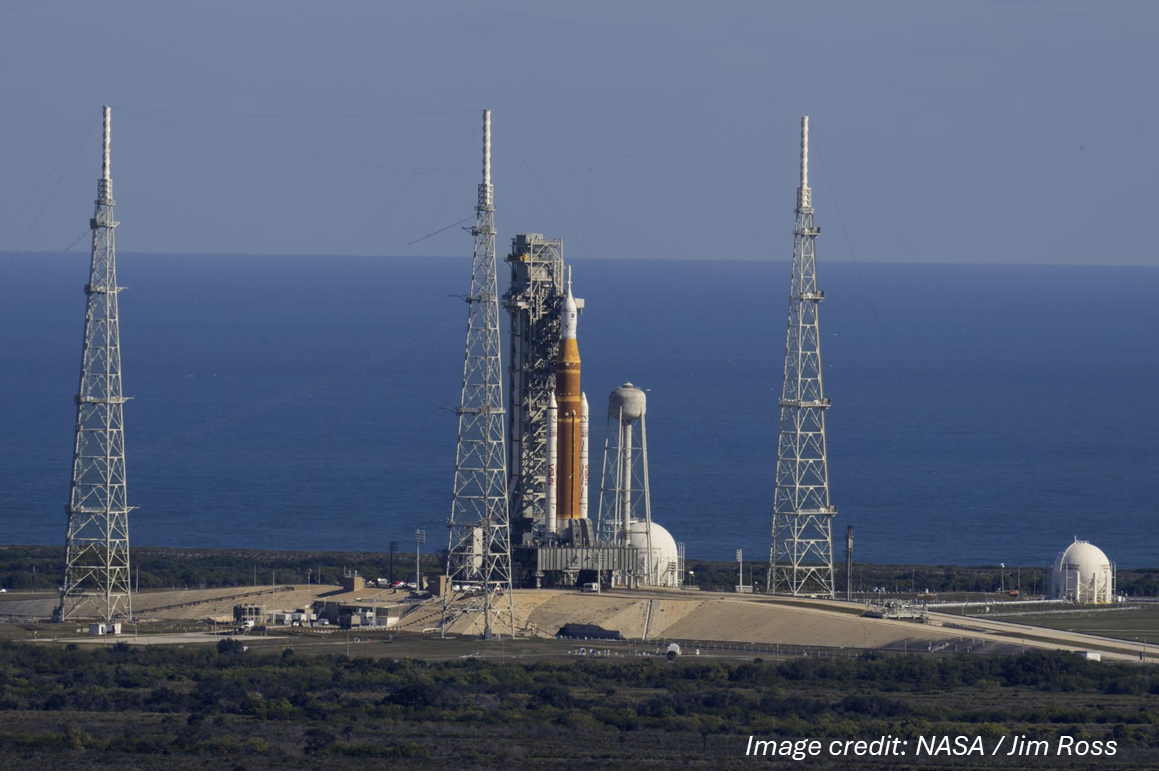
UPDATE 31 March 2026 at 06:45UTC - Based on a speed of 1835 km/s for the coronal mass ejection (CME) associated with yesterday's X-class flare, the SIDC SWx forecaster has issued a CME arrival alert for today 31 March at 12:00 UTC, with an uncertainty of 12 hours. A strong geomagnetic storm is expected (Kp or K = 7), but also here with some uncertainty, i.e. the geomagnetic storm levels may vary between moderate and severe. If this forecast pans out, and weather permitting, there's a small chance for aurora over Belgium, low over the northern horizon, during the early evening hours of 31 March. The later the CME arrives, and the stronger the disturbance is, the higher the likelihood on polar lights over Belgium. This geomagnetic storm is not expected to impact or delay the launch of the Artemis-II mission to the Moon (NASA), currently scheduled for 1 April at 22:24 UTC.
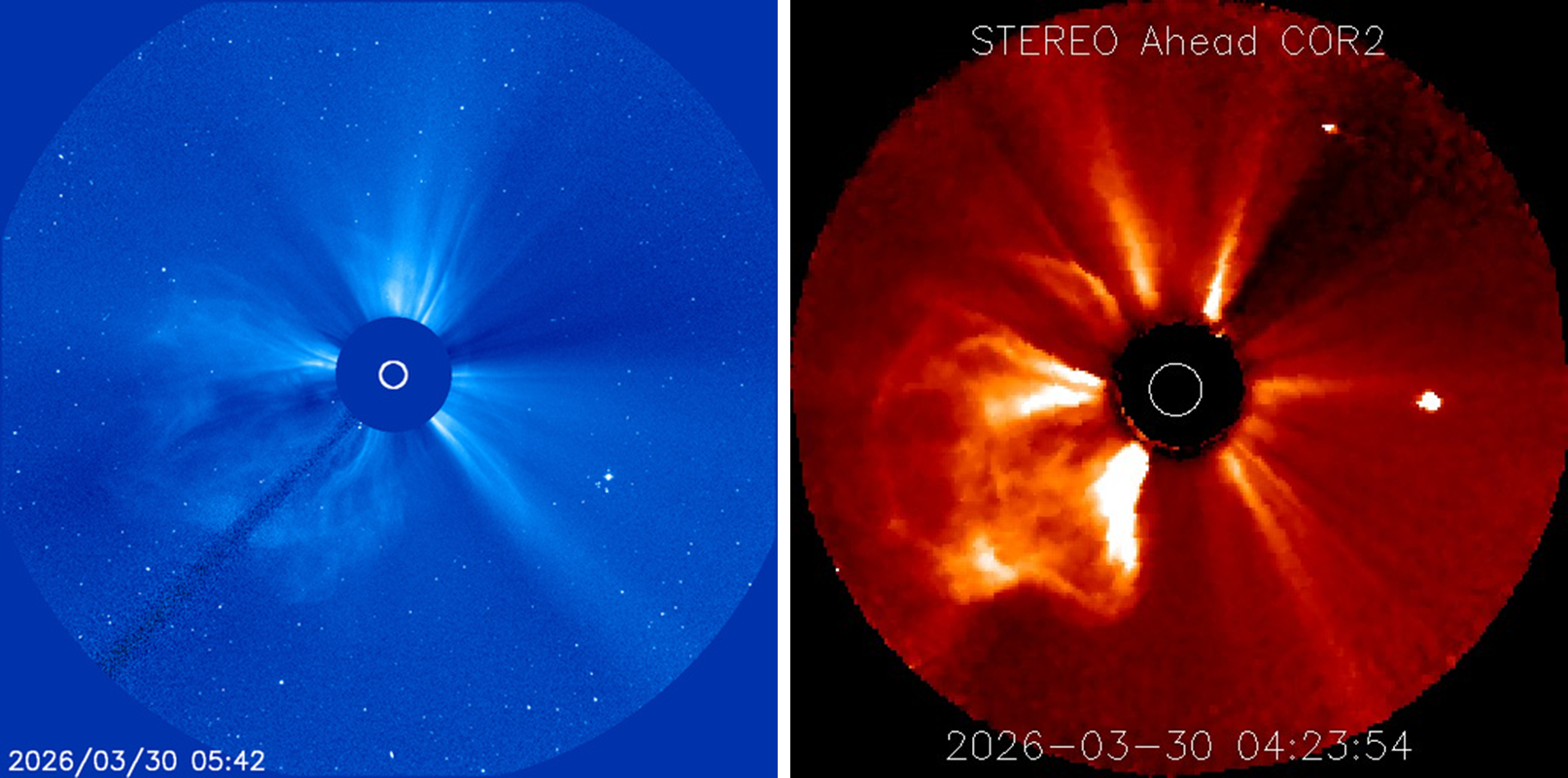
Original 30 March 2026 at 11:30UTC - From the SIDC PRESTO alert on 30 March/07:15 UTC: "An X1.4 flare (SIDC flare 720) was registered by GOES-19 has peaked on 30 March at 03:19 UTC. The source was SIDC Sunspot Group 836 (NOAA Active Region 4405). There is no proton event associated with this eruption. A Coronal Mass Ejection (CME) is already registered in STEREO-A/COR2 observations, but not enough data are yet available to judge its geo-effectiveness."
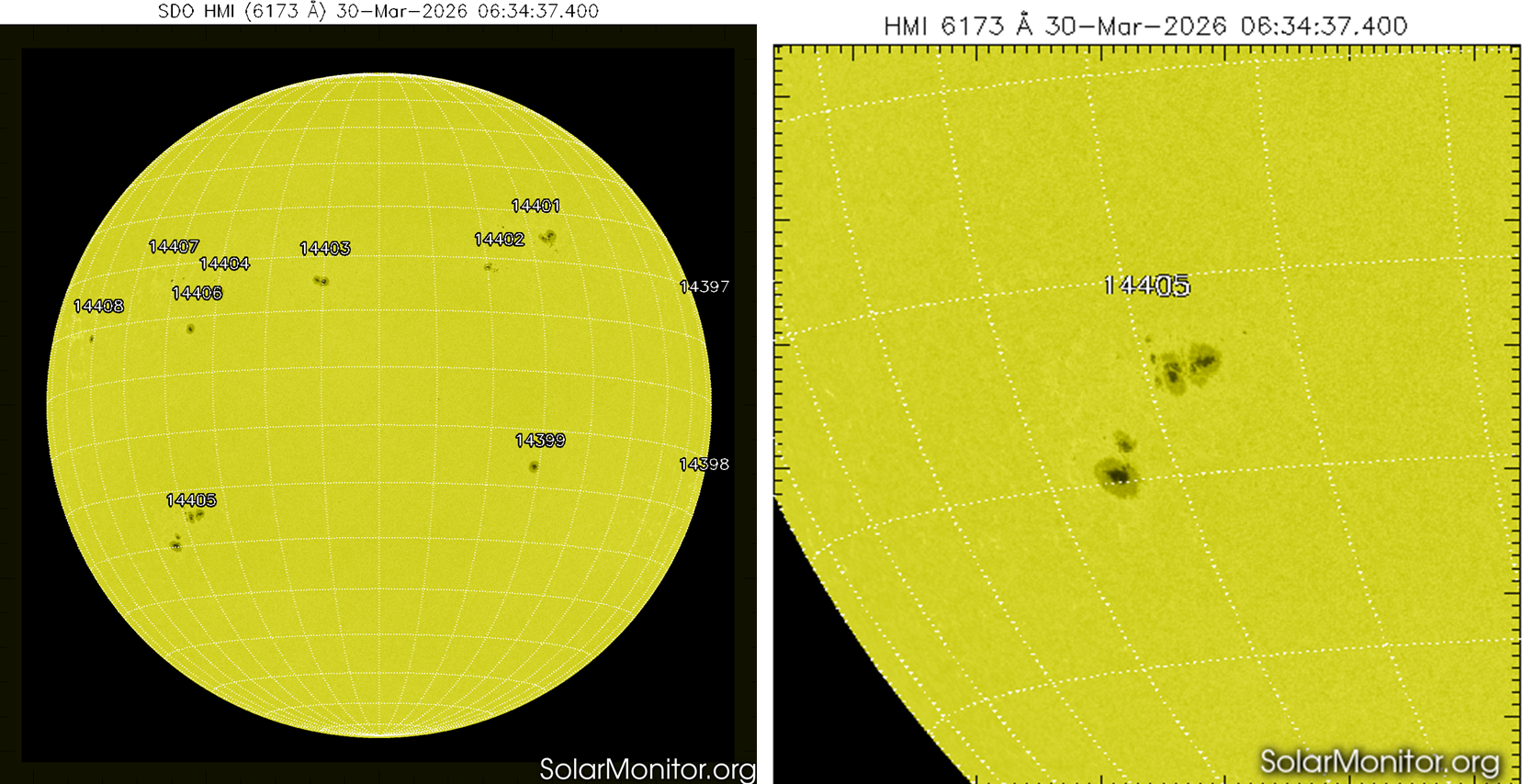
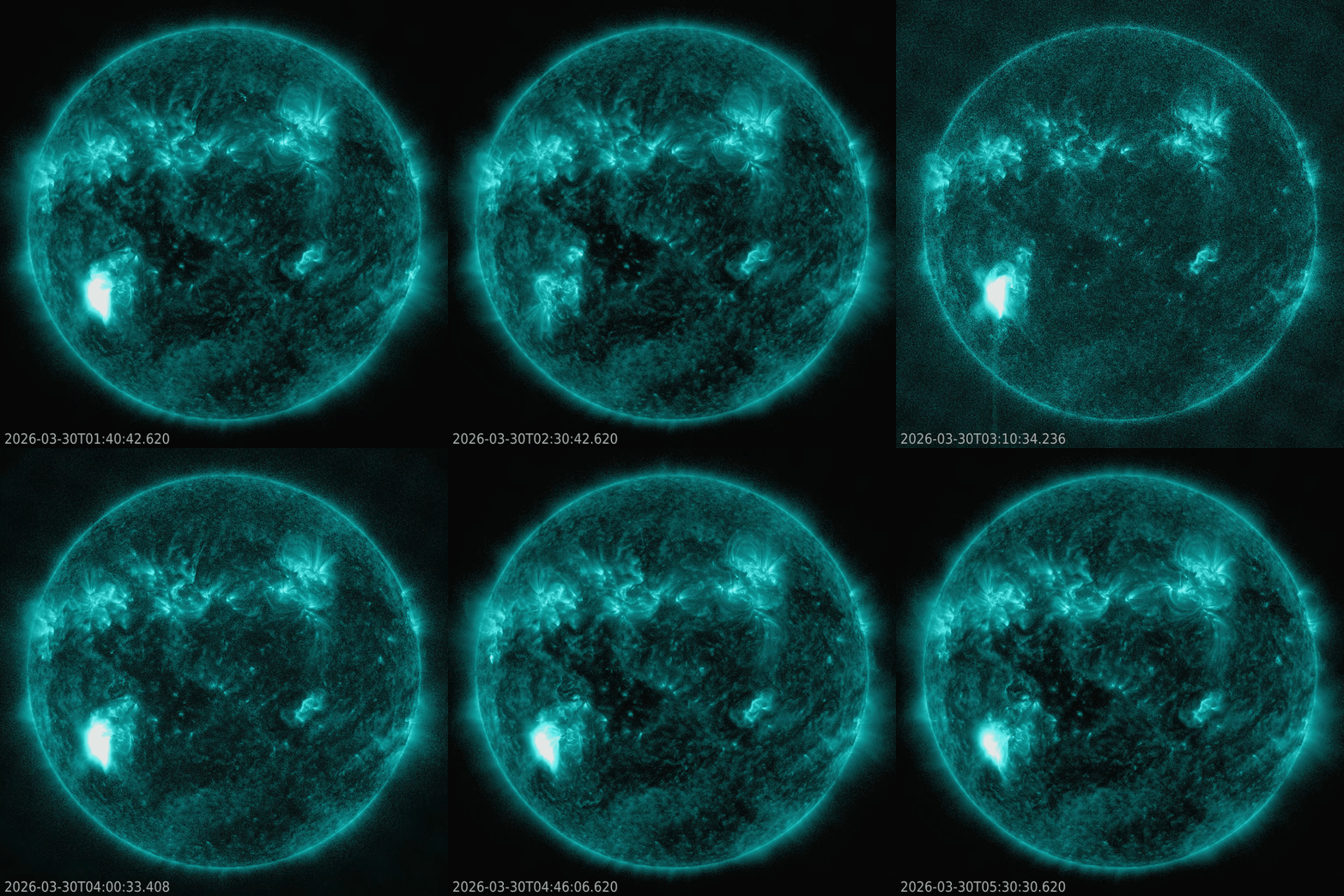
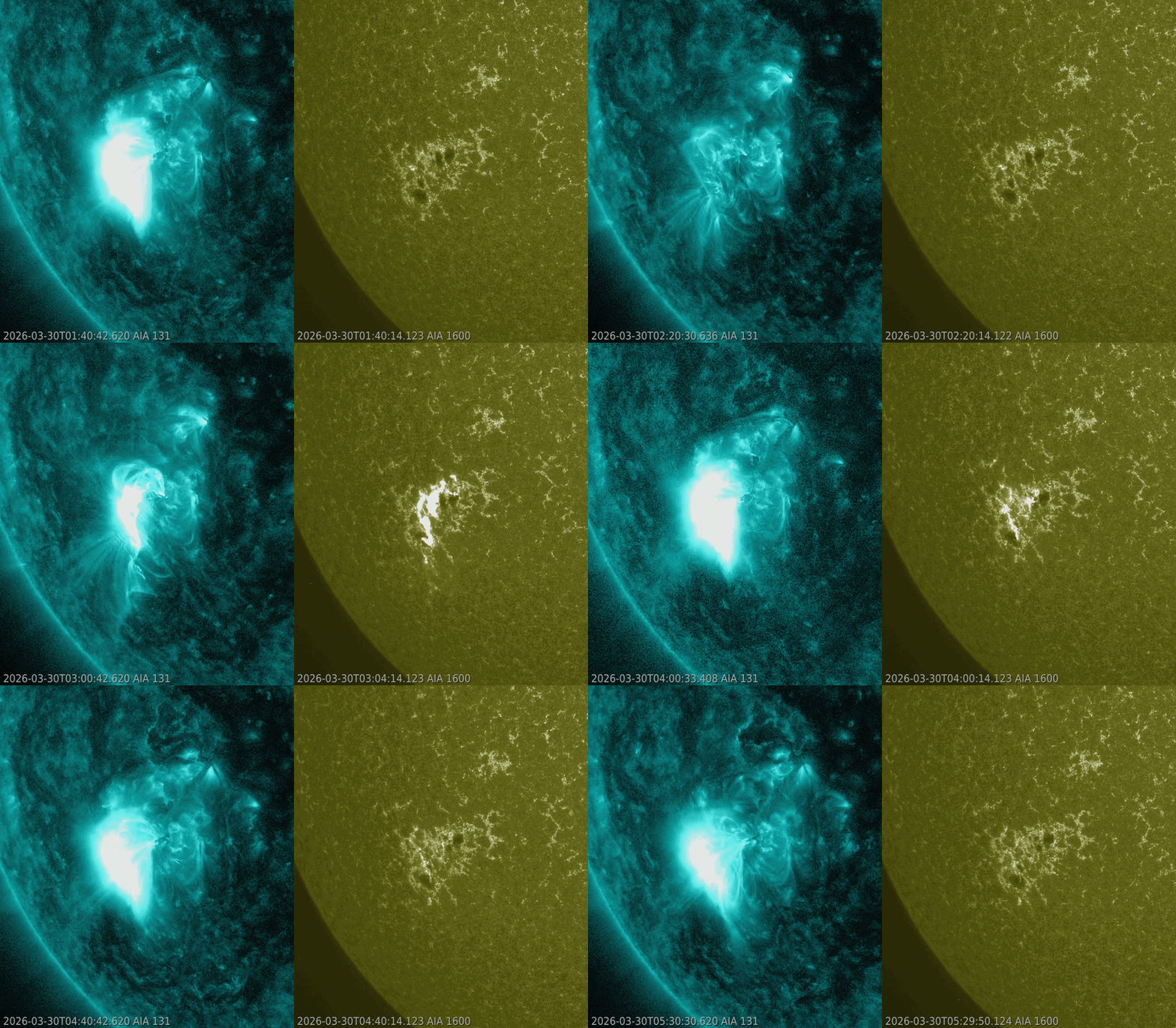
NOAA 4405 is currently the largest sunspot group on the solar disk and located in the southeast solar quadrant (see the above SDO/HMI white light imagery). It hasn't a very complex magnetic structure, but the magnetic mixing that is present is apparently sufficient for a strong flare. The observed X-class event started at 02:47 UTC and peaked at 03:19 UTC. It lasted 57 minutes, making this almost a long-duration event. The clip underneath shows the flare with reference to the entire solar disk in extreme ultraviolet at temperatures of several million degrees (SDO/AIA 131). The next two clips show a zoom on the flare, both in EUV, but the one on the right at much lower temperatures and probing the lower solar atmosphere. The blooming and diffraction patterns that can be seen in these images are instrumental (more information is in Note 1 of this STCE newsitem).
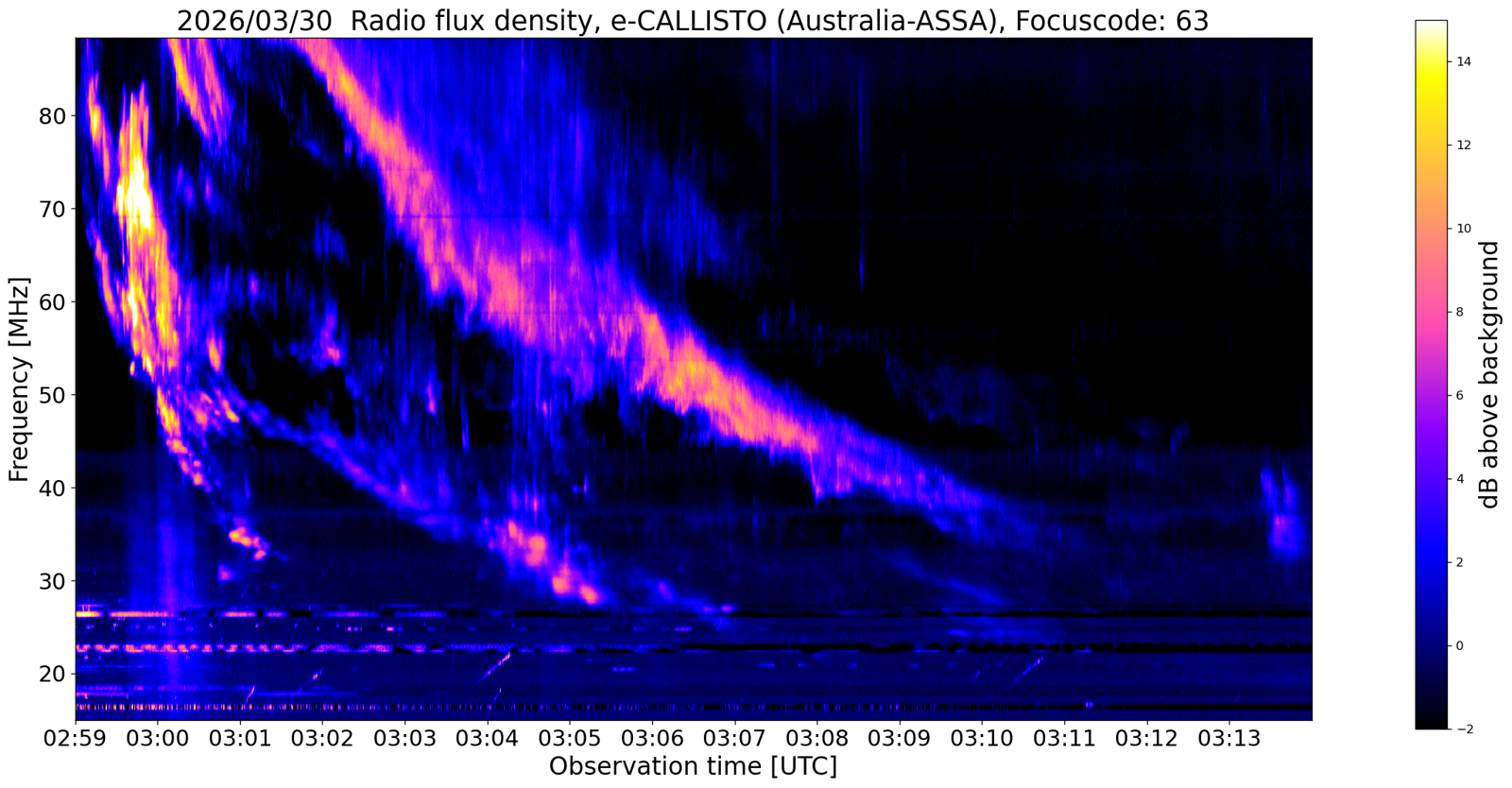
Radio astronomy stations from the e-Callisto network, in particular from Australia and India, were able to record a clear Type II radio burst associated with this eruption. This can be seen in the radio spectrogram underneath (time is on the horizontal axis, frequency on the vertical axis). This type of radio burst is usually associated with the shock of a coronal mass ejection (i.e. the ejection of a magnetic cloud filled with charged particles from the Sun into space).
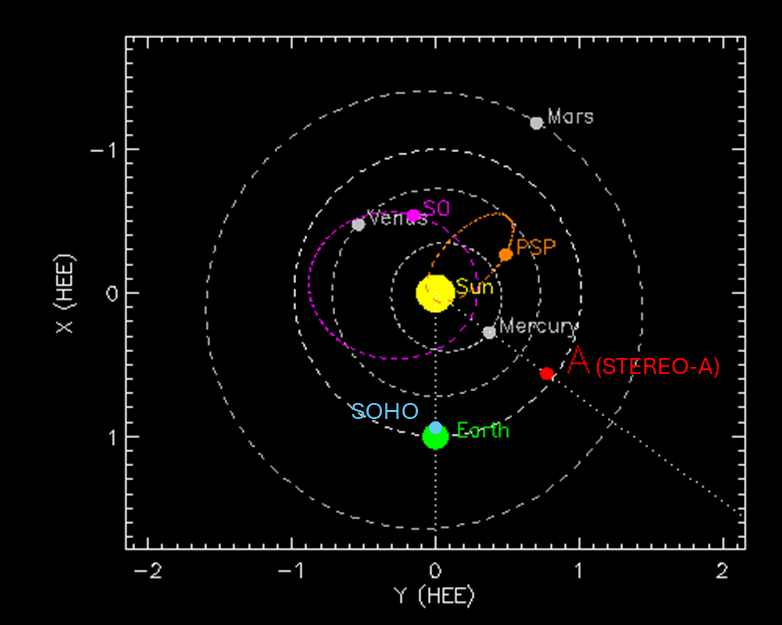
The currently available coronagraphic images taken by SOHO and STEREO-A -the latter being 54 degrees ahead of Earth (map)- show indeed a fast (around 1500 km/s) CME related to today's X-class flare. The bulk of the CME is headed below and behind the Earth, but there seems to be an earth-directed component. A preliminary analysis indicates an arrival time around 18:30 UTC on 31 March, with an uncertainty of 12 hours. Nonetheless, we're standing-by for the more fine-tuned analysis by the SIDC space weather forecaster for a better idea of the CME arrival time and the to-be-expected intensity of the geomagnetic disturbance. There is a chance on another strong flare from this active region over the coming days. The associated CME may then be more earth-directed as the region rotates further to the central portion of the solar disk.
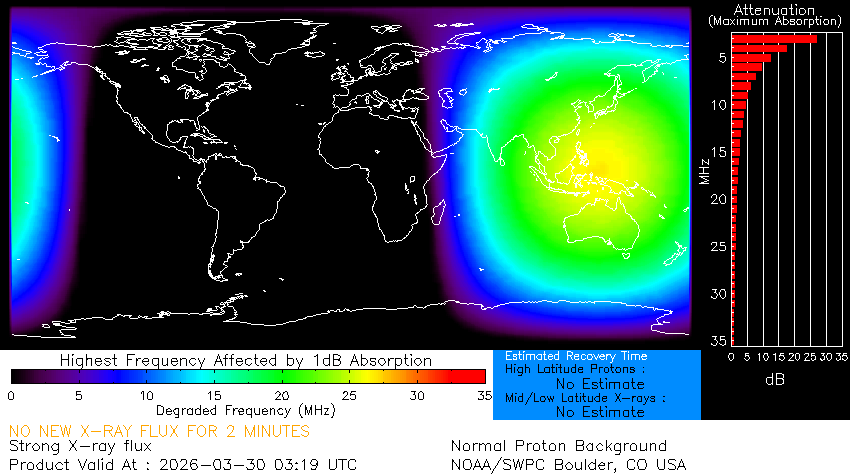
The ionizing radiation of the X-class flare itself affected the lower frequency portion of the High Frequency communication band (HF Com ; 3 - 30 MHz) on the dayside of the Earth, mainly over East- and South-East Asia, Australia and the West-Pacific Ocean. An advisory to civil aviation has been issued (PECASUS). The effects of the X1 flare on HF Com can be seen in the D-RAP (NOAA/SWPC) map underneath.