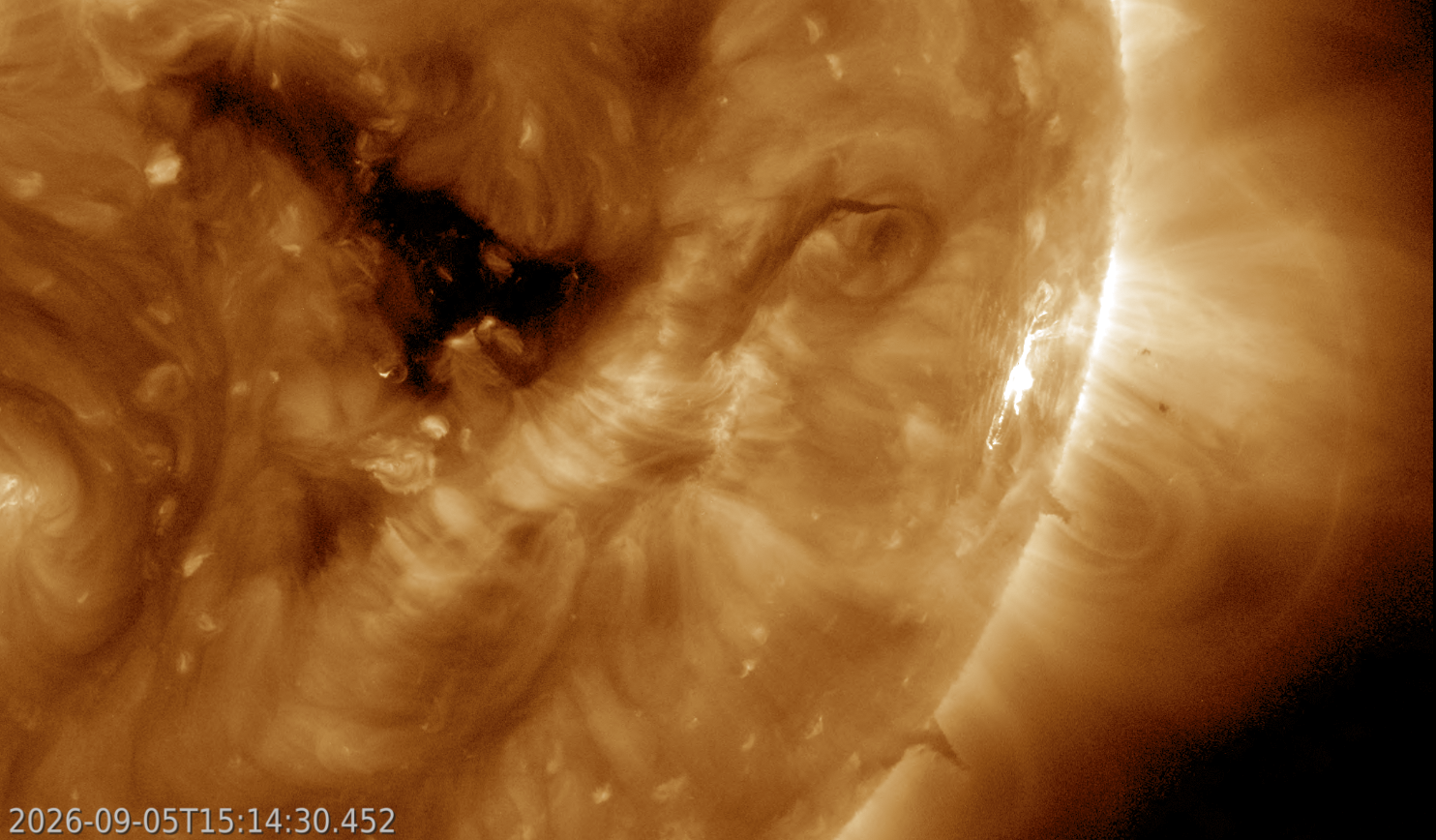
Addendum - H-alpha movies - Please scroll down
Sometimes it's hard to be a space weather forecaster. SIDC sunspot region 951 (NOAA 4520) had become spotless on 3 September and had not produced any significant flaring (C-class or higher) for several days. There was also no filament visible in H-alpha. Solar filaments are clouds of charged particles ("plasma") above the solar surface squeezed between magnetic regions of opposite polarity. Being cooler and denser than the plasma underneath and their surroundings, they appear as dark lines when seen on the solar disk in dedicated filters such as in H-alpha (656.28 nm).
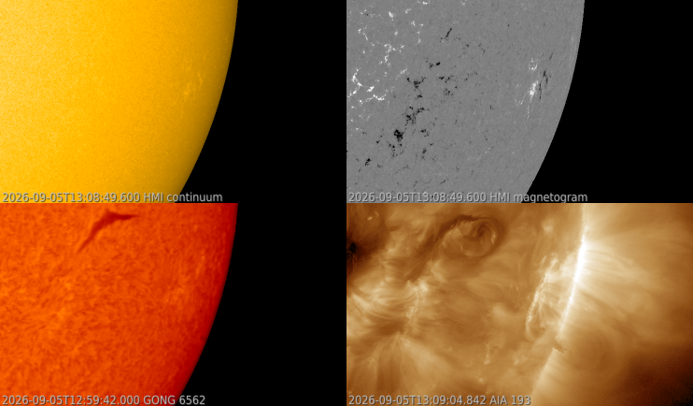
In this case, the region only revealed its location with some facula fields (bright regions in the photosphere), which is typical for a sunspot group that has decayed. Then, as the region was approaching the Sun's west limb on 5 September, out of nowhere it produced an M1.0 flare peaking at 15:18 UTC. The mosaic underneath was composed from SDO and GONG/H-alpha images showing the region two hours prior to the eruption in white light (upper left), H-alpha (lower left), extreme ultraviolet (EUV; lower right) and the magnetogram (upper right). In the latter, white denotes patches where magnetic field lines are leaving the Sun (positive polarity), and black denotes areas where magnetic field lines are returning to the Sun (negative polarity).
The quite violent eruption can be seen in the imagery underneath combining views in white light (left) and in EUV (SDO/AIA 193; right). A distinct coronal wave (also known as EIT wave or EUV wave - see this STCE newsitem) can be seen in the EUV imagery emanating from the location of NOAA 4520. Post-eruption coronal loops can be seen rising along the neutral line in the active region (mainly in the north-south direction), which separates opposite polarity magnetic fields.

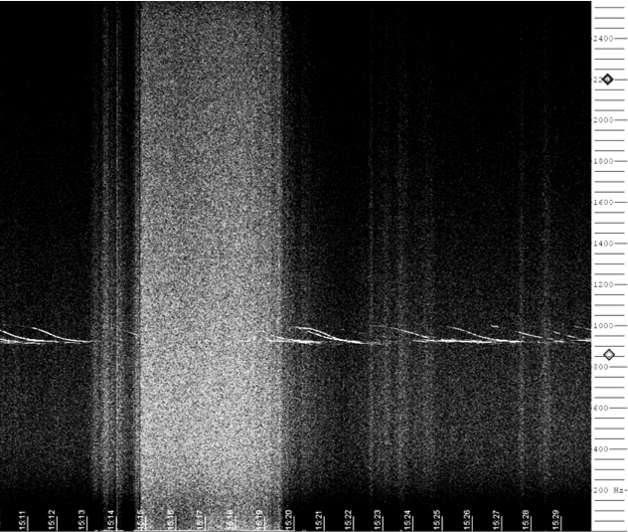
The radio emission associated with the flare was nicely recorded by the SPADE instrument of the Humain Radio Astronomy Station (HuRAS). The spectrogram underneath covers the frequency range from 25 to 75 MHz (vertical axis), with time on the horizontal axis. It nicely shows Type III and Type II radio bursts (see the STCE SWx classification page) around the time of the eruption. This radio noise from the Sun prevented radio-amateurs in Belgium for a full 5 minutes -from 15:15 to 15:20 UTC- to make useful observations of radio meteors at their beacon frequency of 49.99 MHz (Chart - Credits: Felix Verbelen). A small but noticeable interruption.

All these observations already indicated that there was a good likelihood that a coronal mass ejection (CME) would be associated with this flare. A fast halo CME was indeed observed in coronagraphic images from around 15:36 UTC onwards, with an estimated plane-of-sky speed of about 1400 km/s. Due to its source location close to the west limb and the estimated propagation direction, the SIDC forecaster expected only a low probability for this CME to deliver a glancing blow to the earth environment. In the end, the solar wind parameters did not show an obvious change in their values that would indicate a glancing blow from this CME.
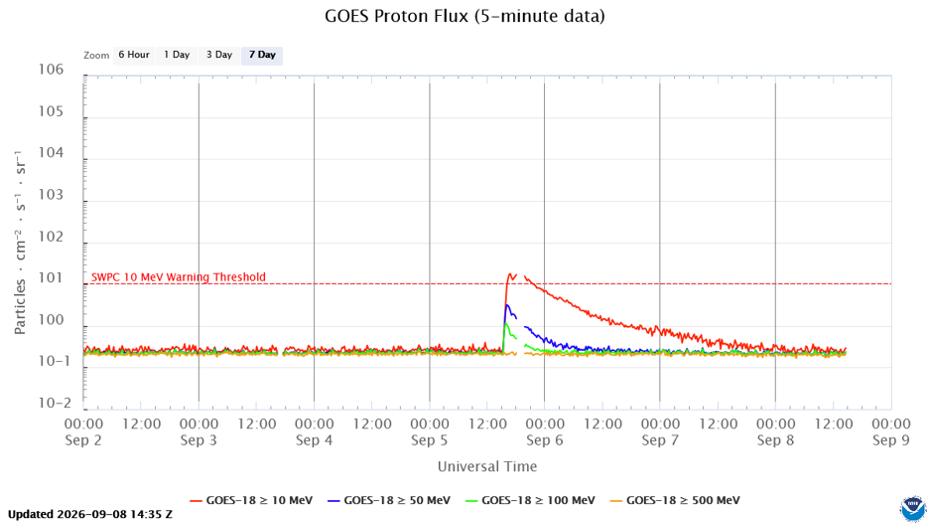
To top it off, this eruption was also associated with a minor proton event. Both the greater than 10 Mev and 100 MeV proton flux briefly reached their alert threshold of respectively 10 and 1 pfu (proton flux units), with peaks of 17 and 1.1 pfu reached about 90 and 30 minutes after the flare's maximum in soft x-rays (GOES chart). This is fast and thus, the proton event cannot be caused by the shock of the associated CME, but is really associated with the eruption itself. The favorable longitude of the sunspot region 68 degrees west of the central meridian helps of course, as it is near the perfect magnetic connection between the Sun and the Earth along the famous Parker Spiral. This allowed the injection of the energetic protons directly into the magnetic "express lane" to Earth. Models indicated that this proton event had not enough punch to create a Polar Cap Absorption, i.e. a disturbance of the High Frequency communication (3-30 MHz) over the polar caps. As a result, no advisory was sent to the international civil aviation by PECASUS. The SOHO coronagraphic imagery underneath shows both the CME and the extra noise from the proton event associated with the M1 flare.

With no sunspots present, no magnetically complex sunspot configurations, and also no filament, the most likely cause of this eruption was probably the sudden destabilisation of an empty filament channel. That's a mouthful, so let's take this on step by step.
Step A. In its simplest form, a filament channel is a magnetic structure consisting of a series of magnetic loops that are hanging over a magnetic polarity inversion line (Parenti - 2014). This "PIL", also called neutral line, separates areas of opposite magnetic polarity, i.e. the white and black areas in the highly simplified sketch underneath. The neutral line itself is indicated as a dashed orange line, and the magnetic field lines are marked in yellow. Note the dip in these magnetic field lines, i.e. the top of the loops is curved downward. This allows the structure to function as a "cradle" for the material that later may make up the filament. More complex forms such as a corkscrew configuration are possible too.
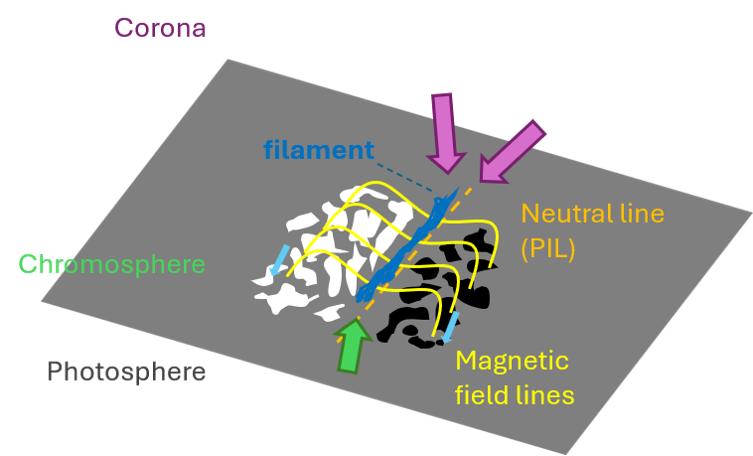
Step B. According to a recent study (Zessner et al. - 2026), random motions in the chromosphere (the Sun's lower atmosphere), may inject a small blob of cool chromospheric material into the magnetic dips. This is the start of the filament (the blue structure in the sketch above), which can then grow from the continued supply of plasma by condensation from the corona (the Sun's hot upper atmosphere) above and/or the continued injections from the chromosphere below. At the same time, material can also drain away from the filament. Indeed, as the filament structure is continuously swaying from side to side, cool plasma can now-and-then rain down along the magnetic field lines from the top of the prominence to the solar surface. In the sketch, the mass supply from the corona and the chromosphere is indicated by respectively the thick pink and green arrows, while the mass drain towards the chromosphere is indicated by the thin cyan blue arrows. It may be clear that this whole structure is very dynamic!
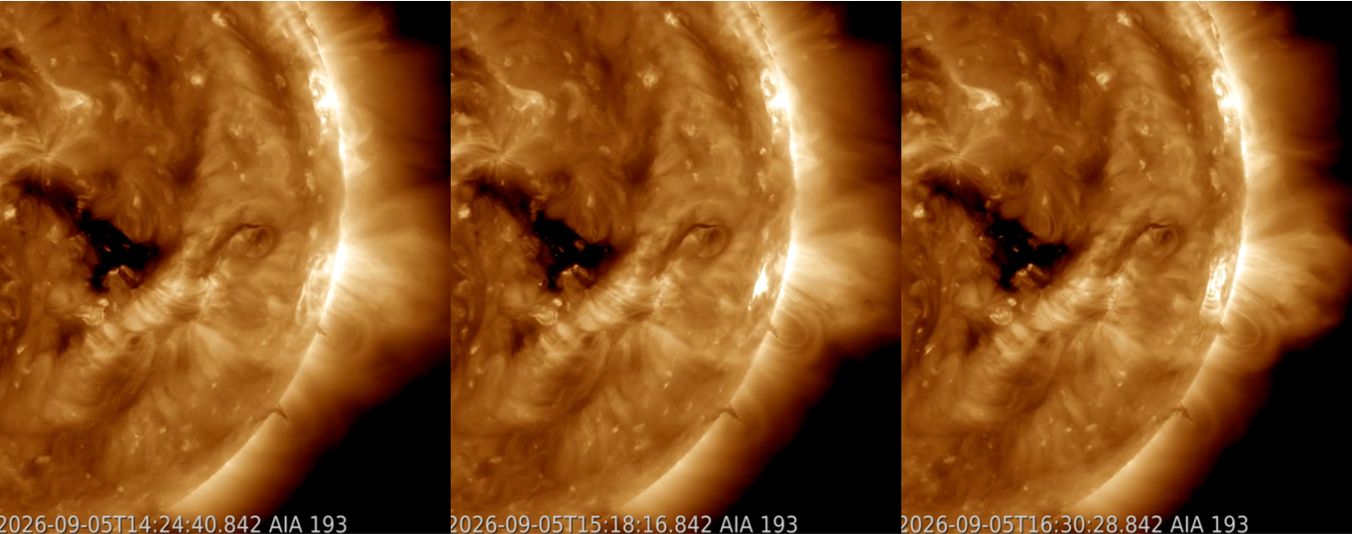
Step C. In the case of spotless NOAA 4520, the absence of a filament in this region suggests that the filament channel was empty. So, no plasma injection from the chromosphere had taken place yet, maybe because the magnetic structure was still in its early formation, or because it was more complex than discussed above and prevented the upload of chromospheric plasma. Local dynamics may then have contributed to the destabilisation and subsequent violent eruption of the filament channel. It's virtually certain that a magnetic structure was present in this region as can be gauged from the series of coronal loops that can be seen developing over the neutral line in this region after the eruption took place (EUV images below). Eruptions of (nearly) empty filament channels in (nearly) spotless regions have been discussed in earlier STCE newsitems here, here, and here - so this kind of eruptions may not be that uncommon. Nonetheless, it remains quite a feat to have an M-class flare, a fast CME and a minor proton event from an eruption in a spotless region.
Addendum - H-alpha movies
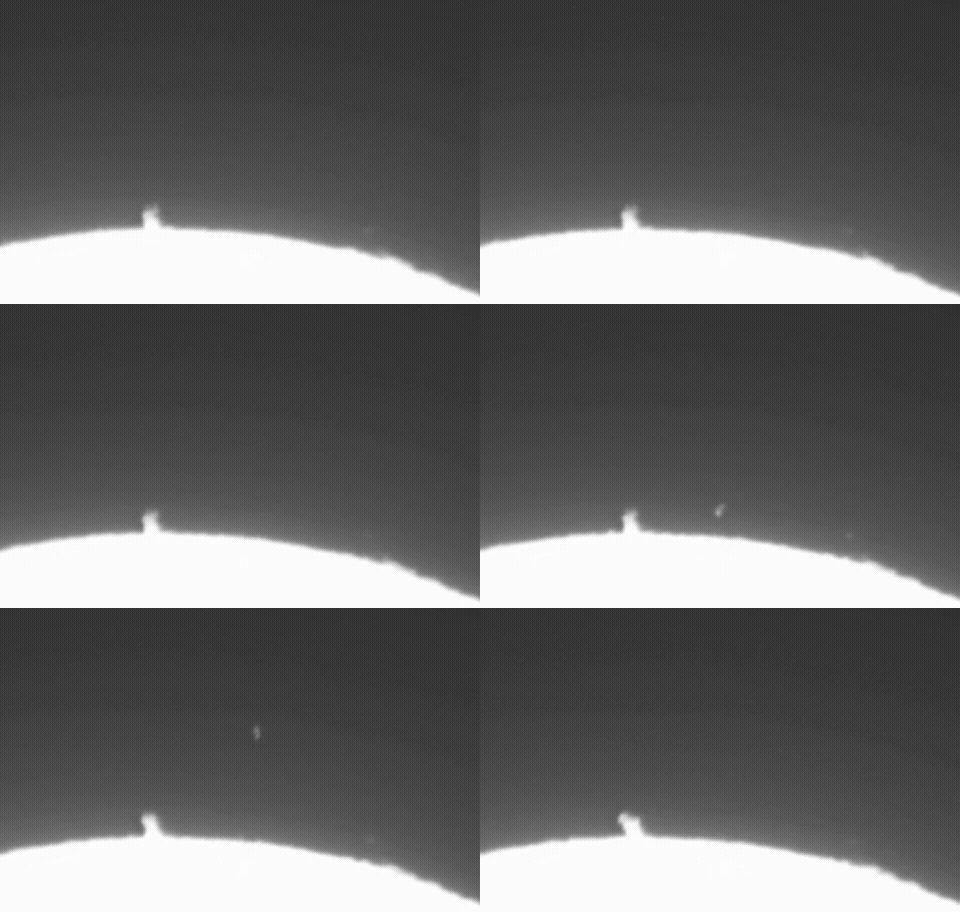
Following the above STCE newsitem "Antics of a spotless active region" on an eruption in a spotless region, Peter Meadows -director of the Solar Section of the British Astronomical Association- forwarded us two video clips of this very same event. They were made by amateur astronomers Scott Benavente (Silverton, Texas, USA) and Mike Cuffe (Isle of Wight, United Kingdom).
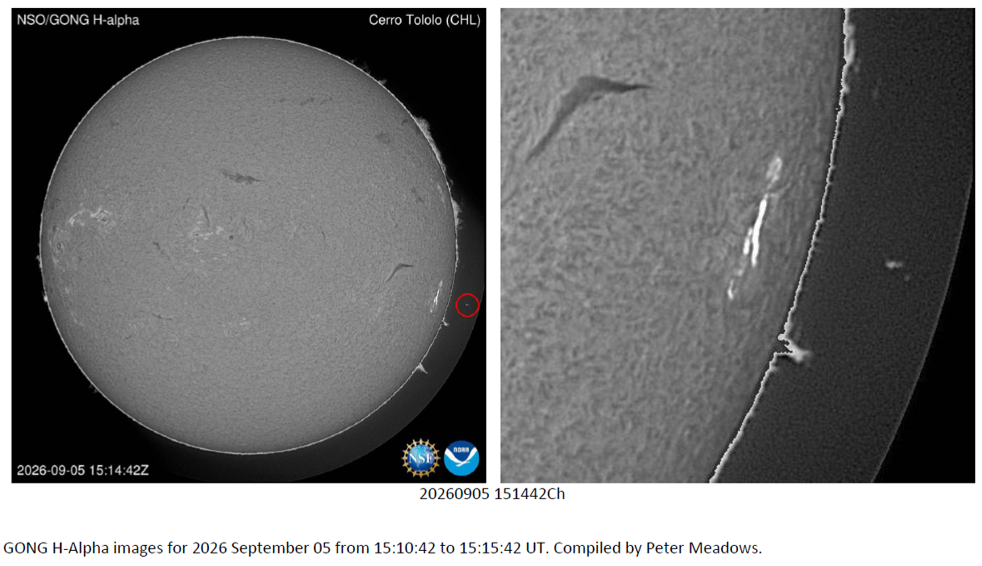
Peter writes: "Early last week I received two emails about a fast moving eruptive prominence observed on the 5th of September at around 15:10 to 15:15 UTC. Both Scott Benavente and Mike Cuffe had imaged this spectacular event and created videos." On reading the STCE newsitem, Peter quickly realised that the article and the clips all referred to the same active region 4520 and associated flare, and connected it also to GONG H-alpha images (attached). H-alpha is an absorption line in the red portion of the solar spectrum, and is often used in ground-based observations to image filaments, prominences and solar eruptions. Solar H-alpha telescopes use ultra-narrow filters (usually etalons with a bandpass under 0.1 nanometers) that completely block out the overpowering, blinding light of the photosphere. By tuning exactly into the dark absorption line, the telescope allows one to see the much fainter light being re-emitted by the active structures in the chromosphere.
The clips underneath were made with dedicated, but small H-alpha solar telescopes: Scott made his recordings with a LUNT 50 (5 cm diameter), while Mike used a Coronado PST (4 cm in diameter). These modest apertures make the obtained clips of course even more impressive. The links in the description provide more information on the recordings. The images have not been corrected for the usual orientation (north on top, west to the left), and may also have been mirrored due to camera and telescope optics.
 |
 |
|
Credits: Scott Benavente |
Credits: Mike Cuffe |
An interesting feature that could be seen in the video clips was a blob being ejected during the eruption (still). Mike Cuffe roughly estimated it to be travelling with a speed near 430 km/s in the plane of the sky. Using higher cadence (1 image per minute) SDO/AIA 193 imagery, some of the blobs are well visible in extreme ultraviolet (EUV) too as can be seen in the imagery underneath (still). The largest and densest of the blobs visible in EUV corresponds most likely to the blob seen in H-alpha. It moved at an average speed around 480 km/s, slightly higher than inferred from the H-alpha images. That this blob is visible in both H-alpha and EUV most likely means that it consisted of "cold" material (around 10.000 to 20.000 degrees), thus becoming visible as a dark silhouette against the bright, million degree hot background imaged by the AIA 193 filter. See e.g. this STCE newsitem for another example, and the introduction in Parenti et al. 2012 for a more in-depth discussion. Finally, it is possible that the blobs were originally part of a lean filament in a nearly empty filament channel. This filament may have been too small and too fragmented to have been obviously visible in solar imagery prior to its eruption.