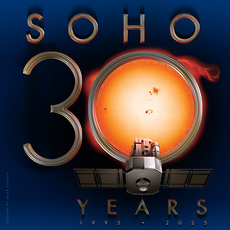
On 2 December 2025, the Solar and Heliospheric Observatory (SOHO) celebrated its 30th birthday. Since its launch in 1995, this versatile spacecraft has become an icon in solar and heliospheric research, and has provided space weather forecasters a solid base to build on.
SOHO, a combined ESA/NASA project, revolutionized space weather monitoring by providing imagery of the Sun in white light, 4 wavelengths in extreme ultraviolet, and magnetograms at a cadence of several images per hour. Its coronagraphs provided a view of the immediate surroundings of the Sun, allowing a good view on the dreaded coronal mass ejections. More importantly, these images were available in near real-time, something unseen up to that time.
SOHO instruments have contributed to several other research domains, such as the solar wind (parameters, origin) or the solar interior (oscillations). The spacecraft is also the best comet chaser in history, having made its 5000th (FIVE thousand!) comet discovery in 2024.
SOHO had a near-death experience in 1998 after a loss of control on 24 June. Fortunately, ground controllers heroically regained contact with and control of the spacecraft over the next few months. It's the single period in SOHO's operational life without imagery, and it became known as "SOHO's holiday". Eventually, this workhorse of the solar scientists and space weather specialists would become superseded by the Solar Dynamics Observatory in 2010, which had a much higher resolution and image cadence. However, the telemetry gained by stopping SOHO's solar disk imagery was used to boost the cadence of the coronagraphic images to one image every 12 minutes, for both coronagraphs. That is why, up to this day, SOHO remains the main spacecraft delivering the so critical coronagraphic imagery.
More information can be found on the SOHO website, linking to specific ESA and NASA bulletins.
Many congratulations to the SOHO team and all who contributed to this ongoing and incredibly successful solar mission!