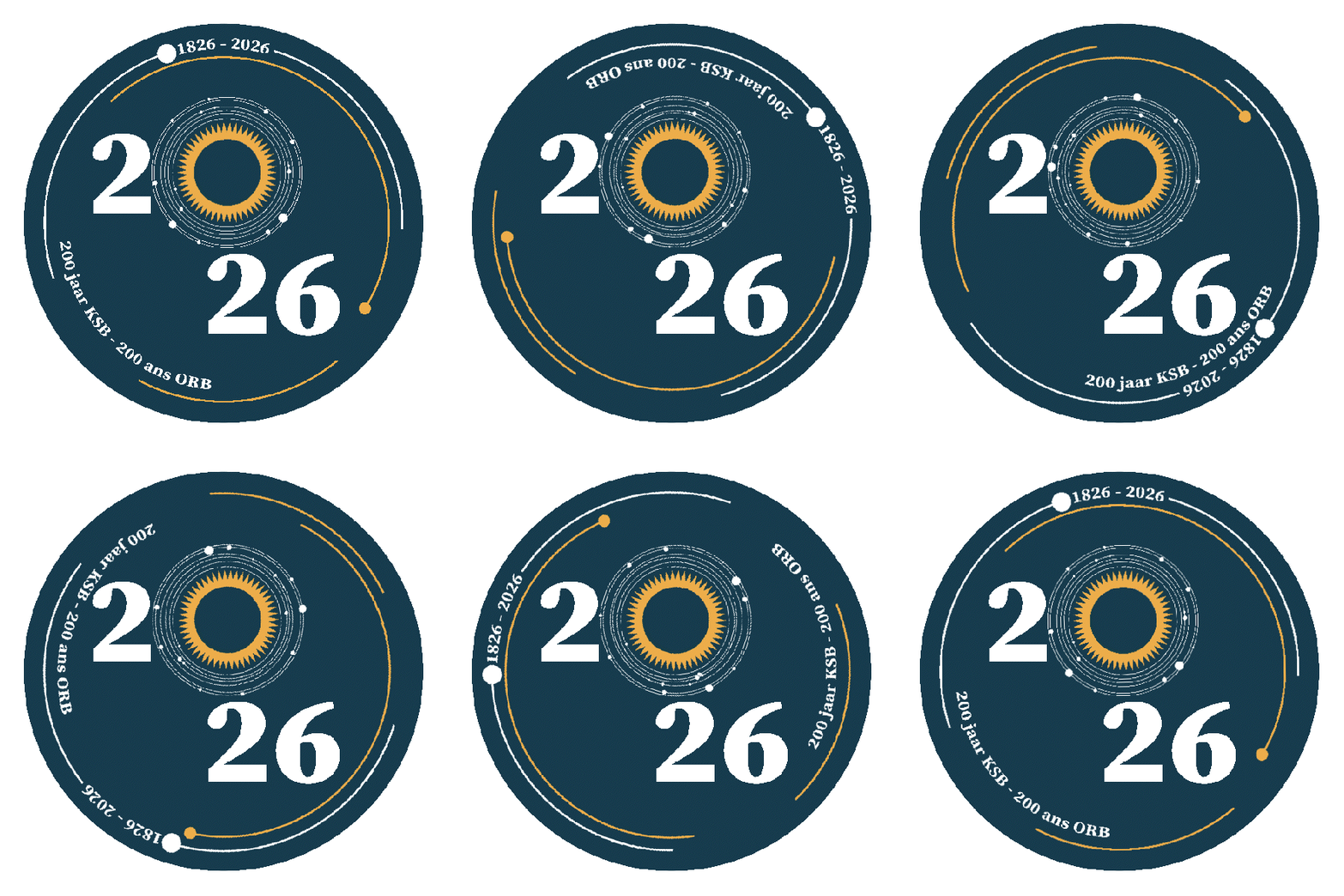
The anticipated arrival of the coronal mass ejection (CME), associated with yesterday's X1 flare (STCE newsitem) came a lot sooner than expected. A jump in the strength of the interplanetary magnetic field (B; white curve in chart underneath) was observed at 18:59UTC by the ACE spacecraft. That's 6 to 12 hours earlier than most of the forecasts had predicted. The north-south component of the interplanetary magnetic field (Bz, red curve) gradually turned deeply negative; reaching -58 nT at 21:04 UTC, before quickly returning to positive values near +50 nT (!) and staying there for the next hours. In comparison, the May 2024 storm reached -55 nT, and during the one from October 2024 Bz reached "only" -46 nT. However, during the latter 2 geomagnetic storms, Bz stayed at these strongly negative values for several hours, instead of a few minutes, resulting in a much more intense and long-lasting disturbance.
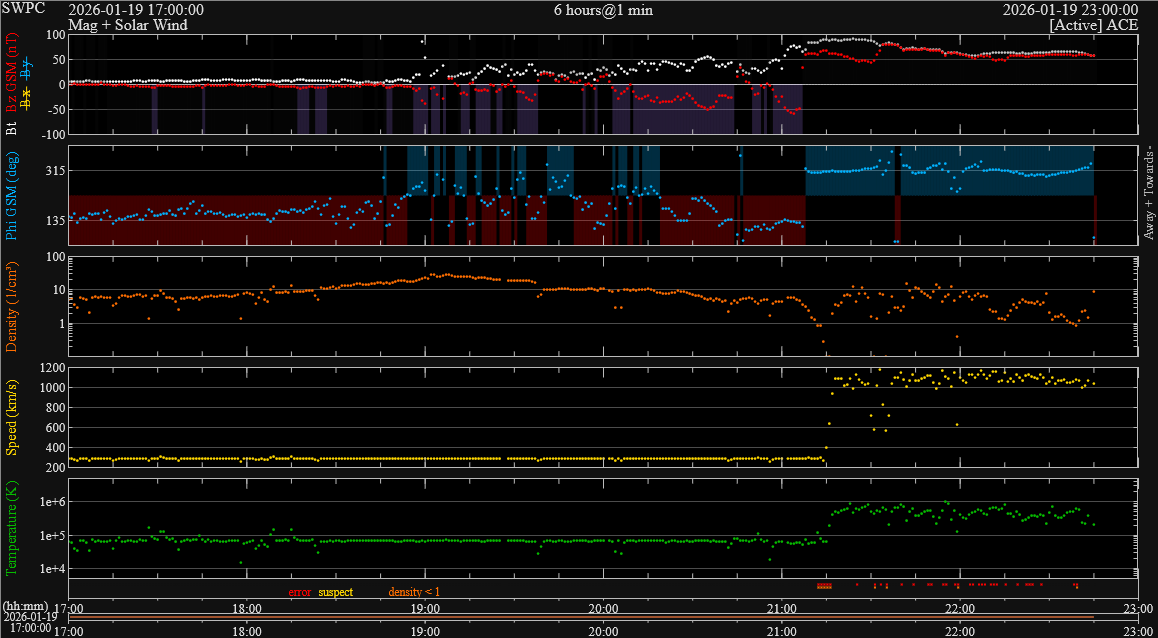
The speed of this interplanetary CME near Earth was at a whopping 1100 km/s (yellow curve in the graph above). The CME covered the Sun-Earth distance in barely 25 hours! That is very fast and places it just outside the club of "Fast Transit Events" (FTE), these are CMEs who complete this transit in less than a day. The powerful CME drove the 10 MeV proton flux to an astonishing 37.000 pfu at 19:15 UTC. We have to go back all the way to 23-24 March 1991 (that's 35 years ago...) to find an even stronger proton event. As mentioned in the other newsitem though, one has to keep in mind that the flux of more energetic protons remained at background levels, and so the radiation levels remained relatively low. As soon as the CME had passed, the proton flux dropped by 2 orders of magnitude.
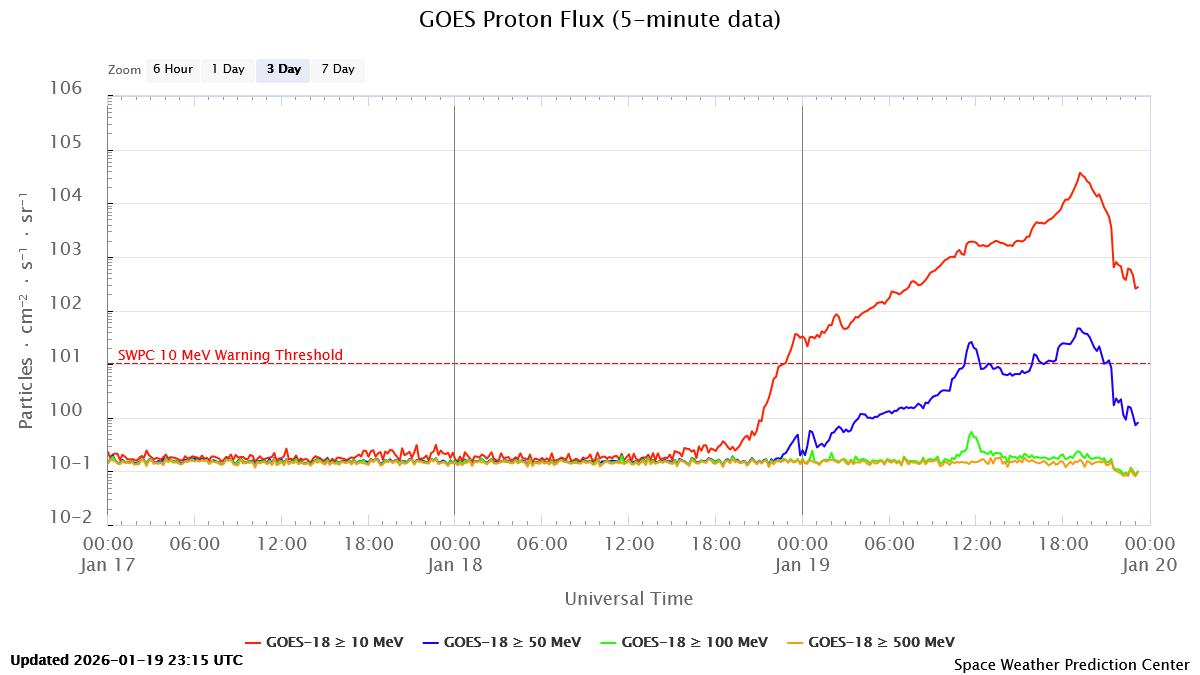
The strong solar wind disturbance resulted in a severe geomagnetic storm, with both NOAA and Potsdam reporting a Kp of 9- during the 21-24UTC interval. Locally, such as in Dourbes (Belgium), an extremely severe storm interval was recorded during the 20-23UTC interval (1-hour K_BEL index of 9). Over the same time interval as NOAA and Potsdam, the 3-hour K_BEL reached only strong levels (K_BEL = 7). See the STCE SWx classification page for details on the various geomagnetic indices and scales. These geomagnetic conditions are of course strong enough to make aurora visible over Belgium. And what a show it was!... Amazingly, this time, the green colour was also prominently displayed, with bright bands well above the horizon and smaller waxing-and-waning bright patches everywhere else in the northern sky. The latter are called "proton aurora", rare and faint, diffuse green or reddish patches of light caused by energetic protons from the solar wind colliding with Earth's atmosphere, unlike typical auroras (Northern/Southern Lights) driven by electrons, appearing as blobs or arcs away from the main auroral oval. Underneath a compilation from some aurora enthousiasts at the Royal Observatory of Belgium. Further intervals of strong to severe geomagnetic storming remain possible throughout 20 January.
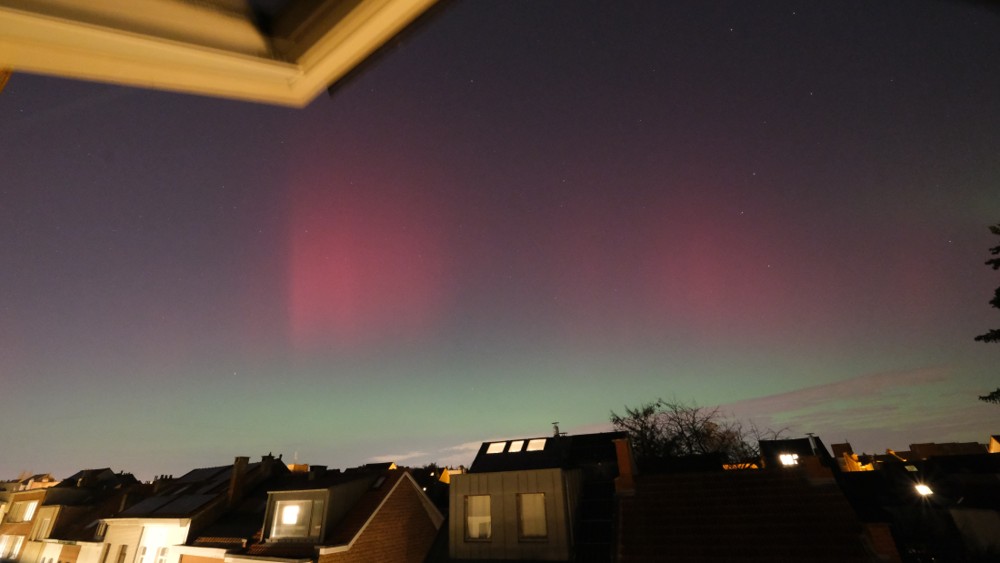
Credits: Thomas Lecocq
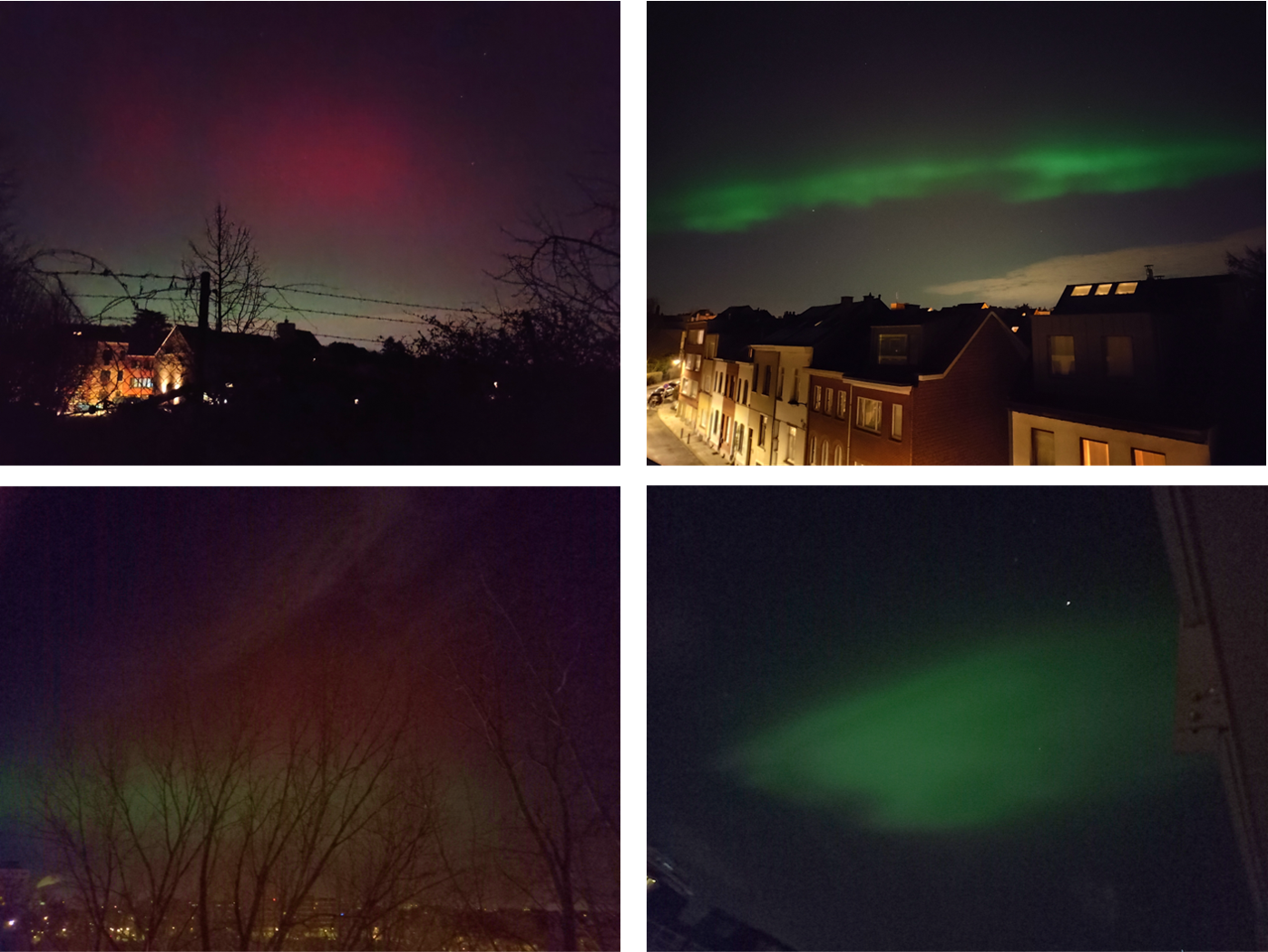
Credits: Jennifer O'Hara (upper left), Thomas Lecocq (upper right), and Jan Janssens (lower row)