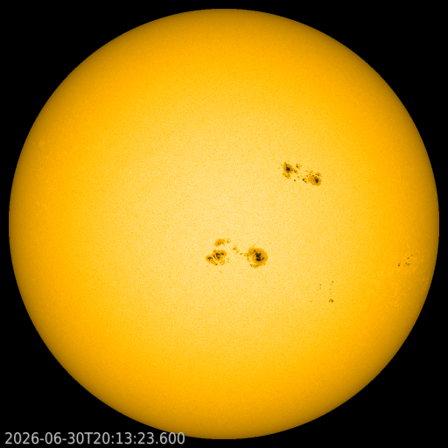
There are currently 2 big sunspot groups on the solar disk. The largest one is NOAA 4478 (SIDC sunspot group 886) which is located in the southern solar hemisphere, whereas the somewhat smaller NOAA 4479 (SIDC sunspot group 860) is located in the northern solar hemisphere. Both are new groups that started their life resp. on the Sun's farside (STCE newsitem) and on the Earth facing solar hemipshere. Using eclipse glasses, they are currently visible with the naked eye, both being close to the central meridian. Despite its size, NOAA 4478 has been very quiet since its apperance near the east limb. NOAA 4479 developed slowly and started to produce somewhat enhanced flare activity from 29 June onwards, when it developed magnetic delta structures particularly in its trailing section.
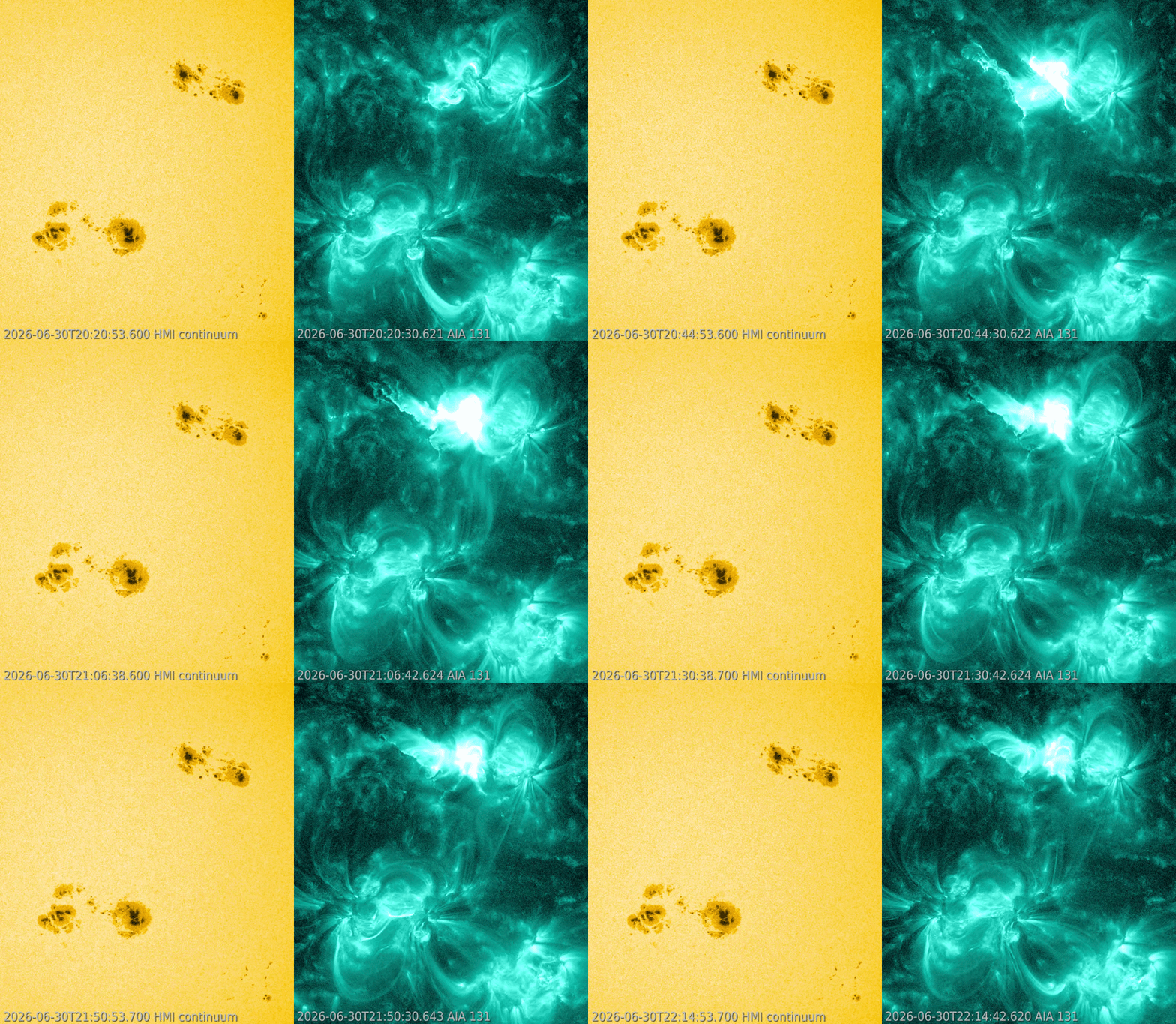
Finally, on 30 June, NOAA 4479 produced an X1.1 flare peaking at 20:50 UTC (GOES).The SDO imagery on the left shows a zoom of the area in white light, while on the right is the view in extreme ultraviolet (EUV) at temperatures of several million degrees showing the eruption. The eruption clearly took place in the trailing portion of the active region. The blooming and diffraction patterns that can be seen in these EUV images are instrumental (more information is in Note 1 of this STCE newsitem).
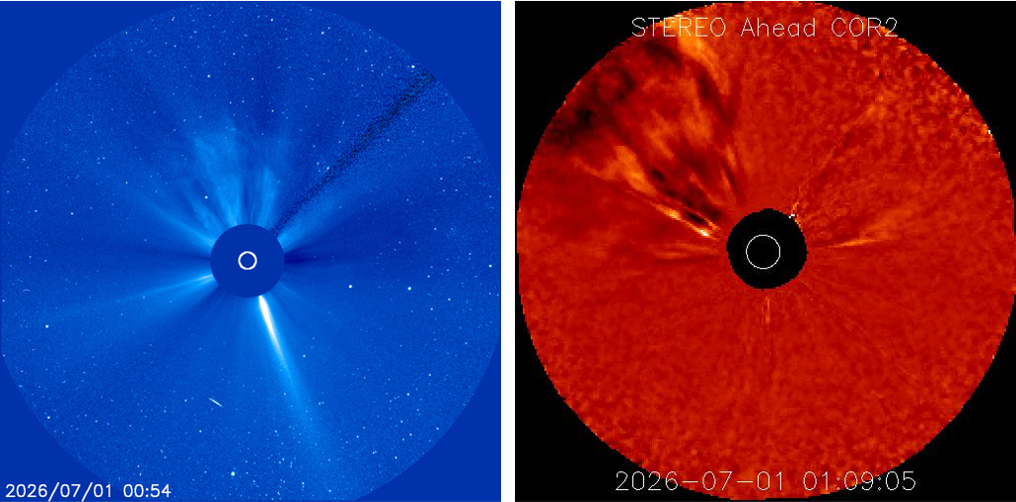
Only moderate enhancements at radio frequencies have been reported (NOAA/USAF). The proton flux (GOES) has remained at background levels. The SIDC forecaster reports that "A wide halo Coronal Mass Ejection (SIDC CME 679) was observed in SOHO/LASCO C2 imagery around 21:00 UTC on June 30. In the plane of the sky, the CME was directed mainly northward to north-westward, with an estimated plane-of-sky speed of about 700 to 800 km/s. ... Due to the source region location close to the central meridian, the CME is expected to have an Earth-directed component. ... " The coronagraphic images underneath show the CME as seen by SOHO (left) and STEREO-A (right). The latter is 62° ahead of Earth, and so it sees the CME from its side (Earth is here to the left). A preliminary estimate of the arrival time of the CME is late on 2 July to early on 3 July, most likely resulting in a moderate geomagnetic storm (K and Kp around 6). Aurora from this storm are unlikely to be seen from Belgium. Standing-by for further fine-tunings by the SIDC forecaster.
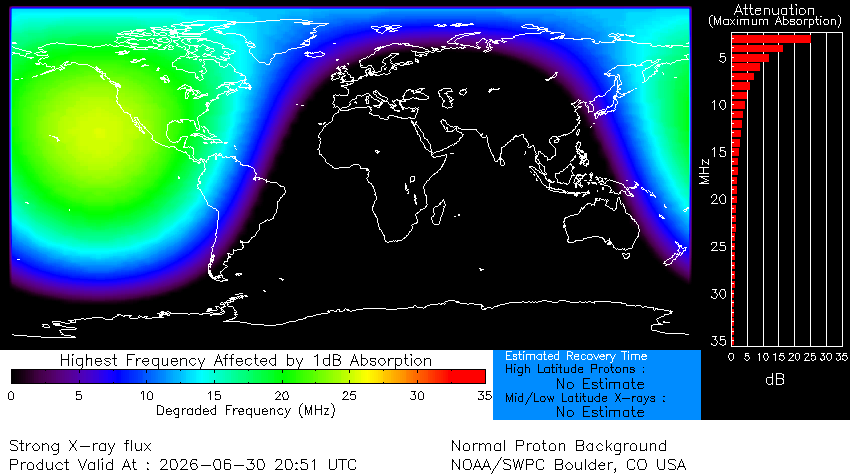
The ionizing radiation of the X-class flare itself affected the lower frequency portion of the High Frequency communication band (HF Com ; 3 - 30 MHz) on the dayside of the Earth, mainly over the Pacific Ocean and North-America. An advisory to civil aviation has been issued (PECASUS/ACFJ). The effects of the X1 flare on HF Com can be seen in the D-RAP (NOAA/SWPC) map underneath.