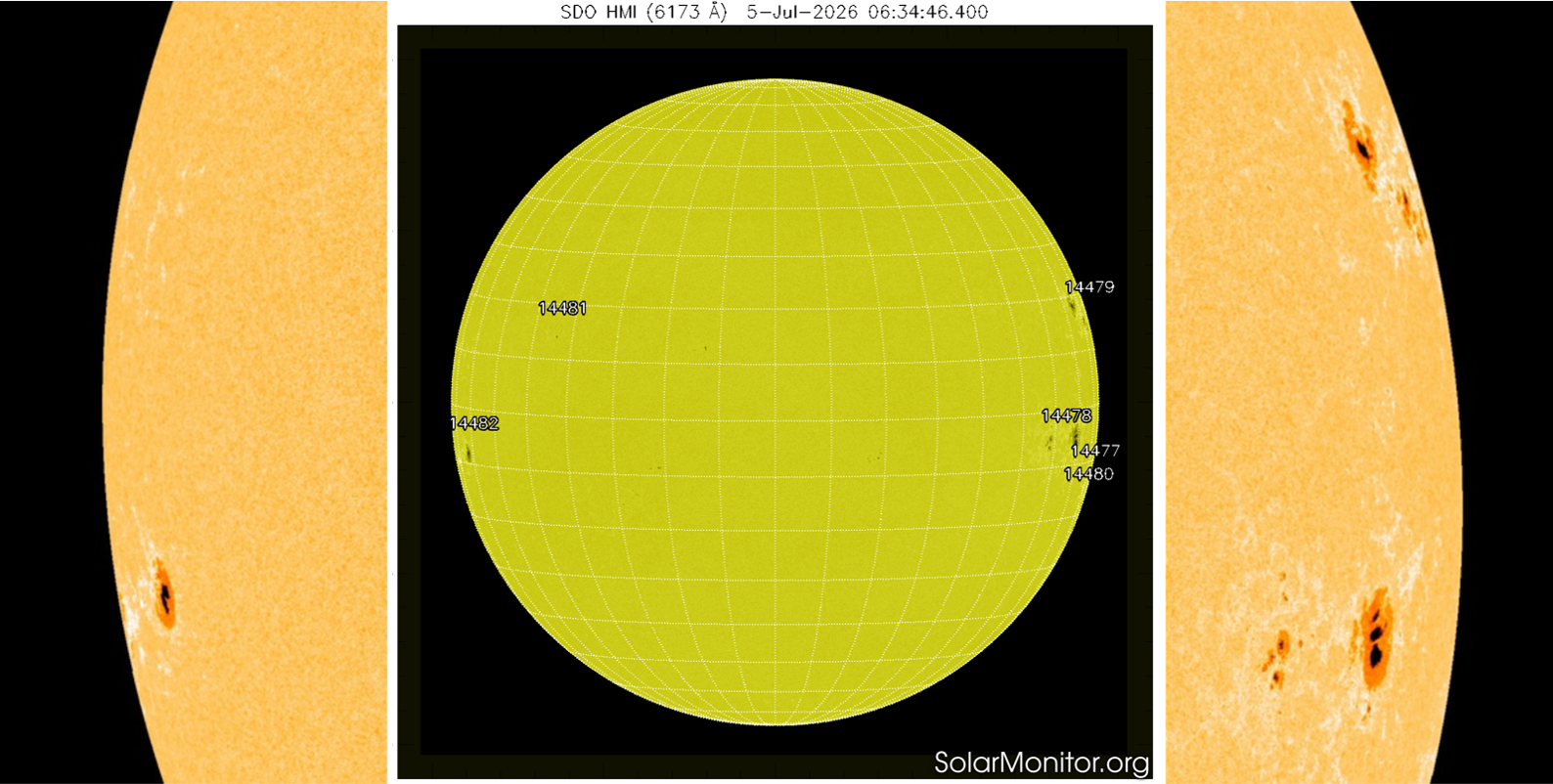
NOAA 4478 and 4479 (SIDC sunspot groups 886 and 860) have been dominating sunspot activity last week. The flare activity was mostly orchestrated by NOAA 4479, which was the source 12 (twelve!) M-class flares on 4 July. However, the strongest flare was generated by a new, large active region NOAA 4482 that is still rotating over the Sun's southeast limb. The locations of the 3 active regions, as well as a zoom can be found in the SDO/HMI images underneath, all taken around 06:30UTC on 5 July.
NOAA 4482 produced the X1.3 flare at 20:41 UTC on 4 July. The extreme ultraviolet (EUV) images underneath were taken by GOES/SUVI and show the full Sun at the flare's peak time, as well as a zoom about 15 minutes later. The EUV images show the Sun at temperatures of several million degrees (SUVI 131). The blooming and diffraction patterns that can be seen in these EUV images are instrumental (more information is in Note 1 of this STCE newsitem). The proton flux (GOES) has remained at background levels.

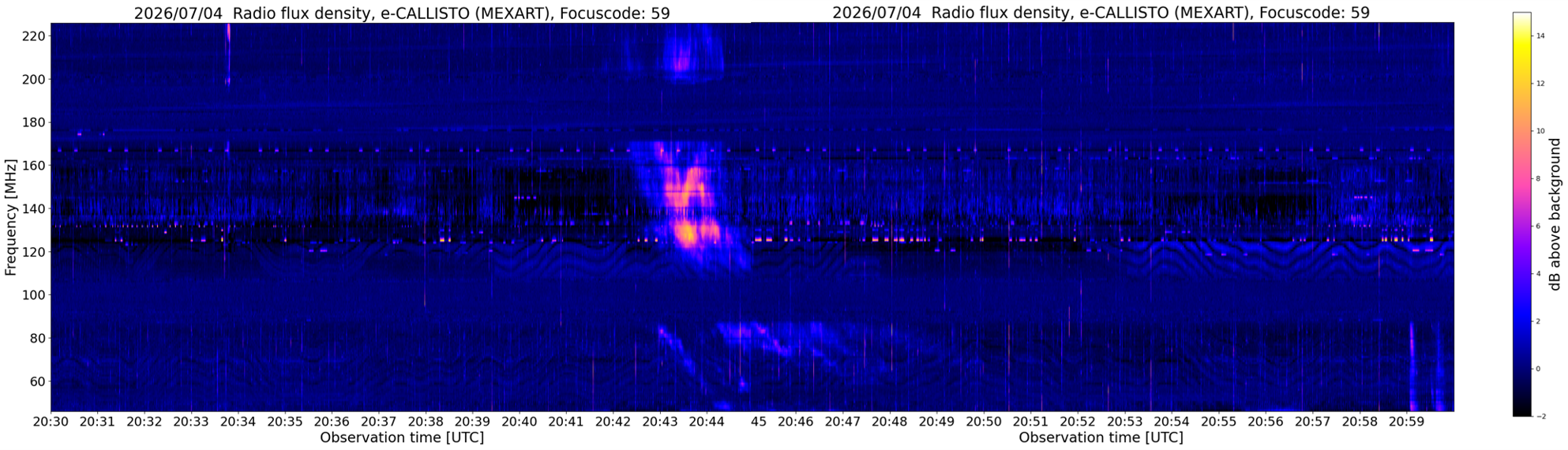
The flare was accompanied by radio emission at frequencies in the GHz range (NOAA/USAF). The Mexico station of the e-Callisto network recorded a Type II burst as shown in the radio spectrogram underneath, with the horizontal axis representing time and the vertical axis representing frequency (lowest frequencies at the bottom). Type II bursts are indicative of a shock propagating through the solar atmosphere, and suggest a coronal mass ajection (CME) associated with the eruption. Unfortunately, there is a large data gap in the current coronagraphic imagery from both the SOHO and STEREO-A instruments, and GOES/CCOR-1 only hints at a weak CME around 23:00UTC. Anyway, any CME associated with the X1 flare is expected to be directed away from the Earth in view of NOAA 4482's location. Standing-by the analysis by the SIDC space weather forecaster.
The ionizing radiation of the X-class flare itself affected the lower frequency portion of the High Frequency communication band (HF Com ; 3 - 30 MHz) on the dayside of the Earth, mainly over the Pacific Ocean and North-America. An advisory to civil aviation has been issued (PECASUS/ACFJ).