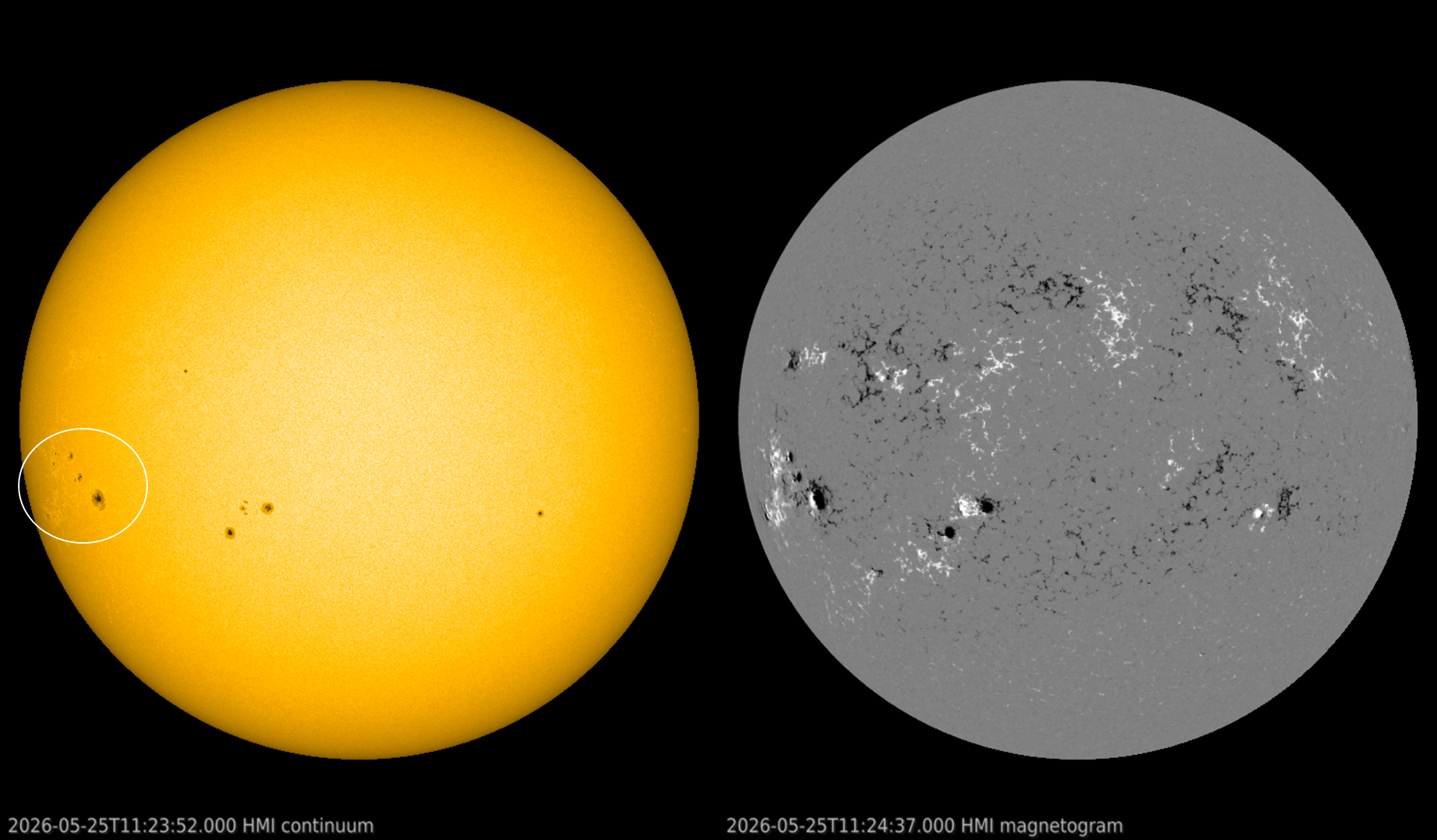
From 15 May onwards, space weather monitors noticed several coronal mass ejections that had their origin on the Sun's farside. The Polarimetric and Helioseismic Imager (PHI) on board of Solar Orbiter quickly revealed the presence of a large and magnetically complex sunspot group. This region was located almost diametrically opposed to the Earth, near the 180° meridian (figure underneath). The 0° meridian (usually known as the "central meridian") is directly facing the Earth, while the 270° meridian denotes the east limb as seen from Earth. The figure underneath (PHI) shows the active region near the far side meridian on 17 May, in white light (left) and in a magnetogram (right). The latter shows a complex magnetic polarity, i.e. a "mixing" of positive (white) and negative (black), in particular in the leading and middle portions of the active region. It also hints at 2 or maybe 3 active regions close together. The inset in both images provides the location of Solar Orbiter (the green dot) and the Earth (the blue dot) with respect to the Sun (orange dot).
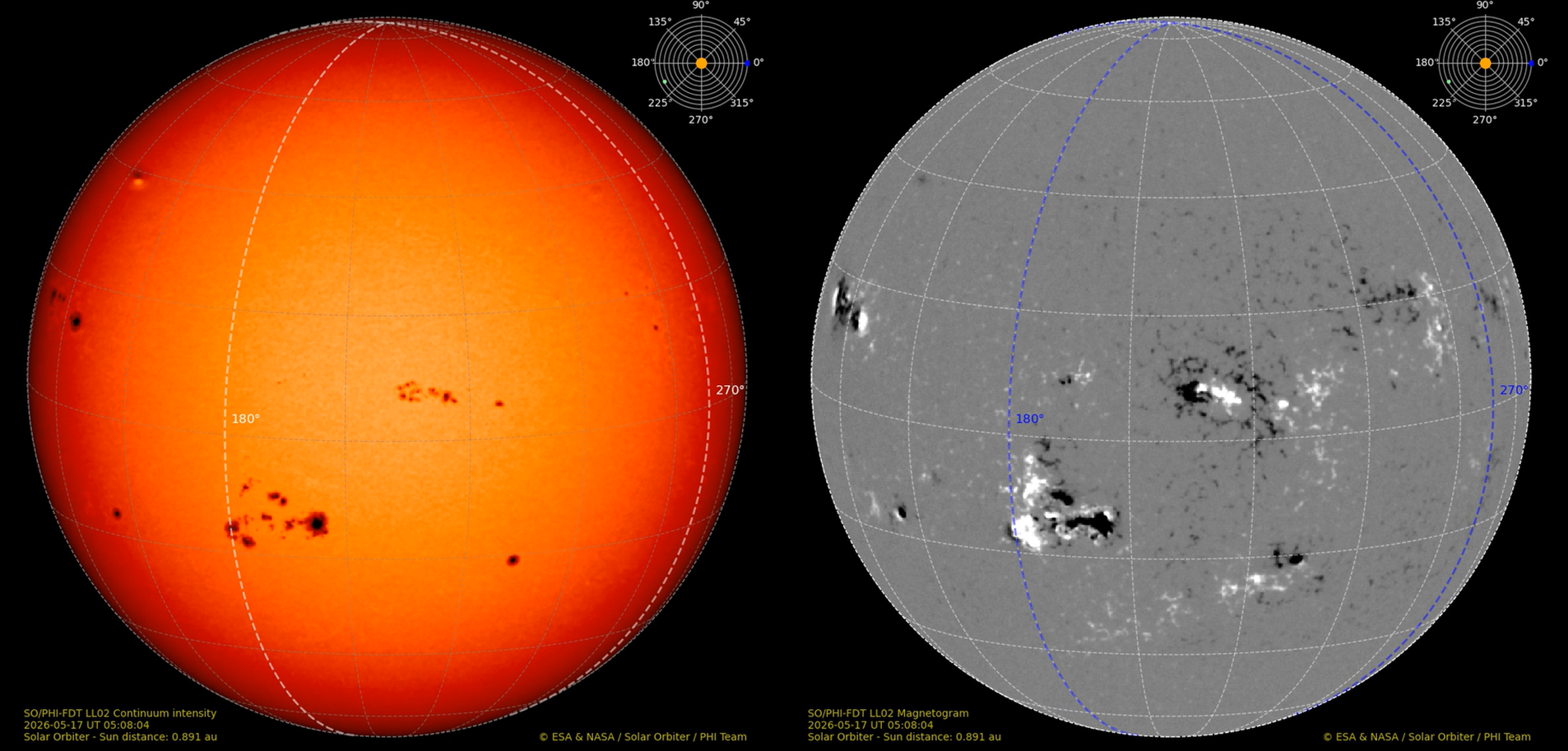
Another instrument on board Solar Orbiter, the Spectrometer and Telescope for Imaging X-rays (STIX), revealed that the Sun was indeed very flare productive between 15 and 17 May. STIX provides a proxy for the intensity of solar flares as normally measured by GOES in soft x-rays, but deduced from observations in hard x-rays. More information is in this STCE newsitem. As it turns out, in just 3 days, more than a dozen of M-class and 3 X-class flares were produced by this active region. The X-class flares took place on 15 May (X1.5), and on 16 May (X1.2 and X1.6). As these are proxies, the true intensity was most likely between M7 and X3 for each of the three flares. Solar Orbiter's Full Sun Imager (FSI), which is part of the EUI instrument (Extreme Ultraviolet Imager) revealed that the source of these "eXtreme" flares was indeed that large sunspot group. The images underneath show the Sun in extreme ultraviolet (EUV) at a wavelength of 17.4 nm (around 1 million degrees) just before (left) and near the maximum of the strongest X-class flare on 16 May.
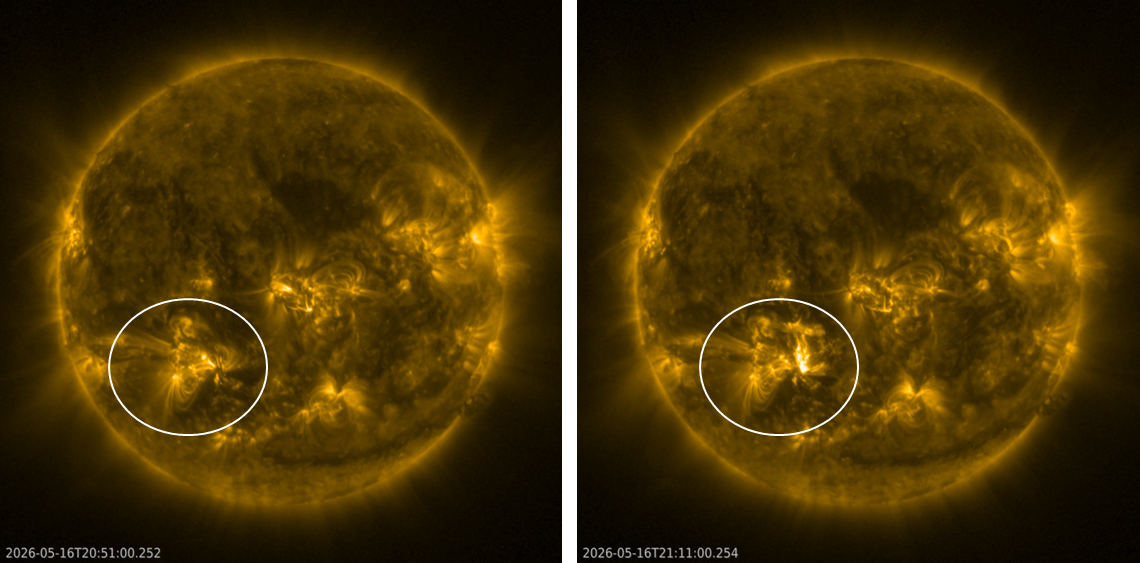
As the region was only a week behind the east limb, anticipation was high that it would still be actively flaring when rotating over the east limb and finally facing its earthly audience. Alas, when it did late on 22 May, it quickly became clear that the entire sunspot structure had shrunk in size, and that its magnetic complexity had mostly defused. No M-class flares have been observed during its transition over the earth-facing solar hemisphere so far. The region has also been split in 3 to 4 smaller sunspot groups, the largest of which is NOAA 4446 (SIDC Sunspot group 873). The SDO/HMI images show the active region in white light (left; annotated) and its corresponding magnetogram (right) on 25 May. Barring the emergence of some new magnetic flux, no further active M- and X-class flaring from this sunspot group is expected.