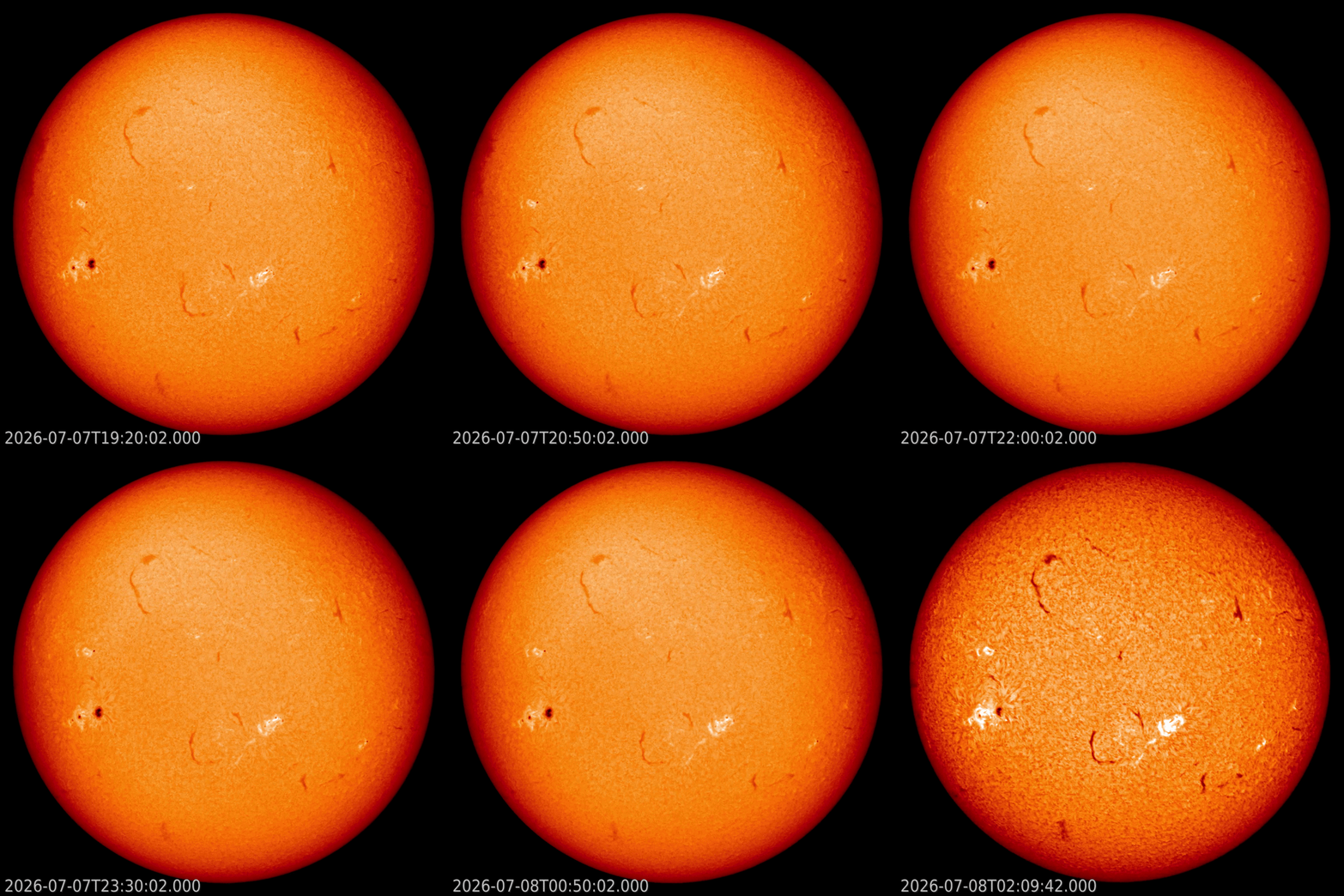
Solar filaments are clouds of charged particles ("plasma") above the solar surface squeezed between magnetic regions of opposite polarity. Being cooler and denser than the plasma underneath and their surroundings, they appear as dark lines when seen on the solar disk and as bright blobs when seen near the solar limb (then they are called "prominences"). Special filters are required to observe these features, such as in the Hydrogen-alpha (H-alpha) line in the red part of the solar spectrum (656.28 nm), or in some extreme ultraviolet (EUV) passbands such as GOES/SUVI 195 or SUVI 304. The H-alpha imagery underneath (GONG H-alpha network) shows several filaments on the solar disk, with the one of interest almost glued to the east ("left") solar limb. The clip runs from 19:00 UTC on 7 July until 02:00 UTC on 8 July.
Underneath is a clip by GOES/SUVI showing the Sun at temperatures around 80.000 degrees (SUVI 304), covering the same timeframe as in H-alpha. Despite the impressive eruption and the bright parallel ribbons along the north-south direction, no signature in soft x-rays was detected by GOES. A C1.8 flare peaking at 22:49 UTC was related to activity in sunspot group NOAA 4485, located near disk centre.
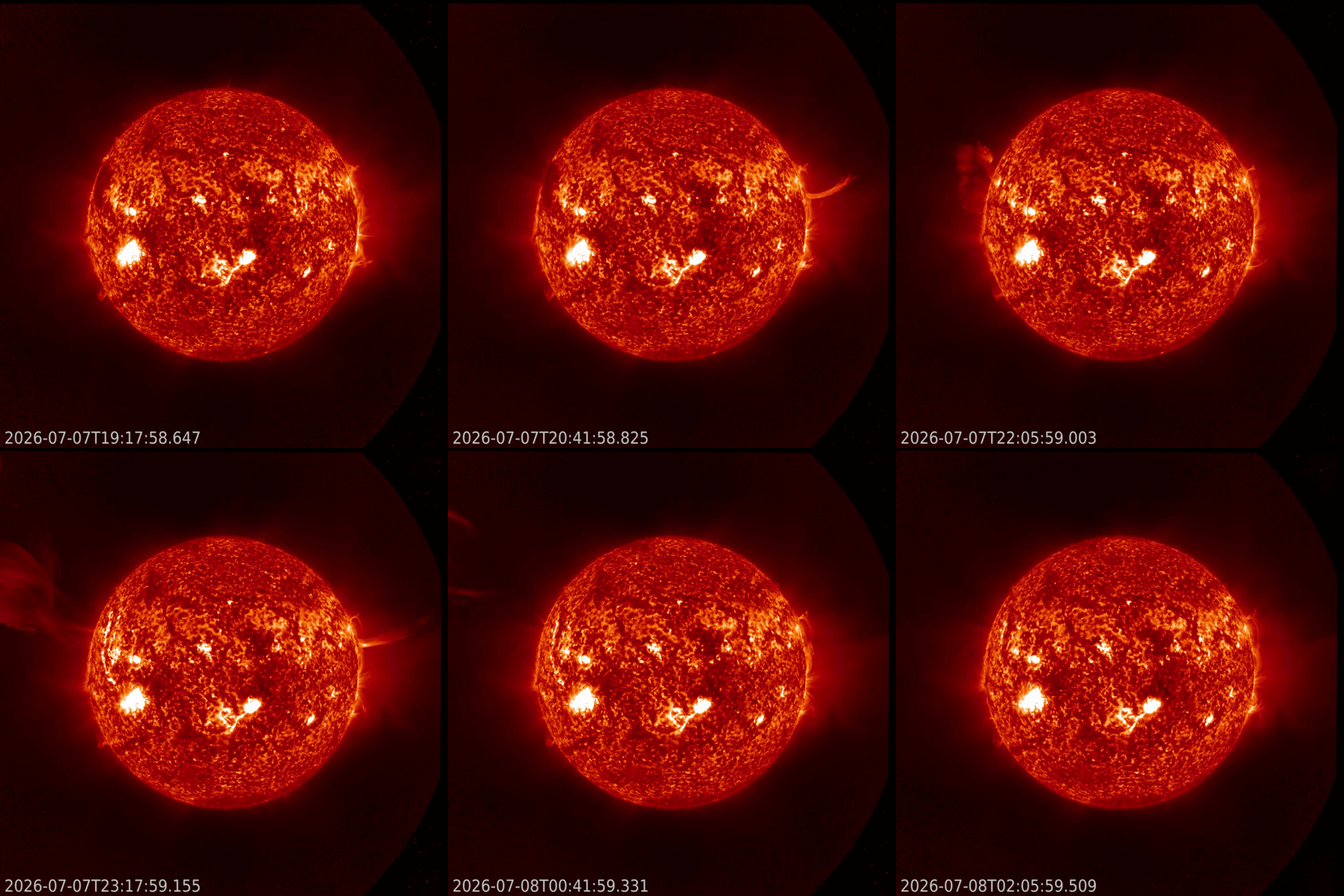
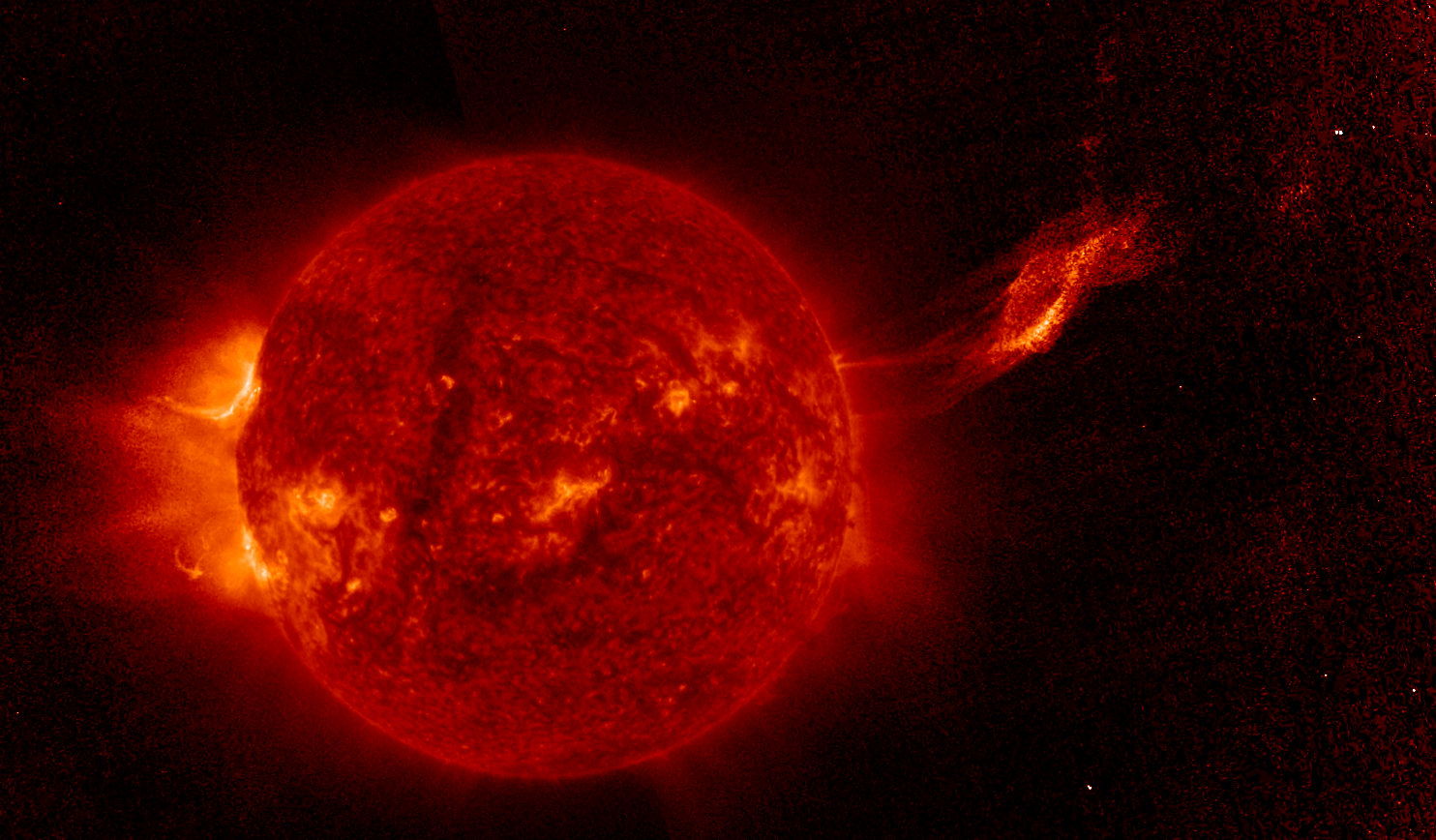
Solar Orbiter, located at the opposite side of the Sun (the "far side" as seen from Earth), also managed to observe the erupting filament. Its image, captured by the EUI instrument in the same wavelength as SUVI (i.e. 30.4 nm), at 23:00 UTC shows the erupting filament towering more than a full solar radius above the Sun's west limb ("right"). This is the equivalent of twice the Earth-Moon distance!
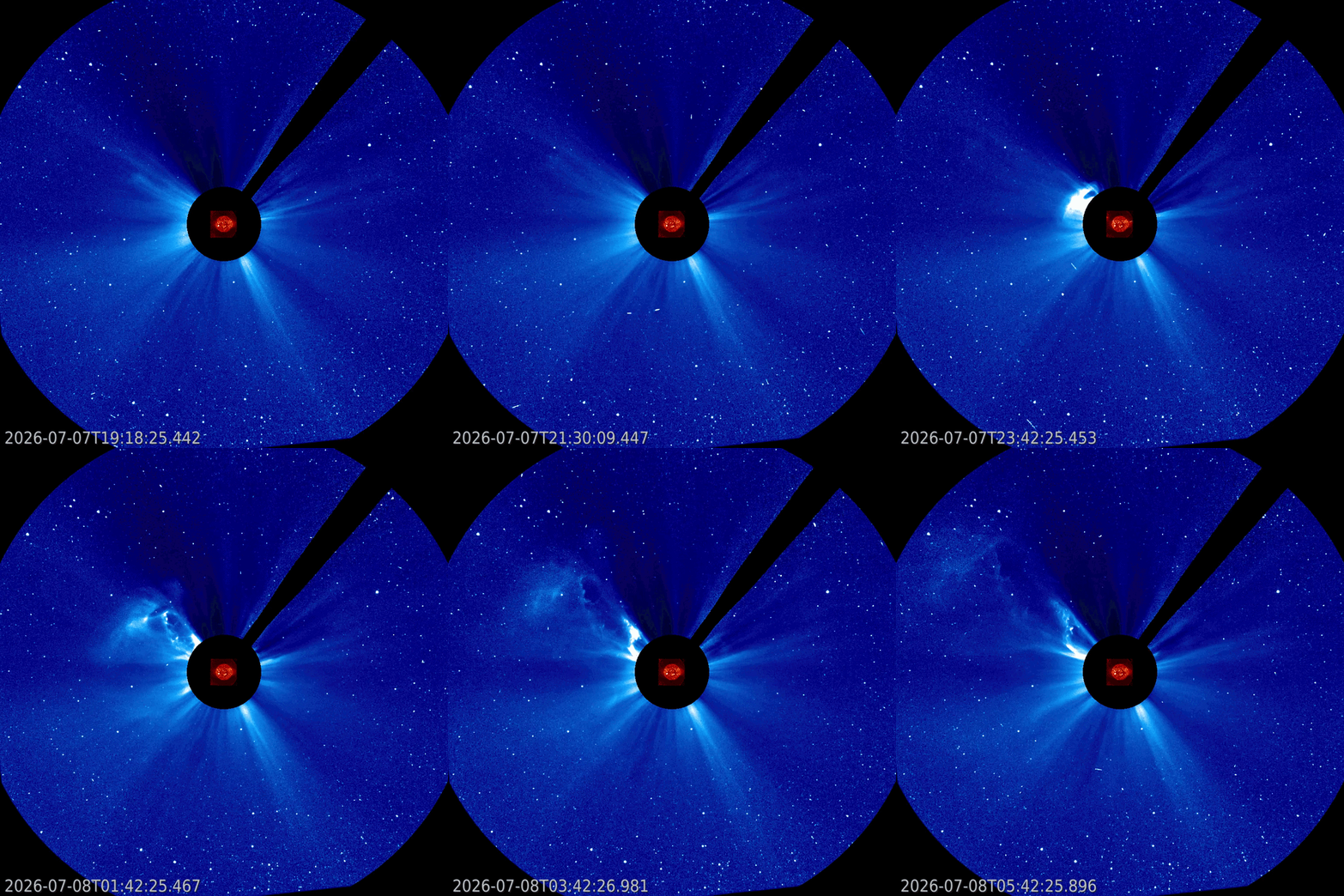
The associated coronal mass ejection (CME) had no earth-directed component. The CME can be seen here in the white-light coronagraphic imagery by SOHO/LASCO C3, with the EUV image of the Sun (SUVI 304) superimposed.