UPDATED - For older posts, please scroll down
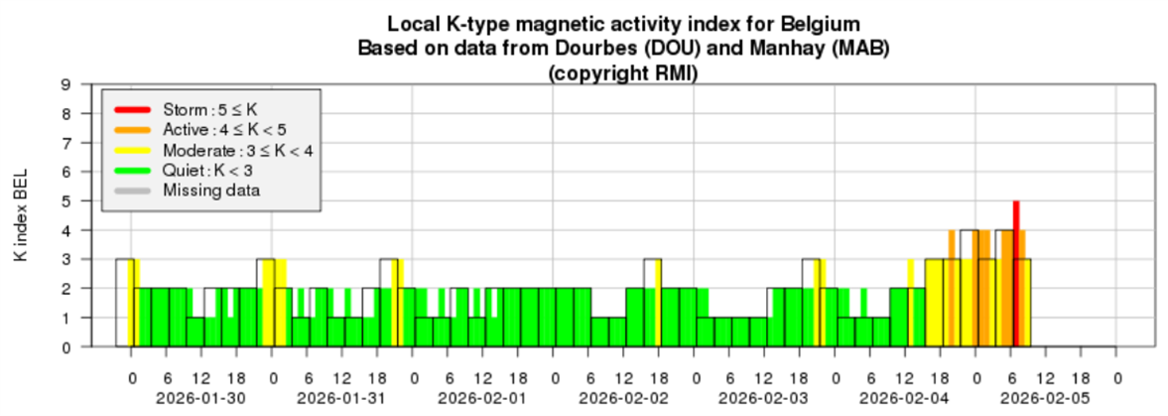
UPDATE 5 February 2026 at 09:30UTC - The magnetic cloud associated with the powerful X8 flare from late on 1 February, arrived yesterday. As expected, it only brushed the Earth's magnetosphere. This resulted in a minor geomagnetic storm (Kp = 5). For Belgium, the local magnetic index K_BEL (STCE/RMI) also showed a (brief) episode of minor storming (K_BEL = 5). This is too weak for polar lights to be visible from Belgium. The storm is still ongoing, with a decreasing chance on a small intensification, pending the orientation of the magnetic field as the interplanetary CME passes by. There remains a good chance on further strong eruptions by SIDC Sunspot Group 784 (NOAA Active Region 4366) in the days ahead.
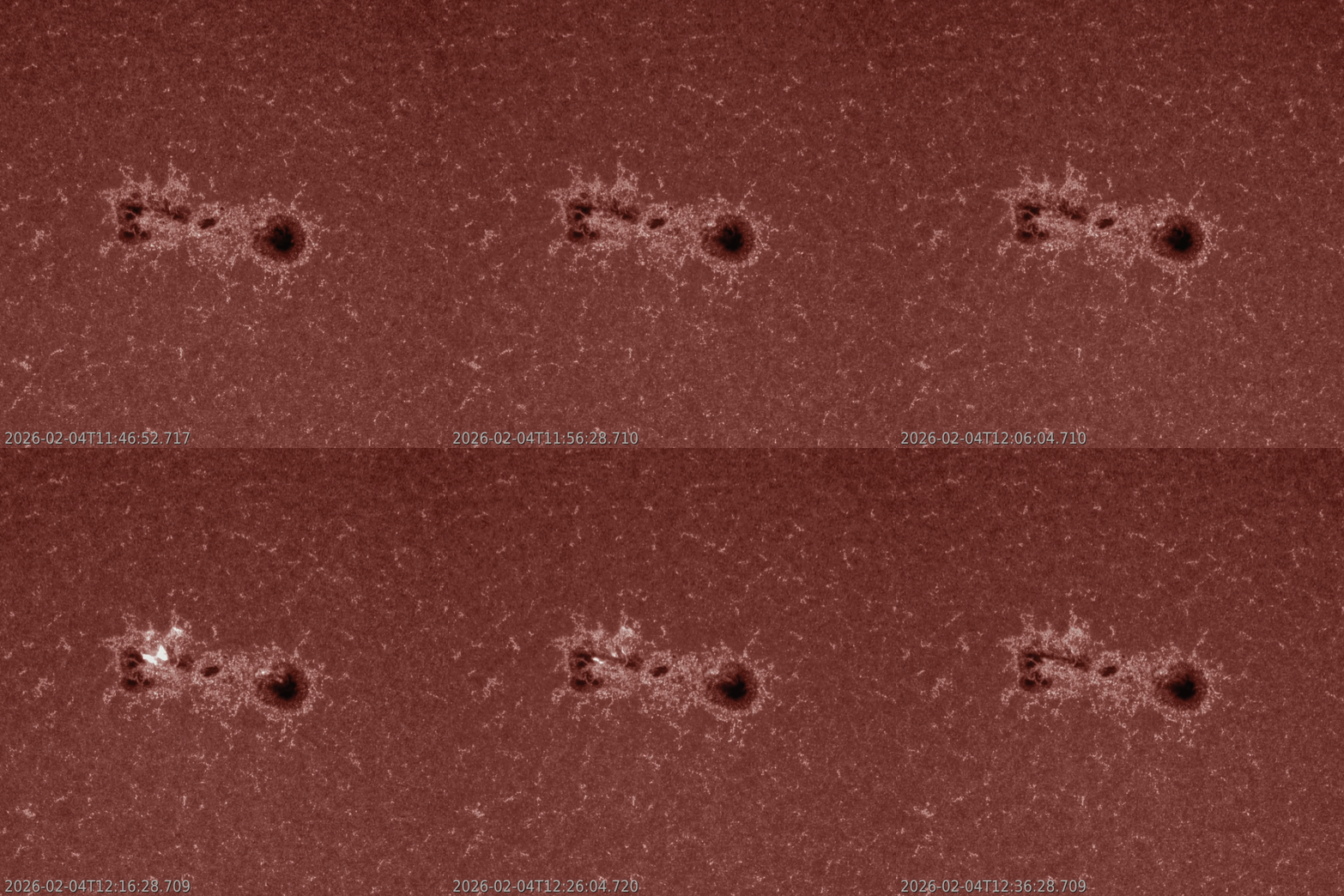
UPDATE 4 February 2026 at 14:45UTC - While waiting for the arrival of the magnetic cloud (see update underneath), SIDC Sunspot Group 784 (NOAA Active Region 4366) thought it a good time to produce another eXtreme solar flare. The X4.2 flare reached its maximum intensity at 12:13 UTC. NOAA 4366 has decreased considerably in size over the last 24 hours, but it has retained its two complex magnetic structures in the middle and trailing portion ("delta's"), allowing it to continue the production of strong solar flares. The clip underneath shows the flare and the sunspot group in the ultraviolet continuum, this is at temperatures of around 5000 degrees (SDO/AIA 1700) just above the solar "surface" (photosphere). The source of the flare is clearly in the trailing portion of NOAA 4366, right where the second delta structure is located. Standing-by coronagraphic images for hints of an associated magnetic cloud ("coronal mass ejection", CME).
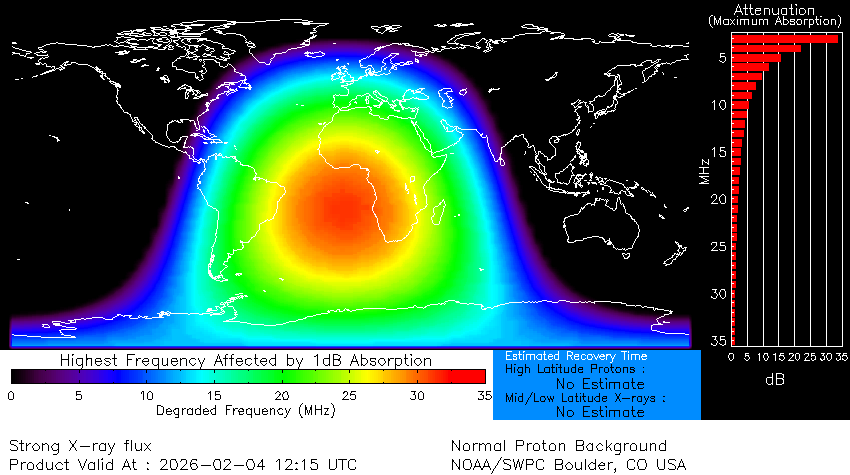
The ionizing radiation of the X-class flare itself affected the lower frequency portion of the High Frequency communication band (HF Com ; 3 - 30 MHz) on the dayside of the Earth, mainly over Africa, the southern portion of the Atlantic Ocean, and most of South-America. An advisory to civil aviation has been issued (PECASUS). The effects of the X4 flare on HF Com can be seen in this D-RAP (NOAA/SWPC) map.
The eruption seems not to have been associated with any solar radiation storm (the flux of energetic protons has remained at background levels - GOES). Active Region 4366 is crossing the central meridian, thus becoming better magnetically connected with the Earth and increasing the risk of a proton storm in case of another strong eruption.
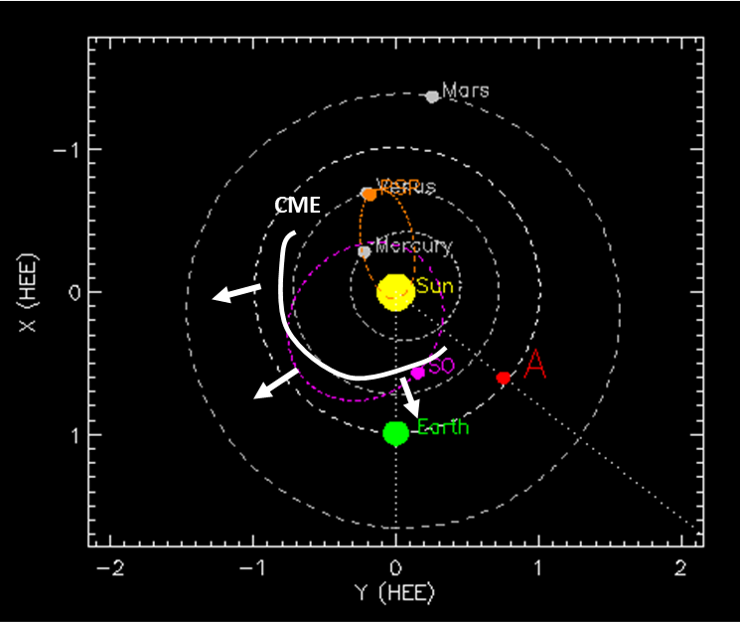
UPDATE 4 February 2026 at 09:30UTC - Solar Orbiter (SO) is currently located between the Sun and the Earth, about 60 million km closer to the Sun than Earth. This can be seen in the annotated map underneath, with just a crude outline of the magnetic cloud (coronal mass ejection , CME) as it propagates through the solar system. As such, this spacecraft could "taste" the approaching magnetic cloud earlier than Earth. Based on the in-situ measurements SO made from the solar wind (Imperial, MSSL) the SIDC SWx forecaster does not exclude the possibility that the expected arrival time of the magnetic cloud near Earth is a little bit earlier than originally thought: 4 February at 23:00 UTC. There's still a healthy uncertainty of about 12 hours, because SO is not exactly on the Sun-Earth line, and the solar wind speed in front of the CME is much slower, thus slowing down the CME considerably. The measured strength of the magnetic field is in line with expectations, though Earth will be slightly closer to the centre of the magnetic cloud than Solar Orbiter. So, -after the CME has reached Earth- the resulting geomagnetic storm is still expected to be only minor to moderate, with only a small chance on strong geomagnetic conditions. As a result, it is unlikely that aurora will be visible over Belgium, not excluding a photographic opportunity low over the northern horizon.
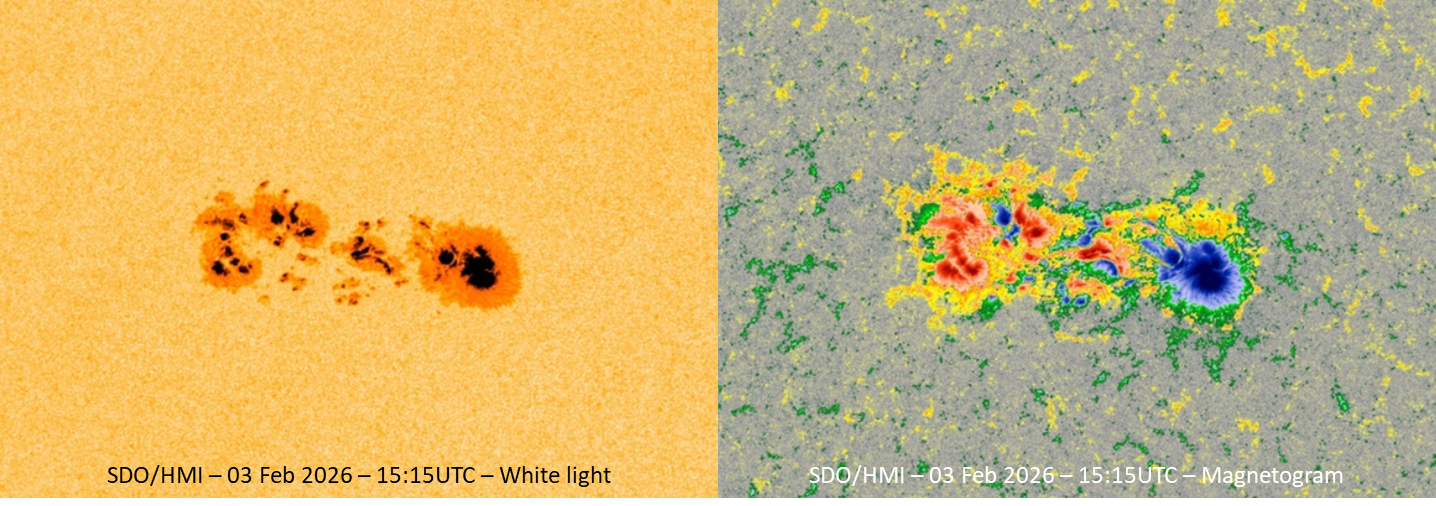
UPDATE 3 February 2026 at 16:30UTC - SIDC Sunspot Group 784 (NOAA Active Region 4366) is now about 14 times as wide as the Earth, and has an area of about 10 times the surface area of the Earth. As can be seen in the SDO/HMI white light image and the magnetogram next to it, it still has a complex magnetic structure, with red and blue colours denoting opposite magnetic polarity. The middle and trailing portion still have strong delta structures, i.e. sunspots very close to each other but of opposite magnetic polarity. These structures may be the source of further strong flaring.
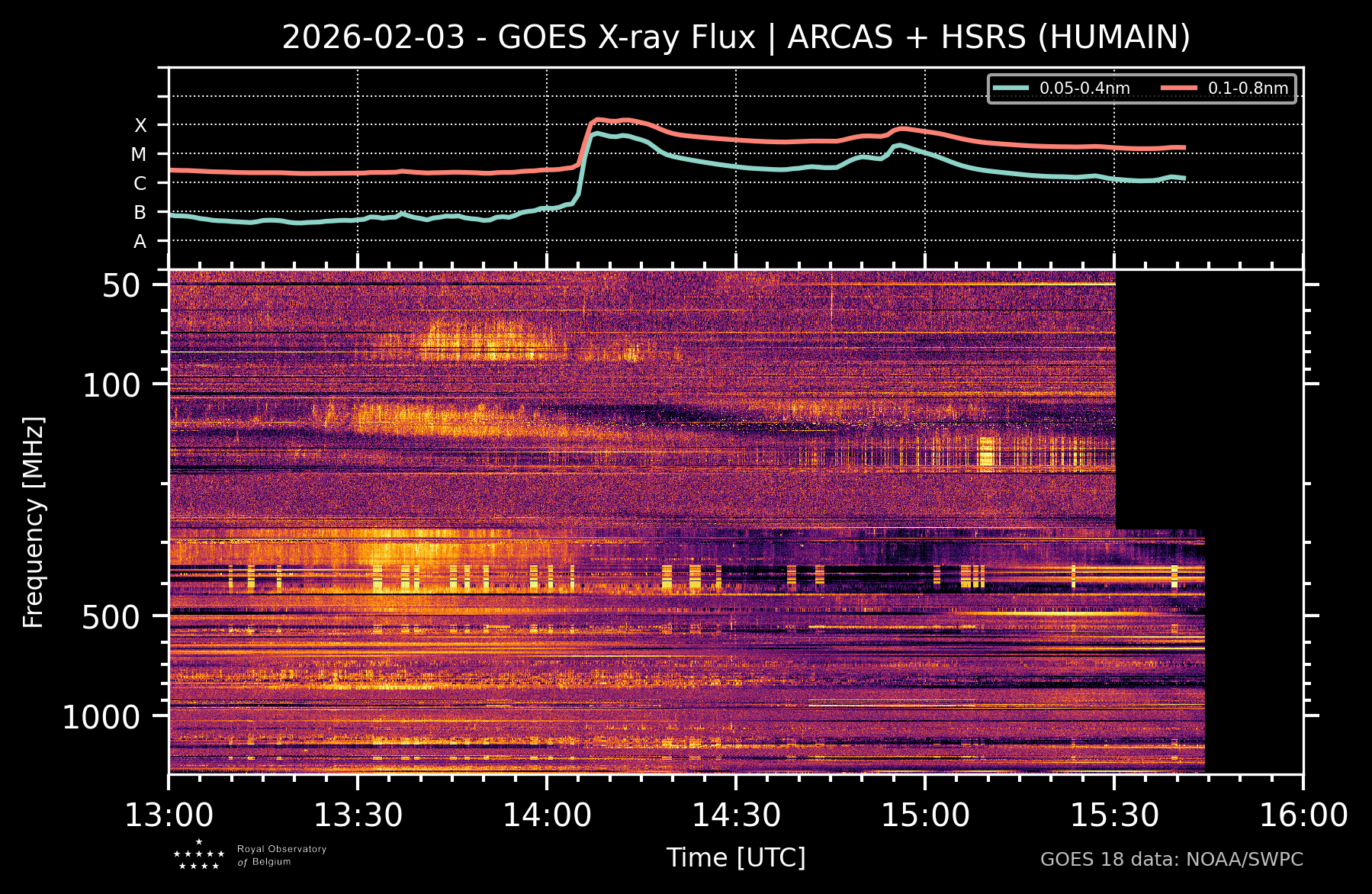
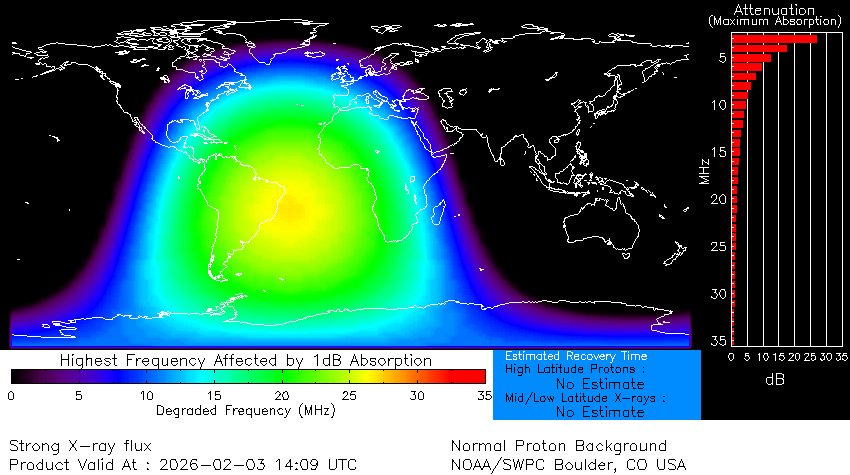
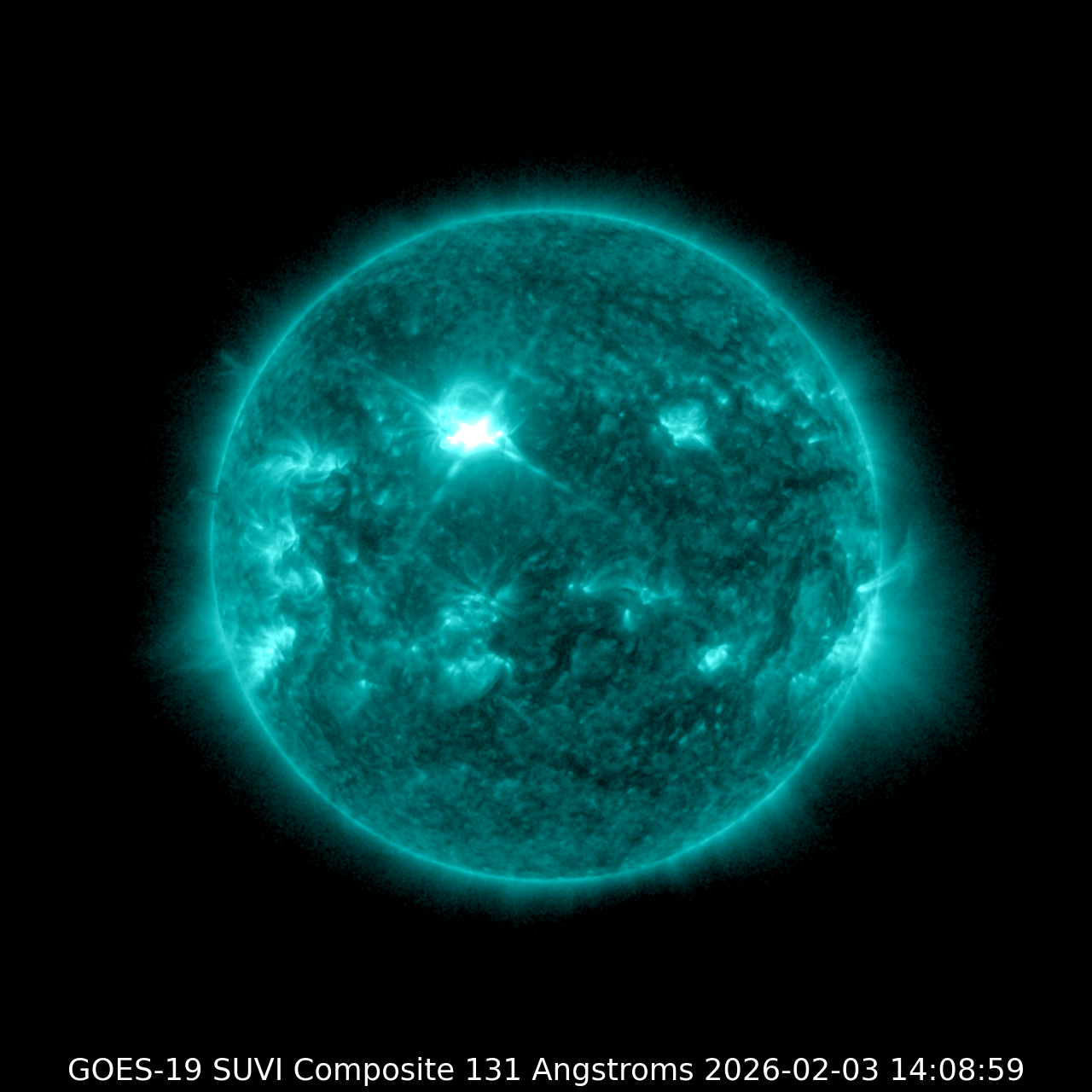
So, it was no surprise that the region produced another X-class flare today. This X1.5 flare peaked at 14:08 UTC (GOES/SUVI image and underneath). The ionizing radiation of this X-class flare affected the lower frequency portion of the High Frequency communication band (HF Com ; 3 - 30 MHz) on the dayside of the Earth, mainly over Africa, the southern portion of the Atlantic Ocean, and most of South-America. An advisory to civil aviation has been issued (PECASUS). The effects of the X1 flare on HF Com can be seen in the D-RAP (NOAA/SWPC) map underneath.
The radio noise associated with this flare has affected mainly -and only mildly- radio frequencies above 2 GHz (NOAA/USAF). Radio observations by the radio-astronomy station in Humain (SIDC, Belgium) as well as numerous stations from the eCallisto network did not reveal any bursts hinting at a magnetic cloud being expelled during this eruption. Standing-by further analysis by the SIDC SWx forecaster. The eruption seems not to have been associated with any solar radiation storm (the flux of energetic protons has remained at background levels). Active Region 4366 will cross the central meridian tomorrow, thus becoming better magnetically connected with the Earth and increasing the risk of a proton storm in case of another strong eruption.
UPDATE 2 February 2026 at 15:30UTC - The SIDC SWx forecaster expects the arrival of the magnetic cloud between 4 (18:00 UTC) and 5 (18:00 UTC) February. The intensity of the geomagnetic storm is thought to reach only minor to moderate geomagnetic storm levels (Kp = 5 to 6). In principle, this is not enough to see or photograph the polar lights from Belgium.
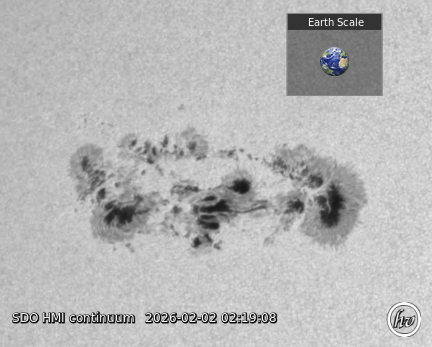
UPDATE 2 February 2026 at 12:45UTC - SIDC Sunspot Group 784 (NOAA Active Region 4366) further increased in size and magnetic complexity. Its surface area is now about 9 times that of the Earth, and its length corresponds to about 10 Earth diameters, as shown in the annotated diagram underneath from early this morning. Using solar eclipse glasses, this region can be seen with the (protected) naked eye.
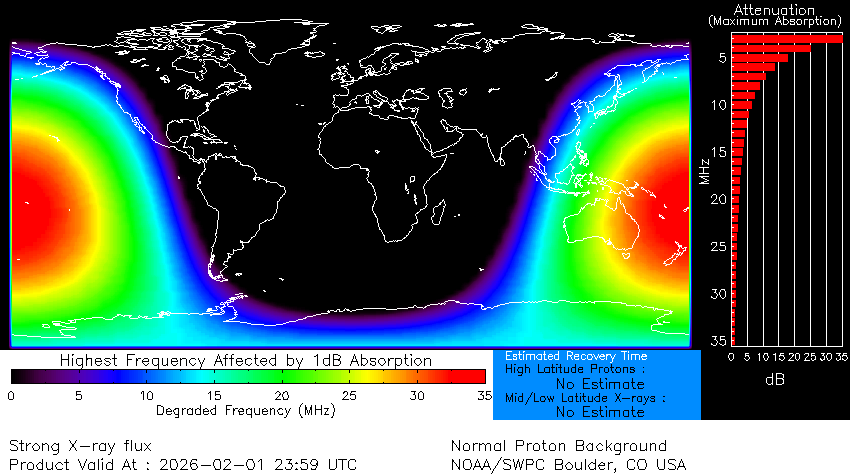
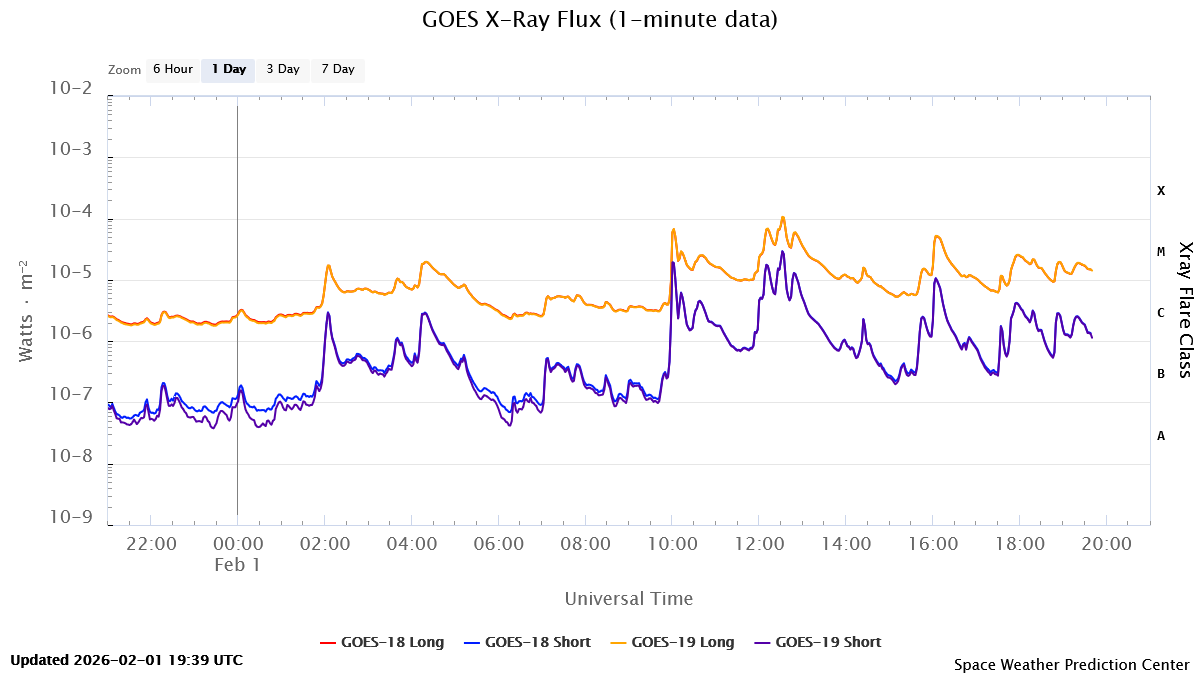
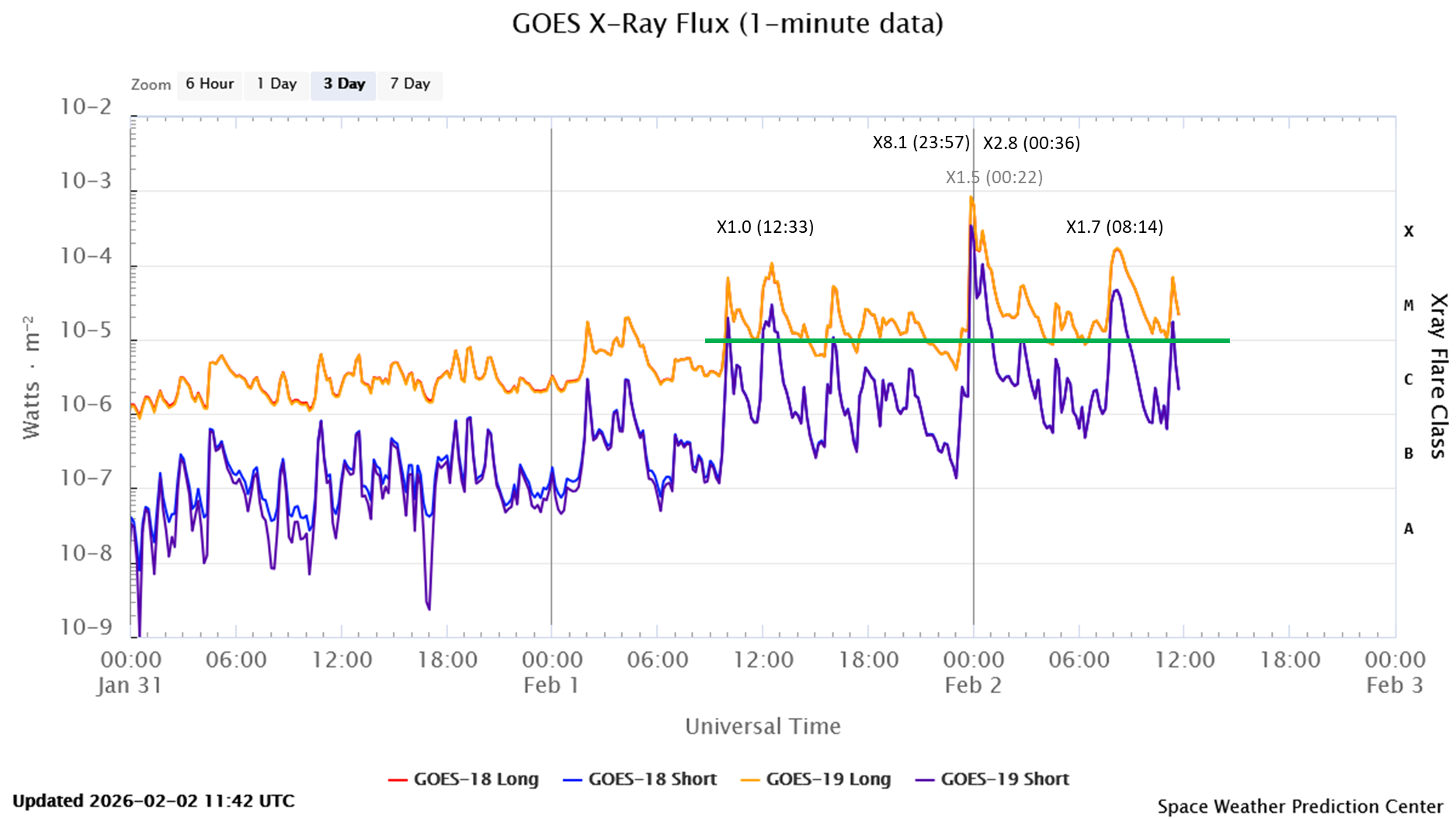
This active region has now produced 5 X-class flares, with the strongest an X8.1 peaking late on 1 February at 23:57 UTC. This is one of the strongest solar flares of the ongoing solar cycle (SC25 tracking page). In the diagram (GOES) underneath, the X1.5 flare is somewhat hidden in the decline of the much stronger X8 flare. The ionizing radiation of the X8 flare itself affected the lower frequency portion of the High Frequency communication band (HF Com ; 3 - 30 MHz) on the dayside of the Earth, mainly over the Pacific Ocean, Australia and Southeast Asia (D-RAP map). Advisories to civil aviation have been issued (PECASUS). Of note is that since the start of the enhanced flaring activity (from about 10:00 UTC on 1 February onwards), the x-ray flux has been consistently high enough (above M1; green thick line) for an almost continuous minor disturbance of the HF Com on the dayside of the Earth.
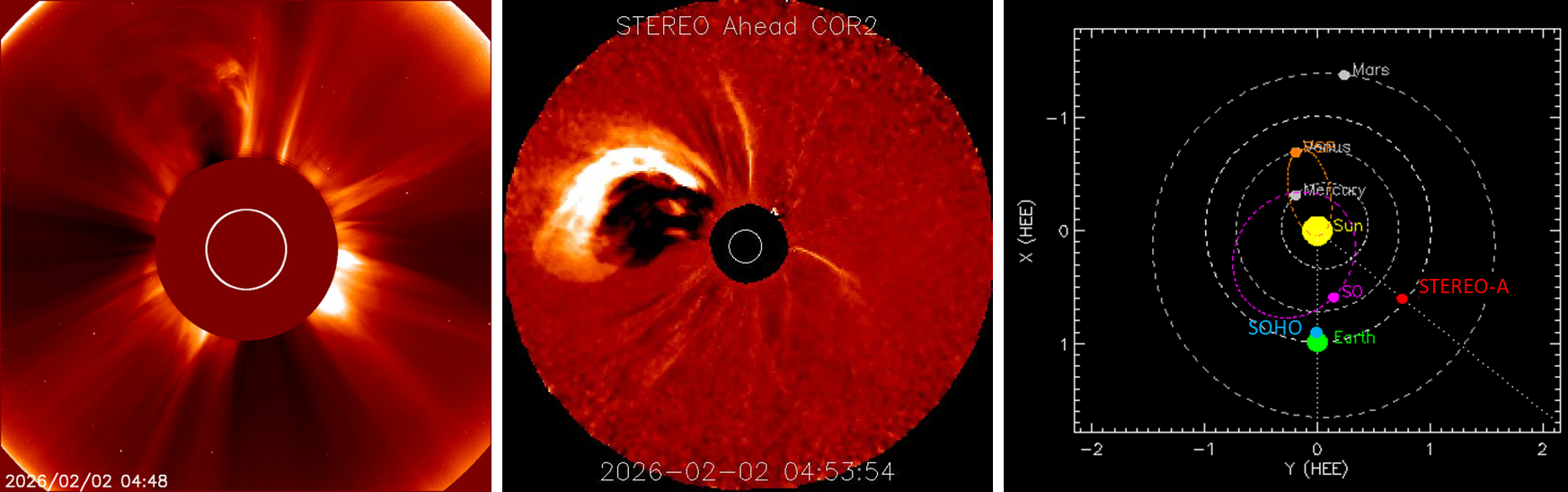
The eruption seems not to have been associated with any solar radiation storm (the flux of energetic protons has remained at background levels). Analysis of the coronagraphic imagery (SOHO) seems to indicate that at least the X8 flare may have been associated with a coronal mass ejection (CME, i.e. the ejection of a magnetic cloud filled with charged particles from the Sun into space). This seems to be confirmed by imagery from other satellites such as STEREO-A (see images underneath with locations of the satellites to the right). As the SIDC SWx forecaster writes in the latest SIDC PRESTO (11:50 UTC): "...The CME has an angular width of about 150 degrees, with an Earth directed component. A preliminary speed derived from the available data is around 700 km/s, giving an expected arrival time on the second half of February 4 (this will be updated when more data becomes available...). " If the CME arrives, there's a chance on minor to strong geomagnetic storming (Kp = 5 to 7), with for Belgium a small chance on photographic aurora low near the northern horizon. As NOAA 4366 rotates further over the solar disk, CMEs associated with further strong flaring from this region may be better directed to Earth causing further geomagnetic storms.
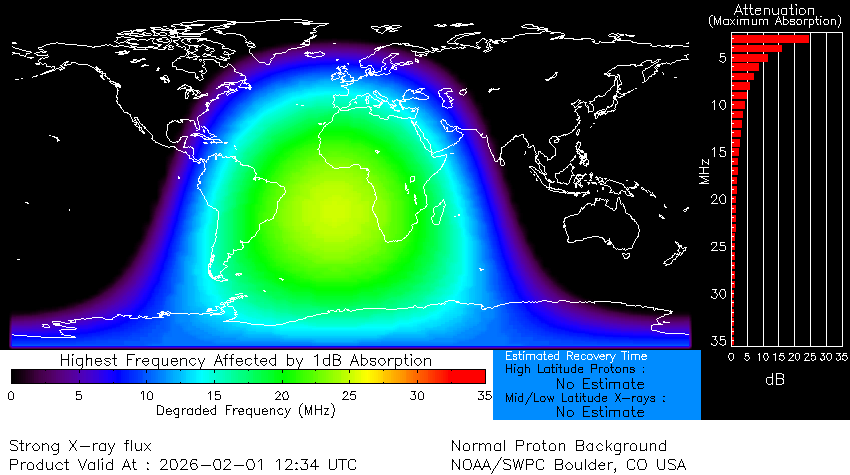
Original 1 February 2026 at 21:30UTC - From the SIDC PRESTO alert on 1 February/13:49 UTC: "An X1.0 flare ... was observed in the GOES 19 x-ray flux data with start time 12:25 UTC, peak time 12:33 UTC and end time 12:37 UTC on 1 February. The flare is associated with SIDC Sunspot Group 784 (NOAA Active Region 4366). This is the largest, most complex and currently rather active sunspot group on the visible solar disk. It is classified as magnetic type beta-gamma-delta and has produced multiple M-class flaring over the past hours. No proton event has been associated to the flaring activity up to this moment. Further coronagraph and solar imagery is awaited to estimate any possible related coronal mass ejection (CME). Further M-class flaring related to this region is very likely with chances for more X-class flaring. Increase in the proton flux levels might be expected with a possible proton event over the next 24 hours."
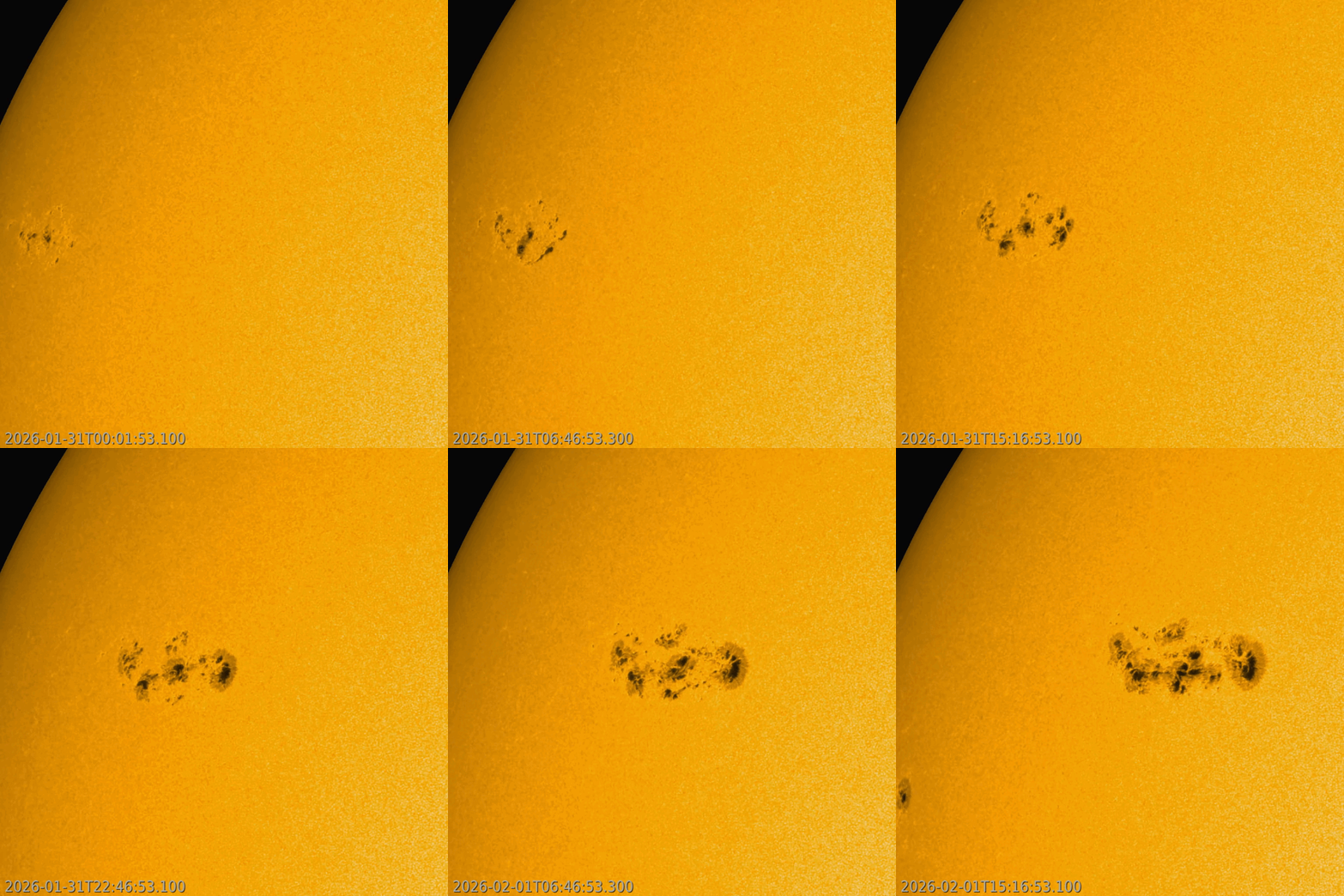
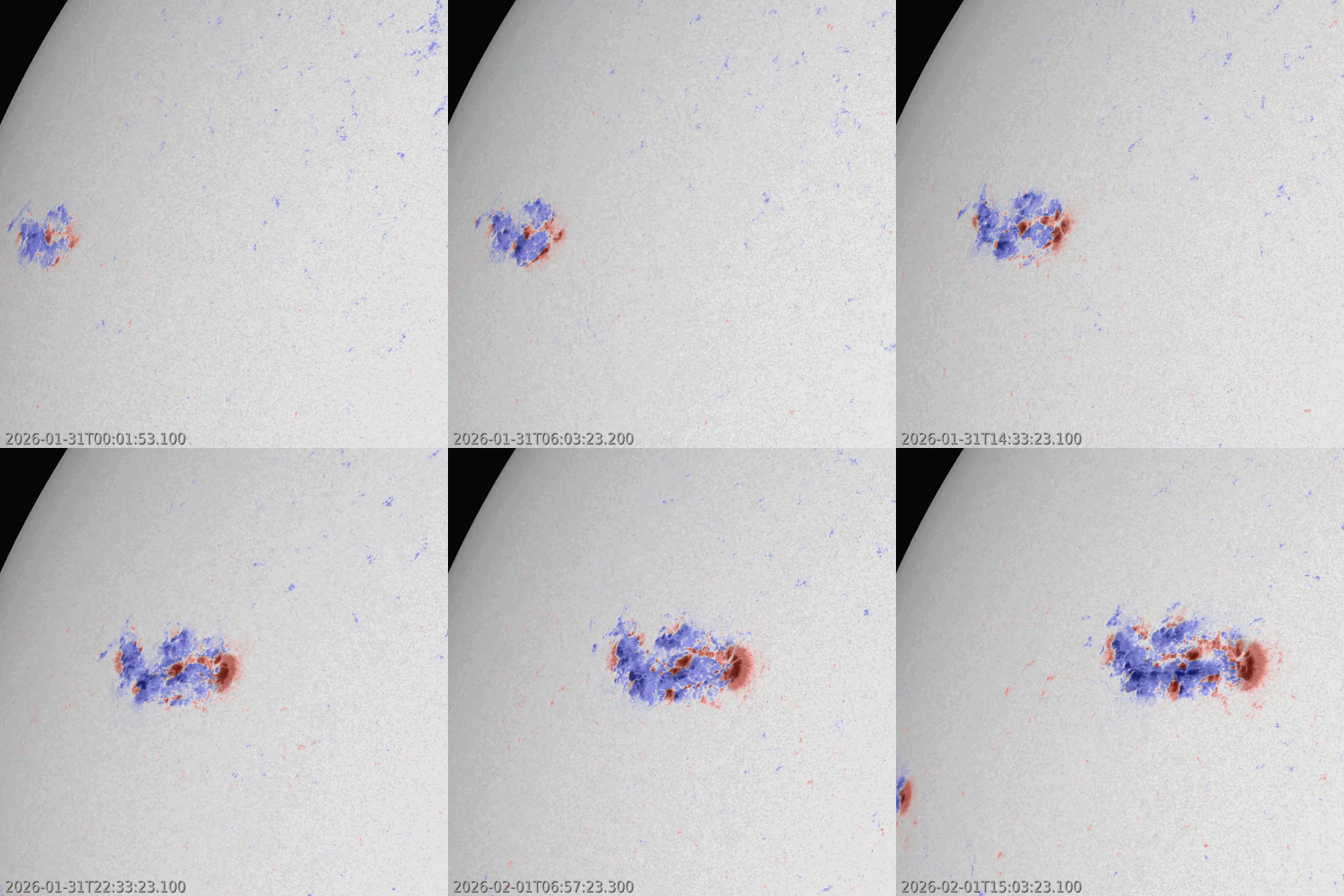
The images (SDO/HMI) underneath show the quick development of NOAA 4366 over the last 40 hours (from 31 January at 00:00 UTC until 1 February near 16:00 UTC). The group has currently a size of 5 times the entire surface area of the Earth, and still growing. The next clip shows the magnetic structure of the group, clearly a mix of sunspots with an opposite magnetic polarity. Red colours represent magnetic field lines coming out of the solar surface ("positive"), blue is for magnetic field lines returning to the solar surface ("negative"). Sunspots with opposite polarities that are close to each other are likely structures to produce strong solar flares.
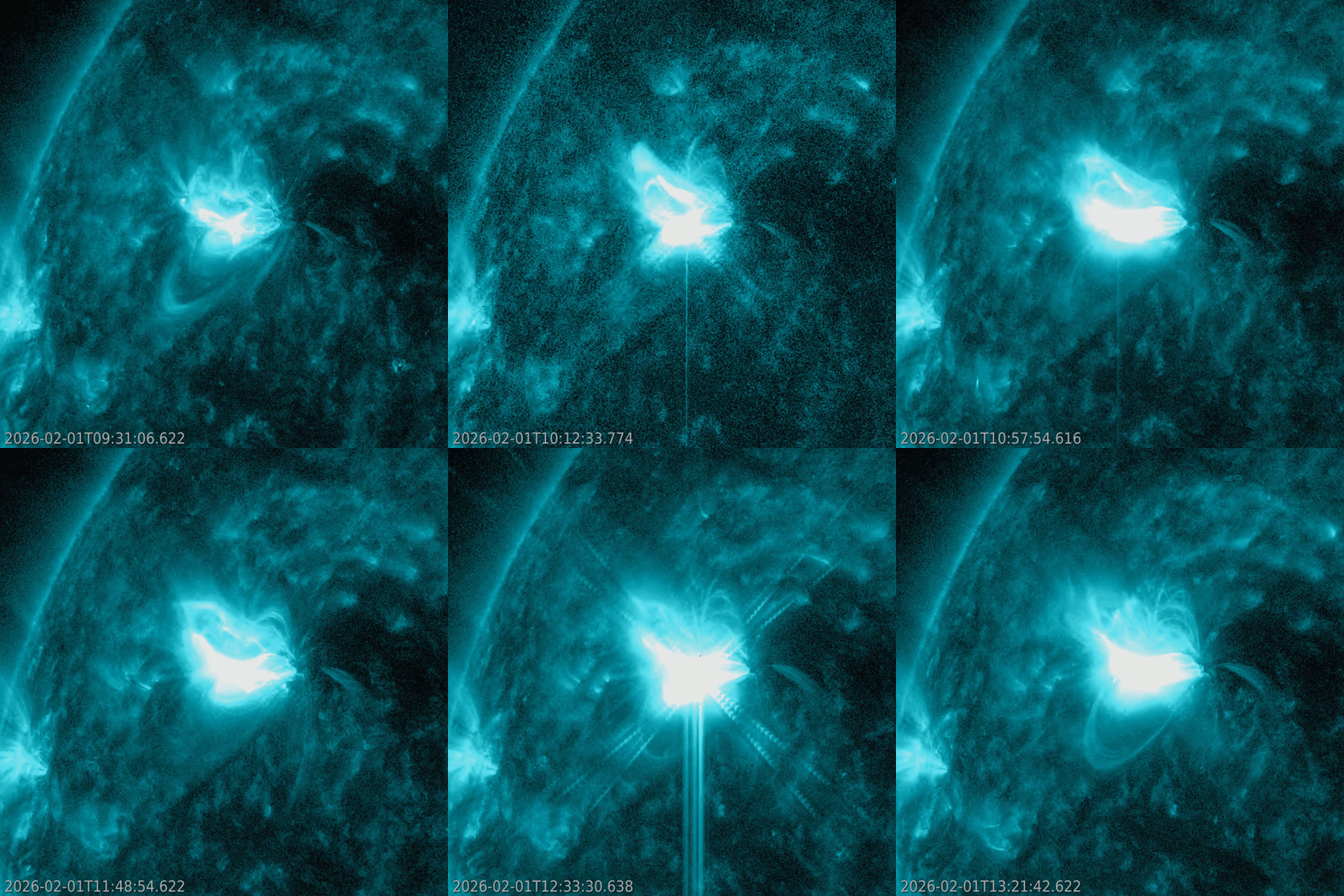
The clip underneath shows the flaring activity (bright "flashes") over NOAA 4366 but seen in extreme ultraviolet at temperatures of several million degrees (SDO/AIA 131). Several M-class ("medium") flares are preceding and following the main X1.0 event that peaked at 12:33 UTC. The blooming and diffraction patterns that can be seen in these images are instrumental (more information is in Note 1 of this STCE newsitem).
The eruption seems not to have been associated with any solar radiation storm (the flux of energetic protons has remained at background levels). Also, radio astronomy stations such as Humain (SIDC, Belgium) have not detected any obvious radio bursts (Type II) that may be linked to a coronal mass ejection (i.e. the ejection of a magnetic cloud filled with charged particles from the Sun into space). So far, none of the currently available coronagraphic images taken by SOHO or STEREO-A show a CME signature related to today's X-class flare. This may change over the coming days as the region further develops and rotates further to the central portion of the solar disk.
The ionizing radiation of the X-class flare itself affected the lower frequency portion of the High Frequency communication band (HF Com ; 3 - 30 MHz) on the dayside of the Earth, mainly over Africa, the southern portion of the Atlantic Ocean, and most of South-America. An advisory to civil aviation has been issued (PECASUS). The effects of the X1 flare on HF Com can be seen in the D-RAP (NOAA/SWPC) map underneath.