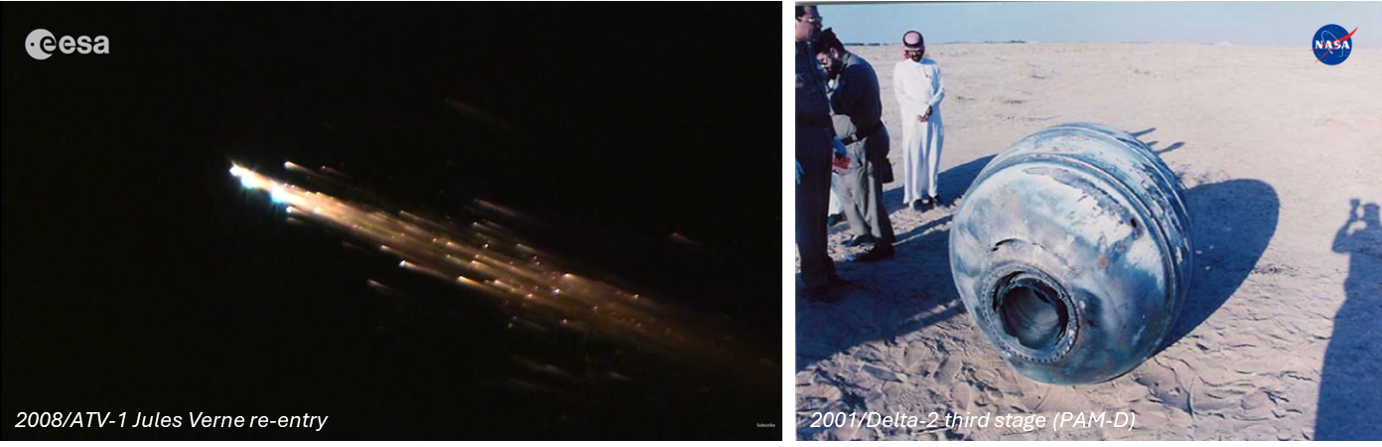
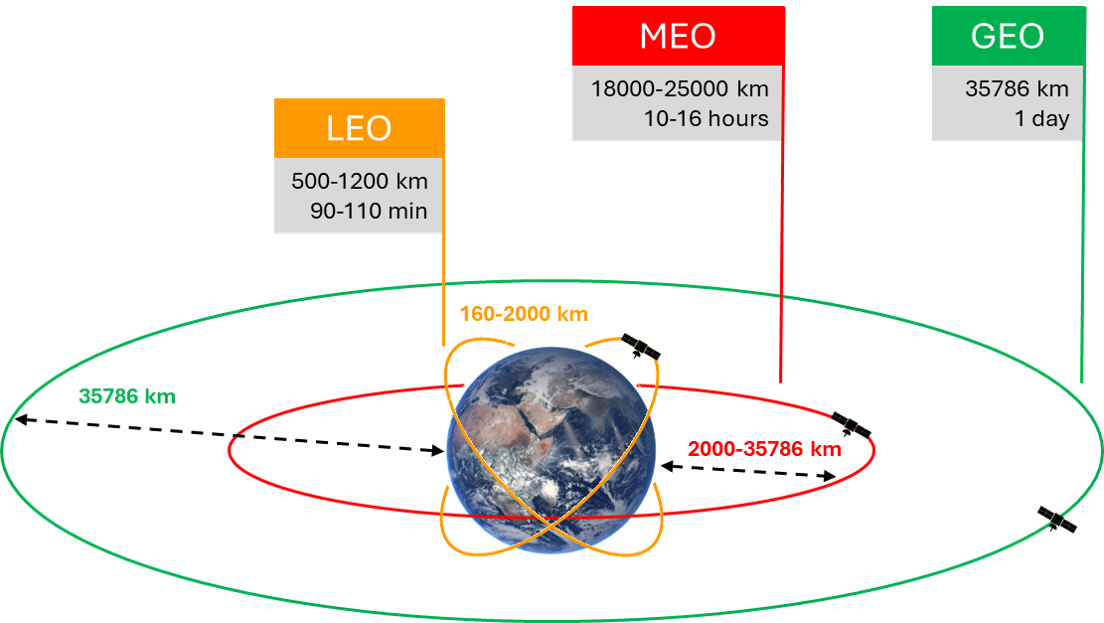
Recent statistics from e.g. ESA (annual Space Environment Report) have shown that there are more than 30.0000 tracked objects in a Low Earth Orbit (LEO), and that this number is quickly growing. LEO is a region of space close to Earth typically ranging from 160 to 2000 km in altitude, with the majority of the LEO satellites located between 500 and 1200 km.
These boundaries are very specific. Below an altitude of about 160 km, the density of the Earth's atmosphere quickly increases. As a result, the atmospheric friction with the satellite results in unrecoverable drag effects and eventually the burn-up of the satellite in the atmosphere. Above an altitude of about 2000 km, the satellite would be exposed to the effects of the inner radiation belt where the presence of highly energetic particles poses a direct threat to the satellite's electronics. The sketch underneath shows typical parameters for the 3 main orbits: Low Earth Orbit (LEO), Medium Earth Orbit (MEO), and Geostationary Orbit (GEO). This sketch is not to scale, and the radiation belts have been omitted for clarity.
So, the room for satellites in LEO is not infinite. In fact, a study by Bongers and Torres (2023) indicated there's room for about 72.000 satellites in outer space, before the Kessler Syndrome might kick in. The Kessler Syndrome is a theoretical, cascading scenario where the density of space debris in LEO becomes so high that collisions between objects cause a chain reaction, generating even more debris and making space operations nearly impossible (Kessler and Cour-Pailais ; 1978).
The graph below was based on recent data (April 2026) compiled by Jonathan McDowell, retired astrophysicist and an honorary professor at Durham University. It shows, since the start of the space age, the evolution of the number of operational satellites and all space debris that can be tracked in LEO. The top 3 data series involve operational satellites, binned as follows:
- "Starlink" are obviously the Starlink satellites, of which the number drastically started to rise from 2019 onwards, and currently totals over 10.000 satellites. So about a third of all the "stuff" that is currently being tracked, and about two thirds of all the operational satellites are Starlinks!
- "Active Sat w/ Prop" are operational satellites equipped with propulsion systems. This is not only important to counter drag effects, but also for collision avoidance with other satellites and space debris, and for the end-of-life scenario (burn-up in atmosphere (LEO), "grave-yard orbit" (GEO),...). Typical examples are the International Space Station (ISS), the Starlinks,...
- "Active Sat w/o Prop" are the non-manoeuvrable operational satellites, i.e. satellites without a propulsion system. They eventually will burn up in the atmosphere, but the time range varies from months to decades, depending on their altitude and on coditions in the upper atmosphere. Typical examples are the first generation satellites and cubesats, such as SIMBA (see the STCE Annual Reports of 2020 (launch), 2022 (end-of-operations), and 2024 (re-entry)). Satellite systems must now comply with international and national regulations focusing on swift de-orbiting using one of several possible propulision systems, usually within 5 years of mission completion for LEO.
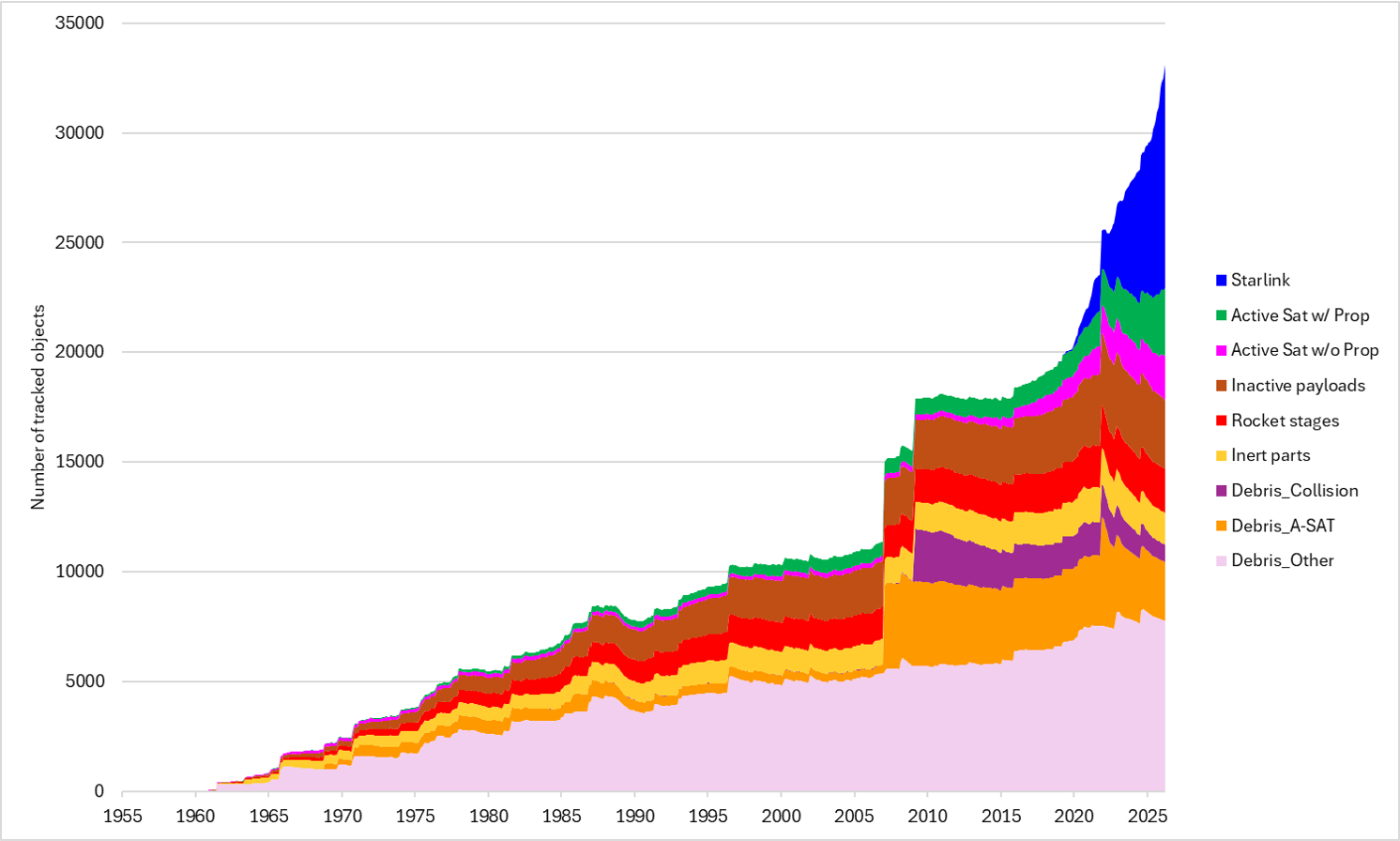
Everything else in the graph represents space debris:
- "Inactive payloads" refer to satellites that are no longer operational and are awaiting to burn up in the atmosphere. Just as the non-manoeuvrable operational satellites, they may stay in LEO for years to decades.
- "Inert parts" are non-functional, non-operating components of satellites or "Rocket stages". Unlike active payloads, they do not communicate with Earth, perform manoeuvres, or carry out missions. They are simply objects drifting or orbiting after being discarded during launch or mission operations. Typical examples of "Inert parts" are launch vehicle adapters, instruments caps and covers, despin systems, dead instruments,... "Rocket stages" constitute over 50% of this group, hence they are displayed separately from the "Inert parts".
- "Debris_Collision" is the debris following the unintentional collision between 2 satellites. A prime example, and prominently displayed in the graph above, took place on 10 February 2009 when the active commercial satellite Iridium 33 accidentally collided with the derelict Russian satellite Kosmos 2251 at an altitude of 789 km above Siberia. This was the first-ever accidental, high-speed collision between two intact satellites, creating more than 2.300 large trackable fragments, along with thousands of smaller pieces and posing a significant long-term risk to low-Earth orbit (LEO) operations. Now, more than 17 years later, there's still a significant portion of the larger debris floating around, with expectations they can remain in orbit -and pose a threat- for decades to come.
-
"Debris_A-SAT" refers to the debris following the intentional destruction of a satellite by an antisatellite (ASAT) weapon.
- On January 11, 2007, China successfully tested an antisatellite (ASAT) weapon by destroying its own inactive Fengyun-1C (FY-1C) weather satellite, orbiting at 865 km. A ground-launched kinetic kill vehicle shattered the satellite, creating over 3000 trackable pieces of debris -the largest debris event in history at that time- posing long-term hazards to satellites. The destruction generated more than 35.000 pieces of debris (down to 1 cm), which was described as the "worst satellite breakup" in terms of creating long-lasting space debris in the LEO. The test, which was not confirmed by China until nearly two weeks later, caused major international concern regarding space security.
- Despite these concerns, Russia basically did the same thing on 15 November 2021 when it conducted a destructive antisatellite test involving missile striking its own defunct satellite COSMOS 1408. The destruction generated over 1500 pieces of trackable, long-lived orbital debris in LEO, as well as hundreds of thousands of smaller, non-trackable pieces. The test was widely condemned by the international community due to the danger it posed to orbital safety. According to NASA, the debris field posed an immediate danger to the ISS, forcing the crew -which included American, Russian, and German astronauts- to shelter in their docked capsules for two hours as a precaution.
- "Debris_Other" concerns all the tracked debris not covered by the above sections. Prime examples here are the fragmentation events that took place on 12 November 2022 and 6-7 August 2024, involving in both cases the breakup of a Chinese Long March 6A (CZ-6A) rocket upper stage shortly after launching its payload at an altitude of around 800 km. Each time, the incident created a cloud of several hundreds of pieces of trackable debris in LEO. According to several news sources, the debris was orbiting in a "high-traffic" area posing risks to over 1000 satellites as well as the ISS.
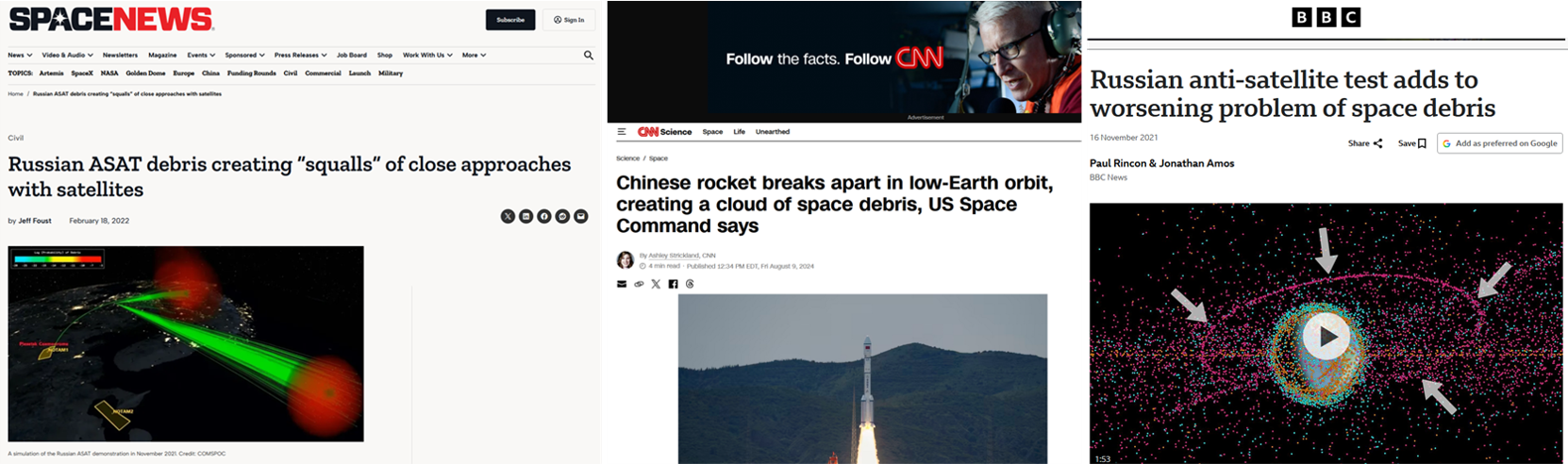
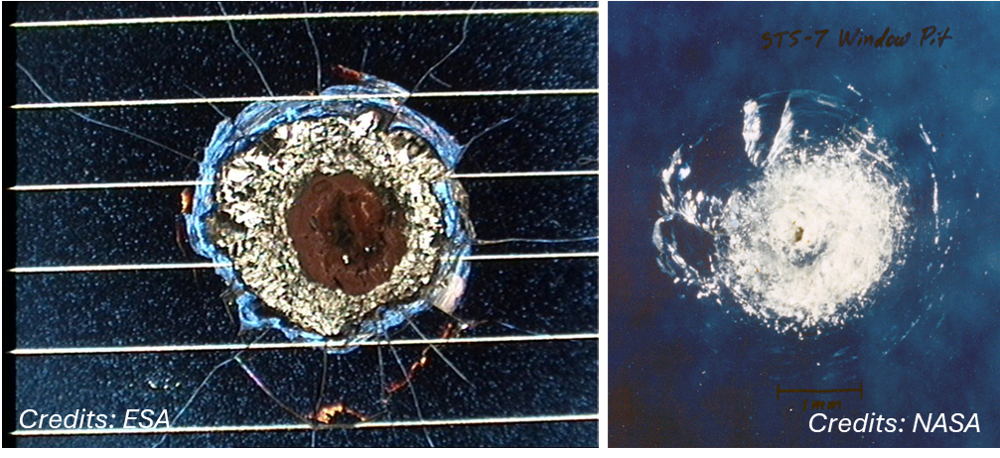
Note that only the number of large fragments, i.e. with sizes of about 10 cm or larger, are shown in the graph above. ESA estimates that, on top of these, there are over 1.2 million objects with sizes between 1 and 10 cm. These cover small items from the usual nuts and bolts over pieces of insulation to frozen fuel and coolant droplets. They also include the smaller fragments from collisions, fragmentations or anti-satellite tests. Space debris between 1 and 10 cm in size is often referred to as the "lethal non-trackable" population and considered to be one of the greatest threats to operational satellites and spacecraft because they are too small to be tracked accurately from the ground, but large enough to cause catastrophic damage (ESA). Traveling with speeds of 7-8 km/s (25.000-29.000 km/h), these marble- and tennisball-sized objects can still pack enough energy to penetrate the shielding of the ISS or destroy a satellite. Due to the Russian antisatellite event in 2021, a new term was coined: "squall". A "conjunction squall" is a term used in space situational awareness to describe a period when a large amount of debris creates a "squall" or sudden surge of close approaches (conjunctions) with active satellites in LEO. Events such as the Russian ASAT incident can produce thousands of close approaches between debris and active satellites over just a few days. The images underneath show the impact of much smaller debris on a solar panel of the Hubble Space Telescope and on the window of a space shuttle.
Solar activity and space weather in general can help in decreasing the amount of space junk in LEO. Increased x-ray and extreme ultraviolet radiation from solar flares, as well as the energy and particles dumped in the atmosphere during geomagnetic storms, make the upper atmosphere expand. This increases the drag with the space debris present, and allows a faster eliminiation of this space junk. This can be seen very well in the graph when during the maximum of solar cycle 22 in 1989-1991, there there was a clear dip in the amount of tracked space debris. Also the ongoing solar cycle 25, which experienced a higher-than-predicted maximum in 2024-2025, had a significant, measurable effect on the amount of space debris in LEO. The increased solar activity (see the STCE SC25 tracking page) has led to a notable reduction in debris at lower altitudes, especially in the 200-400 km altitude range, due to faster orbital decay. Other effects that have been observed, are faster-than-anticipated Starlink re-entries, debris from the Cosmos 1408 breakup following the 2021 Russian ASAT test is reentering faster than originally estimated, and the space debris re-entry rate in 2023 was roughly 5 times higher than that in 2022, directly correlating with the ramp-up in solar activity. However, while solar maximum helps clear low-altitude debris, it also poses challenges, as it increases orbital drag on operational satellites, requiring more fuel for station-keeping and complicating collision avoidance as debris trajectories become less predictable.
Unfortunately, according to the ESA 2025 Space Environment Report, not enough satellites leave the already heavily congested orbits at the end of their lives, creating a collision risk. The adherence to space debris mitigation standards is slowly improving over the years, especially in the commercial sector, but it is not enough to stop the increase of the number and amount of space debris. Even without any additional launches, the number of space debris would keep growing, because fragmentation events add new debris objects faster than debris can naturally re-enter the atmosphere. To prevent this runaway chain reaction (Kessler syndrome) from escalating and making certain orbits unusable, active debris removal is required.